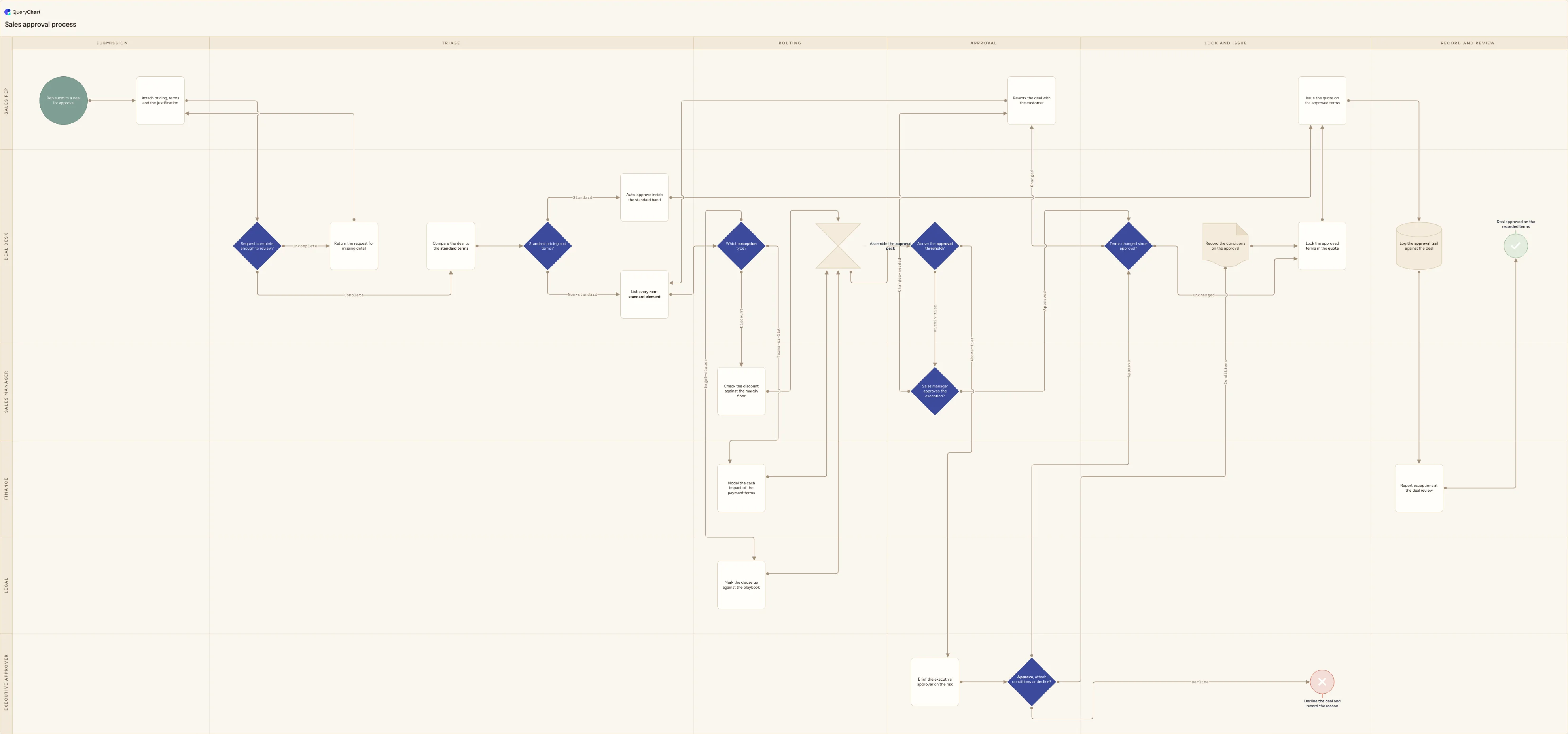
Sales approval process flowchart (deal desk and non-standard terms)
Sales approval process flowchart template: deal desk triage, standard-terms auto-approval, routing by exception type, threshold tiers, approval with conditions, rework loops and the approval trail.
What the sales approval process flowchart (deal desk and non-standard terms) process is
Sales approval is what happens to a deal that does not fit the price book. The trigger is a rep who needs something the standard quote will not give them: a discount below the floor, ninety-day payment terms, a bespoke service level, an indemnity the contract template does not carry. The chart below follows one such deal end to end. The submission and its justification, a triage step that separates the deals nobody needs to look at from the ones that need several people, an itemised list of every non-standard element, review by whoever owns that kind of exception, the approval decision at the tier the value calls for, and the approved terms being locked into the quote and logged so that what was approved and what was issued can still be compared a year later.
This is the approval of terms, not the selling of the deal and not the signing of the contract. Everything that carries an opportunity to the point of a quote, the discovery, the business case and the forecast, belongs to the pipeline and opportunity processes; this chart starts once the rep knows what the customer is asking for. At the other end it stops at an issued quote, because the authority ladder a settled contract goes through, the counter-signature and the register entry are the contract approval process, and this chart hands to it rather than repeating it. It is also wider than discount approval, which is a single-variable ladder priced off margin. Here the discount is one of three exception types sitting alongside payment terms and legal wording, and the point of drawing it this way is that they get traded against each other. Because the terms approved here become accounting inputs, treat the chart as a starting point to adapt under your own delegation of authority schedule, revenue policy and finance review rather than as a control that exists because it has been drawn.
Four decisions carry the process. 'Standard pricing and terms?' settles how much work the rest of the chart does, and it sits in the Deal desk lane because the desk owns the definition of standard, not the rep asking for the exception. 'Which exception type?' routes the deal to the person who can actually judge it: discount depth to the sales manager against a margin floor, payment terms and service levels to Finance, non-standard wording to Legal. 'Above the approval threshold?' separates what a manager may sign off from what an executive must, and it sits with the desk rather than with either approver so that nobody grades their own authority. 'Terms changed since approval?' is the decision most approval charts leave out and the one that fails most often in practice: it sends a deal that moved after sign-off back round the loop instead of onto a quote, which is the difference between an approval record and a rubber stamp.
What this flowchart covers
In this template
- Six swimlanes (Sales rep, Deal desk, Sales manager, Finance, Legal and Executive approver) across six phases: submission, triage, routing, approval, lock and issue, and record and review
- A triage gate that runs before any approver is involved: "Request complete enough to review?" returns a thin submission for missing detail, and "Standard pricing and terms?" sends anything inside the price book straight to "Auto-approve inside the standard band"
- "Which exception type?" as a three-way router rather than a queue: discount depth to the sales manager, payment terms and service levels to Finance, non-standard wording to Legal, all converging on "Assemble the approval pack"
- A tier decision taken separately from the approval itself, so nobody grades their own authority: "Above the approval threshold?" either hands the deal to "Sales manager approves the exception?" or briefs an executive approver on the risk first
- Three outcomes at the executive decision, "Approve, attach conditions or decline?", where conditions are written onto the approval before anything is quoted and a decline is a recorded terminal rather than a deal that quietly goes cold
- A re-approval check most approval charts miss: "Terms changed since approval?" pushes a deal that moved after sign-off back to "Rework the deal with the customer", so only unchanged terms reach "Log the approval trail against the deal"
When to use this template
- You are standing up a deal desk and want the approval path agreed on paper before anyone builds it into CPQ or a CRM approval process
- Approvals are the slowest part of your sales cycle and you cannot tell whether the delay sits in triage, in routing, or with one overloaded approver
- Signed deals keep turning up on terms nobody remembers approving, and the re-approval and term-locking steps need to be explicit and owned
- Finance and Legal are being pulled into deals that should never have reached them, so the standard band and the exception list need writing down
- An auditor or a new revenue policy has asked you to show who is authorised to approve which concessions, and where that decision is recorded
How it works
Rename the lanes to your roles
Replace Sales rep, Deal desk, Sales manager, Finance, Legal and Executive approver with the roles that genuinely exist here. Plenty of organisations have no deal desk at all and the work sits with sales operations or the finance business partner; merge that lane rather than drawing a handoff to a function nobody staffs.
Write down what counts as a standard deal
The standard band is the whole point of the first triage decision, so define it: the discount range, the payment terms, the contract template and the service levels a rep may quote without asking anyone. Anything you cannot state in a sentence will be argued about every week, and the auto-approval branch will not hold.
Fix the exception taxonomy on the router
Replace 'Discount', 'Terms or SLA' and 'Legal clause' with the exception types your deals actually raise: bespoke service levels, non-standard billing structures, custom security commitments, unusual currencies. Each type needs one named reviewer, because an exception with two owners waits for both and is chased by neither.
Set the approval thresholds and their basis
The tier boundaries in this chart are placeholders and should be replaced with your own. Be explicit about what the number measures: total contract value, annual value, or the margin at risk. Whole-life value is the honest basis, and quoting the annual figure instead is the usual way a deal gets approved one tier too low.
Decide what an approval with conditions means
Conditions are only worth attaching if somebody checks them. Agree who writes them onto the approval, where the rep sees them, and what happens if the customer will not accept one. If a condition cannot be carried into the quote or the order form, it is a preference, and the approver should be declining instead of attaching it.
Set the rule for re-approval after a change
State exactly which changes void an approval: a lower price, a longer or shorter term, different payment terms, a swapped product, a new contracting entity. Then say what that does to timing, because a deal that has to go back round on the last day of a quarter is the deal most likely to skip the step altogether.
Walk it against three deals you have closed
Take a standard deal, a discounted one and one that went to an executive, and trace each through the chart against the records they actually left behind. Steps people describe that are not drawn, and steps drawn that nobody performed, are the findings worth fixing before you publish this as your process.
Frequently asked questions
What are the steps in a sales approval process?
A rep submits the deal with its pricing, terms and justification. The deal desk checks the request is complete, returns it if it is not, then compares it to the standard terms: anything inside the standard band is auto-approved and goes straight to the quote. A non-standard deal has every exception listed and routed to the reviewer who owns it: discount depth to the sales manager against a margin floor, payment terms and service levels to Finance, non-standard wording to Legal. The desk assembles the approval pack, and the value decides the tier: within tier the sales manager approves or sends the deal back for rework, above tier an executive is briefed and either approves, attaches conditions or declines. Before anything is issued the deal is checked for changes made since sign-off, conditions are recorded, the approved terms are locked into the quote, and the approval trail and exception report close the loop.
What is the difference between sales approval and discount approval?
Discount approval handles one variable: a price concession measured against a margin floor, escalating up a tiered ladder as the discount deepens. Sales approval is the wider gate a non-standard deal goes through, and the discount is only one of the things that can make a deal non-standard. Payment terms move cash and can change when revenue may be recognised. A bespoke service level creates an operational commitment somebody has to deliver. A struck indemnity or a raised liability cap is an exposure no margin calculation can see. The reason to draw the wider process is that these get traded against one another in real negotiations, and a ladder that prices only the discount waves through the cheaper half of the concession. Contract approval is a third thing again: it begins once the wording is settled and answers who may bind the organisation and how the executed copy is filed.
Who should own the sales approval process?
The owner is whoever holds the definition of a standard deal, which in most organisations is a deal desk, sales operations or a finance business partner rather than the sales line itself. That separation is the control: the person asking for the exception should not be the person deciding whether it is an exception, and the person deciding the tier should not be the approver whose authority is being tested. The individual approvals still belong to the functions that carry the consequence, so the sales manager owns margin, Finance owns cash and billing structure, and Legal owns wording. What the owner is accountable for is the shape of the process itself: the standard band, the exception list, the threshold table, the response times and the exception report that says whether the whole thing is still calibrated.
How long should a deal approval take?
Set a published response time per step rather than one figure for the whole process, because the parts behave differently. Triage is a same-day check against a written standard band. A specialist review is bounded by how clear the playbook is. An executive decision is bounded by when that person next sits down. Publish the target, name a deputy for every approver, and state what happens when a target is missed, whether that is automatic escalation, a default position, or simply a visible ageing report. Then measure where the time actually goes: if most of the elapsed time is the deal sitting incomplete, or bouncing round the rework loop, no approver is the bottleneck and adding another tier will make it worse. Quarter-end is the real test, since that is when the volume arrives and the temptation to bypass the process is highest.
What records should a sales approval leave behind?
Keep enough to answer three questions later: what was requested, who approved it, and which version of the terms they approved. That means the submitted pack, each reviewer's response, the decision with its tier and any conditions, and the quote the approved terms were locked into. This matters beyond sales hygiene because the terms are accounting inputs. Under IFRS 15 and ASC 606 an arrangement is only accounted for as a contract with a customer when the parties have approved it and are committed to perform, the rights and payment terms are identifiable, it has commercial substance, and collection of the consideration is probable. Staff guidance from the SEC's Office of the Chief Accountant warns that side agreements often pose a significant risk to proper revenue recognition, and that companies should have internal controls ensuring such alterations are given proper accounting recognition.
Where this process fits
In most operations this process hands off to Contract approval process flowchart (approve, sign, execute).
Comes after
- Contract approval process flowchart (approve, sign, execute) — A contract approval process flowchart for the stage after review: delegation of authority check, approver tiers, e-signature, execution and register filing.