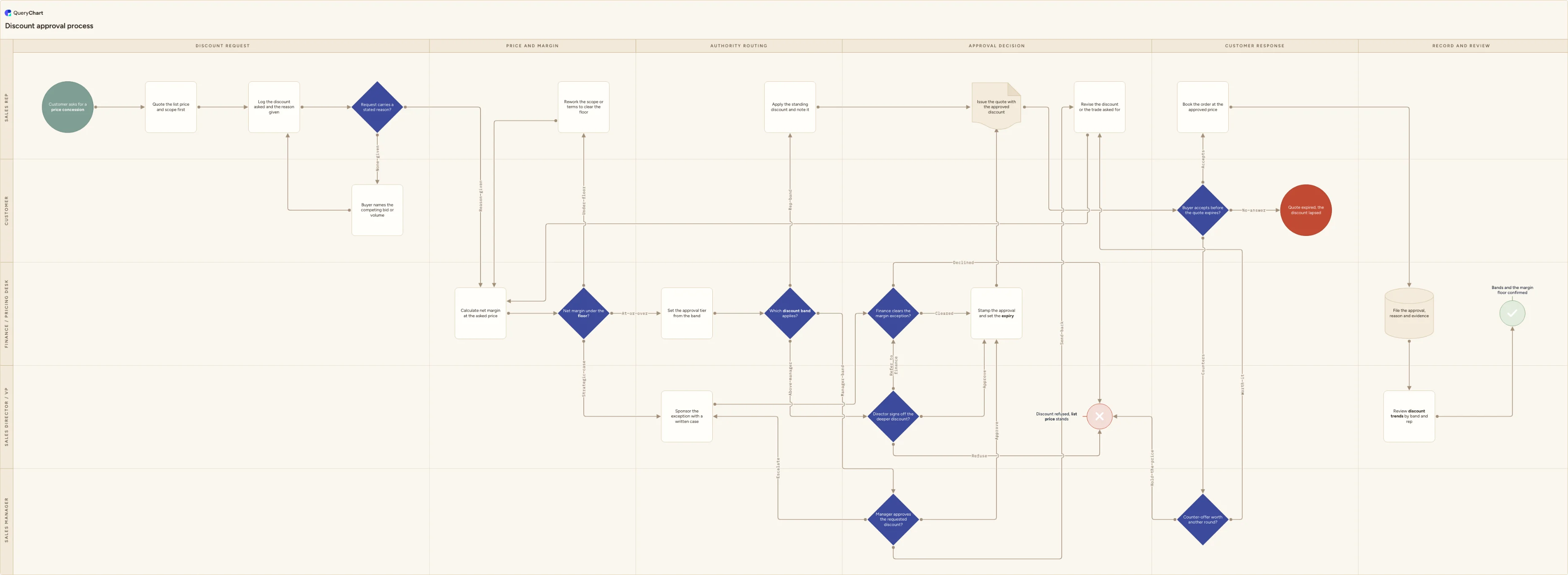
Discount approval process flowchart (tiered approval by band)
Discount approval process flowchart template: the request and its justification, a net margin and floor check, tiered routing to manager, director and finance, a counter-offer loop, and a discount trend review.
What the discount approval process flowchart (tiered approval by band) process is
A discount approval process is what an organisation does between a buyer asking for a better price and that price being allowed. The trigger is the ask itself: a percentage in an email, a line in a tender response, a number a procurement team opens with. Everything after it is governance, because a price concession is money that leaves the business permanently and quietly, with no purchase order, no invoice and no payment run to make it visible. The chart below follows one request end to end: the ask logged with the reason behind it, the net margin recalculated at the price being asked for, a check against the margin floor, routing to an approval tier by band, the manager, director or finance sign-off that follows, the approved percentage stamped on a quote with an expiry date, the buyer's answer, and the record and trend review that decides whether the bands were set right in the first place.
This chart is about price and price only. A request that also changes payment terms, a service level, a liability cap or the contract structure is a non-standard deal, and it belongs to a deal desk approval process where legal and finance review the terms alongside the number; drawing both on one canvas produces a chart nobody follows. It is also not an expense approval, which settles money an employee has already spent, and it is not the spreadsheet import version of the same idea, where the interest is in how a table of approval steps points backwards to a rework row. The boundary matters because the two failure modes are different. A discount that is too deep costs margin on one deal. A term that was never reviewed costs something else entirely, and no discount band will catch it. Treat the chart as a starting point and set the bands, the floor and the sign-offs under your own pricing, finance and legal procedures.
Four decisions carry the process. 'Request carries a stated reason?' comes first on purpose, because pricing an unexplained ask teaches the buyer that asking is enough. The margin test sits in the Finance / pricing desk lane rather than the seller's, since the person whose quota depends on the answer should not be the only person calculating it, and a floor only means something when one team owns the cost basis behind it. 'Which discount band applies?' is the routing rule, and putting it before the approvers rather than after them is what stops a deal going to whoever answers fastest. The last decision belongs to the buyer, and the chart carries all three of its answers: an acceptance, a counter-offer that loops back through the same margin check, and silence, which is the outcome most discount processes forget to model and the one that leaves an approved price sitting in a forecast long after it should have lapsed.
What this flowchart covers
In this template
- Five swimlanes (Sales rep, Sales manager, Sales director / VP, Finance / pricing desk and Customer) across six phases: discount request, price and margin, authority routing, approval decision, customer response, and record and review
- A gate before any pricing work is done: "Request carries a stated reason?" sends an unexplained ask back for the buyer to name the competing bid or the volume behind it, so margin is only ever calculated against a trade somebody can describe
- The margin test in the finance lane rather than the seller's. "Net margin under the floor?" has three exits: back to the rep to rework the scope, on to the band routing, or straight to a sponsored exception when the case is genuinely strategic
- Tiered authority as one routing decision. "Which discount band applies?" splits into a rep band the seller clears alone, a manager band, and anything above it, while the manager's own escalate branch hands a case up to the director to sponsor in writing
- Three separate approval gates rather than one: "Manager approves the requested discount?", "Director signs off the deeper discount?" and "Finance clears the margin exception?", all converging on "Stamp the approval and set the expiry"
- A capped negotiation loop and three endings. "Counter-offer worth another round?" either sends the deal back to be revised or holds the price, and the process finishes at "Book the order at the approved price", "Discount refused, list price stands" or "Quote expired, the discount lapsed"
When to use this template
- You are writing or rewriting a discount policy and need the bands, the approvers and the margin floor on one page rather than spread across three documents
- Discounts are agreed over chat and email, the thresholds are folklore, and nobody can say who signed the last exception or what it was given for
- You are configuring CPQ or CRM approval routing and want the tiers, the floor and the escalation route agreed before anyone builds the rules
- Average selling price is drifting down and you need to see whether the leak sits in the rep band, the manager band or the exception path
- Auditors or a new finance lead have asked how a discount is authorised, evidenced and recorded against the quote it belongs to
How it works
Rename the lanes to your roles
Replace Sales rep, Sales manager, Sales director / VP, Finance / pricing desk and Customer with the roles you actually have. In a small team the director and the finance approver are one person: merge those lanes rather than drawing a handoff that never happens. If a deal desk owns pricing exceptions, give it the finance lane and say so on the chart.
Put your own numbers in the bands
The bands are placeholders. Set them from your own price book so the top band covers most quotes, and state whether the test reads discount percentage or resulting margin, which currency it is in, and whether it looks at a single line or the whole deal. Test the wrong side of that and one deal arrives as three quotes that each sit under the limit.
Define the margin floor and what margin means
Write down the cost basis behind the floor: standard cost or actual, what is loaded into it, and which price book version it is measured against. Name who owns the number and who may change it. Decide too whether a below-floor deal is refused outright or becomes a sponsored exception, because the chart treats it as an exception rather than a rejection.
Say what counts as a justification
List what the reason field will accept: a named competitor with evidence, a committed volume, a longer term, a reference or a strategic account. List what it will not accept, which in most organisations means the end of the quarter. Approvers who apply different tests turn the same request into a different answer depending on who picks it up.
Put an expiry on every approval
Decide how long an approved percentage stays valid, what it is tied to (the quote, the opportunity, or the account) and what change forces a fresh approval, such as a reduced volume or a shortened term. Without that rule an exception granted once becomes the price the customer expects at every renewal, and nobody can point to when that happened.
Decide when the negotiation loop stops
Cap the number of times a deal may come back. Name who is allowed to hold the price, who may walk away, and what evidence a second or third round needs to carry. An uncapped loop is how a quote bounces between a rep and one approver for weeks while the discount ratchets one point at a time in the buyer's favour.
Walk it against three real quotes
Take one quote that cleared inside the rep band, one that was escalated, and one that was refused, and trace each through the chart. Any step people describe that is not drawn, or drawn but skipped in practice, is what to fix before you publish. Then keep the revision, so a reader can tell which version of the bands they are looking at.
Frequently asked questions
What are the steps in a discount approval process?
A typical sequence is: the customer asks for a price concession, the seller quotes list price and scope first, and the discount asked for is logged together with the reason given. A request with no stated reason goes back to the buyer to name the competing bid or the volume behind it. Finance or the pricing desk then calculates net margin at the asked price and tests it against the margin floor, sending a below-floor deal back for rework or forward as a sponsored exception. The approval tier is set from the discount band: a rep band the seller clears alone, a manager band, or anything above it going to the director, with finance ruling on margin exceptions. An approved discount is stamped with an expiry date and issued on the quote. The buyer accepts, counters or lets the quote lapse, and the approval, its reason and its evidence are filed and reviewed as a trend by band and by rep.
Who should approve a discount, and at what level?
Tie the approver to the size of the concession rather than to the size of the account or to who is available. A written delegation of authority that names each band, the role that signs it and the role that signs when that person is the requester is what makes the routing decision on this chart mean anything. Two rules do most of the work. Nobody approves their own request, which is why the chart gives the rep a standing band and sends everything above it to someone else. And approval should sit with whoever carries the margin the concession comes out of, which is usually why the deepest discounts end at finance rather than at a sales leader: at that point the decision is about the profit and loss account, not about the deal. Keep the number of tiers small. Four gates that each add a day cost more deals than one badly set band.
What is the difference between discount approval and deal desk approval?
Discount approval settles the price. Deal desk or non-standard deal approval settles everything else that has been changed: payment terms, a custom service level, liability and indemnity wording, an unusual delivery or renewal structure, and any clause that departs from the standard agreement. The two overlap, because a deep discount is often traded for a longer term, but they need different reviewers and different evidence. Price is a margin question that finance and sales leadership can answer between them; a non-standard term is a legal and delivery question, and no discount band will catch it. Both differ again from expense approval, which authorises money an employee has already spent and is settled through payroll or a payment run rather than through a quote. If your organisation runs a single committee for all three, draw them as separate flows anyway, so the handoffs and the evidence stay visible.
How should discount approvals be recorded for audit?
Keep the approval where the quote is rather than in an inbox. The record wants the requested and approved percentage, the reason and its evidence, the resulting margin, who approved it at which band, the date, and the date the approval lapses. That matters beyond sales hygiene: under ASC 606 and IFRS 15, discounts and price concessions are variable consideration that reduces the transaction price, so the figure recognised has to be the figure that was actually approved for that contract. Concessions agreed outside the quote, the side letter being the classic form, are a long-standing route to misstated revenue and a recurring theme in enforcement, which is why the chart puts the stamp before the quote is issued rather than beside it. Set the retention period, the evidence and the sign-off against your own finance and legal procedures; this template is a starting point, not an accounting policy.
Can we offer different customers different prices?
Usually yes, but not without checking, and the answer depends on what you sell and where. In the United States the Robinson-Patman Act makes it unlawful to discriminate in price between different purchasers where the effect may be substantially to lessen competition. Its reach is narrower than it first looks: it applies to commodities rather than services, and the buyers generally have to be in competition with one another for the resale of those goods. The Act also recognises defences, including cost justification, where the difference reflects the seller's own cost of manufacture or delivery, and meeting competition. Other jurisdictions regulate pricing and resale conditions on their own terms. So treat the bands on this chart as commercial governance, keep the reason recorded next to the approval since that is the evidence a cost or competition defence would rest on, and take any pricing that differentiates between competing resellers to your own legal team before it becomes policy.