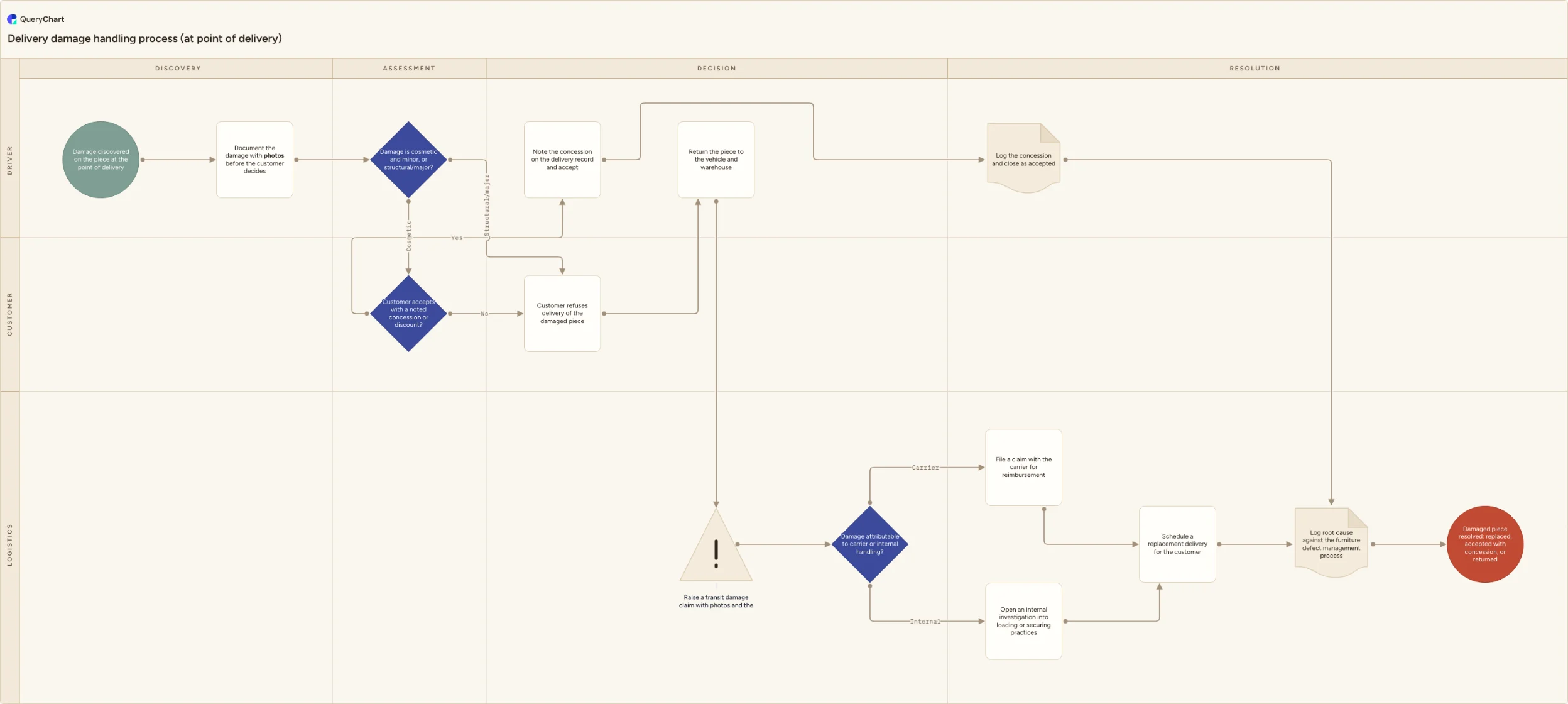
Delivery damage handling process flowchart
A delivery damage handling process flowchart covering at-delivery photo documentation, a severity assessment, a concession-or-refusal decision, and claim attribution.
What the delivery damage handling process is
Damage discovered at the moment of delivery, with the driver and customer both present, is a fundamentally different situation than the same damage discovered days later through a customer complaint — the evidence is fresh, the customer's decision (accept or refuse) can happen on the spot, and the claim's cause is far easier to trace. This template exists specifically for that in-the-moment scenario, distinct from the customer quality complaint process that handles issues surfacing after delivery has already been accepted.
The cosmetic-versus-structural assessment this template makes explicit is what determines whether a concession is even on the table. Minor cosmetic damage might reasonably be resolved with a discount and acceptance; structural or major damage generally shouldn't be, regardless of what discount is offered, because the customer would be accepting a piece that may not perform as expected.
The process runs across four phases (discovery, assessment, decision and resolution) and three lanes (Driver, Customer and Logistics), attributing the resulting claim to the carrier or internal handling before deciding how the cost and any recovery gets handled, and scheduling a replacement delivery regardless of which path caused the damage.
What this flowchart covers
In this template
- Photo documentation at the point of discovery, before the customer makes any decision — capturing evidence while it's freshest and least disputable.
- A cosmetic-versus-structural/major severity assessment that determines whether a concession is a reasonable option at all.
- A concession-or-refusal decision for cosmetic damage, giving the customer a real choice rather than an automatic refusal or an automatic discount.
- Claim attribution to carrier versus internal handling, routing to an external carrier claim or an internal investigation accordingly.
- A replacement delivery scheduled regardless of attribution, so the customer isn't waiting on the internal investigation's outcome to get a working piece.
When to use this template
- You are documenting how drivers should handle damage discovered at the point of delivery, distinct from a complaint process for issues found later.
- Damage disputes are harder to resolve than they should be because evidence wasn't captured at the moment of delivery.
- You need a documented distinction between cosmetic damage (where a concession makes sense) and structural damage (where it generally doesn't).
- You want damage claims properly attributed to carrier versus internal handling for cost recovery and process improvement, not resolved without tracking the cause.
How it works
Document before the customer decides anything
"Document the damage with photos before the customer decides" should happen immediately on discovery — evidence captured before any decision is made is more reliable and more useful for a subsequent claim than evidence gathered after the fact.
Only offer a concession for genuinely cosmetic damage
The cosmetic-versus-structural assessment should gate whether a concession is even offered. Structural or major damage generally shouldn't be resolved with a discount, since the customer would be accepting a piece that may not hold up as expected.
Attribute the claim before closing it out
"Damage attributable to carrier or internal handling?" needs a real determination, not a default assumption either way — this decision drives whether the cost is recovered externally or investigated internally for a loading or securing process improvement.
Schedule the replacement regardless of attribution outcome
The customer shouldn't wait for the internal investigation or carrier claim to resolve before getting a working replacement. Schedule that delivery in parallel with, not dependent on, the attribution and claim process.
Frequently asked questions
How is this different from the customer quality complaint process?
This process is specifically for damage discovered at the point of delivery, with the driver and customer both present — evidence is fresh, and the customer can decide on the spot whether to accept with a concession or refuse. The customer quality complaint process handles issues discovered later, after delivery has already been accepted, which is a different situation requiring remote or field diagnosis rather than an in-person, real-time decision.
Why does damage severity determine whether a concession is offered?
Because a concession makes sense for damage that's genuinely cosmetic — the customer gets a working, structurally sound piece at a discount. Offering the same option for structural or major damage means the customer might accept a piece that doesn't actually perform correctly, which typically causes a worse problem later than simply refusing delivery and getting a proper replacement would have.
Why does the claim need to be attributed to carrier versus internal handling?
Because the appropriate response is different for each — carrier-caused damage should generate a claim against the carrier for reimbursement, while internally caused damage (poor loading or securing) should trigger an investigation into the loading and packaging and loading process to prevent it from recurring. Treating both the same way means neither the carrier accountability nor the internal process improvement actually happens.
Should the replacement delivery wait for the claim investigation to conclude?
No — scheduling the replacement should happen in parallel with, not dependent on, resolving who's responsible for the damage. The customer's need for a working piece and the business's need to determine attribution and pursue recovery are two separate tracks that shouldn't be coupled together.
Where this process fits
In most operations this process follows Furniture delivery process flowchart.
Comes before
- Furniture delivery process flowchart — A furniture delivery process flowchart covering route execution, a customer-availability check, an installation branch, and an at-delivery condition inspection.