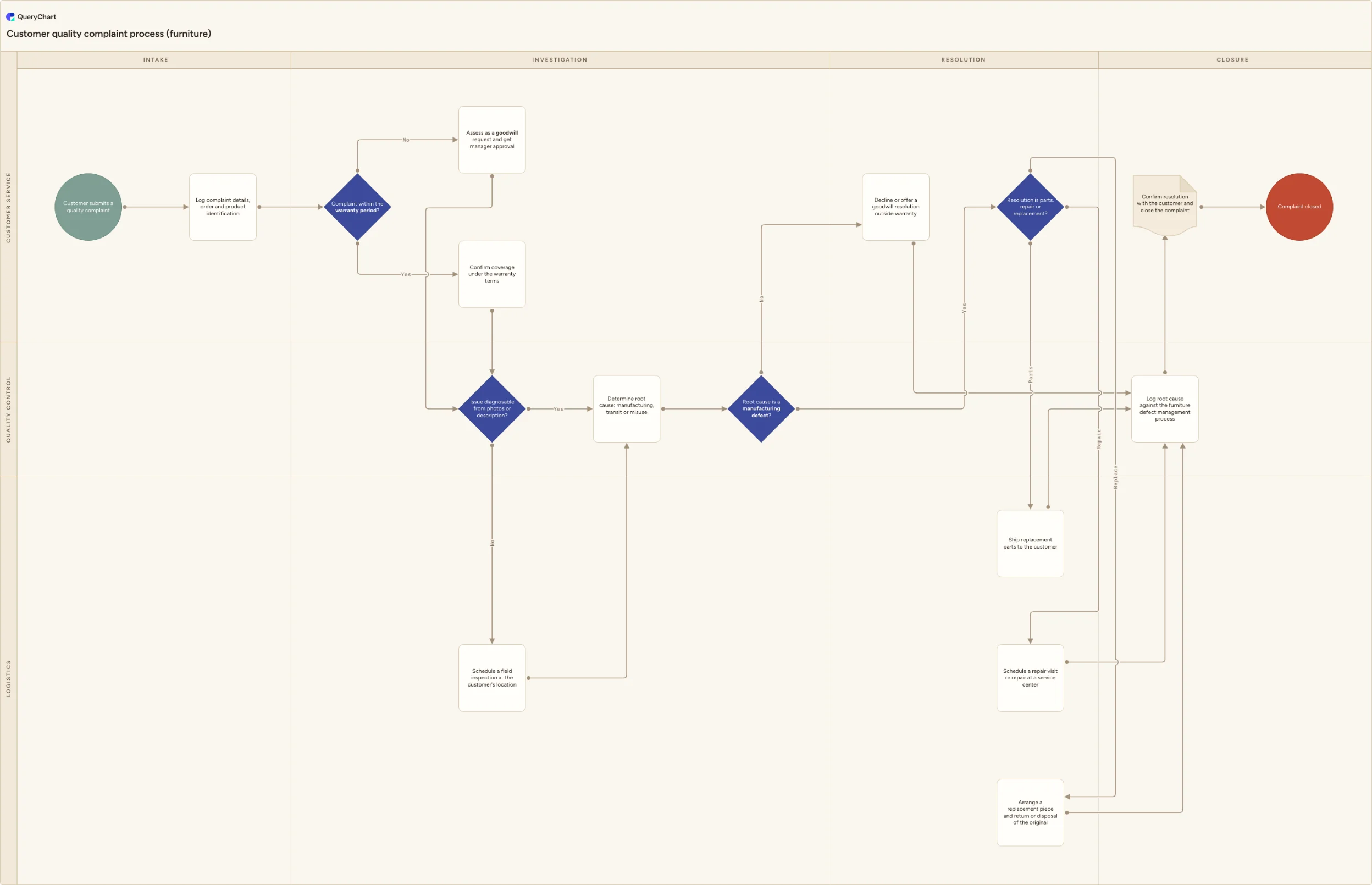
Customer quality complaint process flowchart (furniture)
A customer quality complaint process flowchart covering warranty checks, remote versus field diagnosis, root cause determination, and a parts, repair or replacement resolution.
What the customer quality complaint process flowchart (furniture) process is
Furniture complaints have a logistics problem most product complaints don't: the item is often too large to simply return for inspection. That's why this template includes a genuine decision — diagnosable remotely from photos and description, or does someone need to physically inspect the piece — rather than assuming every complaint can be resolved over the phone or, at the other extreme, sending a technician to every single complaint regardless of how clear-cut it is.
The root-cause determination this template requires before resolution matters because a furniture complaint's cause changes who's responsible and what the right resolution actually is. A manufacturing defect is a warranty matter with parts, repair or replacement as options; damage from transit or misuse is a different conversation entirely, and resolving the complaint before establishing which one occurred risks either an unwarranted concession or an unfair denial.
The process runs across four phases (intake, investigation, resolution and closure) and three lanes (Customer service, Quality control and Logistics), closing every complaint by logging its root cause into the furniture defect management process — so an individual customer's problem also becomes data about whether it's part of a pattern.
What this flowchart covers
In this template
- A warranty-period check at intake, branching to goodwill assessment for out-of-warranty complaints rather than a blanket denial.
- A remote-versus-field diagnosis decision, scheduling a field inspection only when photos and description aren't sufficient to determine the issue.
- Root cause determination — manufacturing defect, transit damage or misuse — before any resolution is decided, not after.
- A three-way resolution decision (parts, repair or replacement) matched to the actual defect, rather than a default response applied regardless of severity.
- Root cause logged against the furniture defect management process at closure, connecting individual complaints to the broader defect trend.
When to use this template
- You sell furniture directly to consumers and the current complaint process has no documented decision between remote diagnosis and a field visit.
- Resolutions (parts, repair, replacement) are being decided before root cause is established, leading to inconsistent outcomes for similar complaints.
- You need complaint root causes feeding into your broader quality system rather than closed and forgotten once the individual customer is satisfied.
- You want a documented, defensible process for warranty versus goodwill decisions rather than an ad hoc call per complaint.
How it works
Decide warranty status before determining resolution
"Complaint within the warranty period?" should be checked at intake, before any resolution discussion, so goodwill and warranty complaints follow appropriately different approval paths from the start.
Only schedule a field inspection when remote diagnosis genuinely isn't sufficient
"Issue diagnosable from photos or description?" should be a real assessment, not a default to always or never inspect in person. Bulky furniture makes returns impractical, but not every complaint needs an in-person visit to resolve.
Establish root cause before deciding the resolution
"Determine root cause: manufacturing, transit or misuse" needs to happen before parts, repair or replacement is decided — resolving first and diagnosing after risks an unwarranted concession or an unfair denial, in either direction.
Close every complaint back into defect management
"Log root cause against the furniture defect management process" turns an individually resolved complaint into data. Without this step, a pattern across multiple customers with the same defect stays invisible.
Frequently asked questions
Why does a furniture complaint need a decision about field inspection that other product complaints might not?
Because furniture is often too large or expensive to ship back for inspection the way a smaller product might be. This template makes that decision explicit — diagnosable from photos and description, or does the issue need someone to physically examine the piece — rather than assuming every complaint can be resolved remotely or defaulting to an in-person visit for every case regardless of how clear the issue is.
Why determine root cause before deciding on parts, repair or replacement?
Because the resolution should match the actual cause, not be decided independently of it. A manufacturing defect might warrant free replacement; transit damage might be a carrier claim; misuse might not be covered at all. Deciding the resolution before establishing which of these occurred risks either an unwarranted concession or an unfair denial to the customer.
What happens to a complaint outside the warranty period?
It routes to a goodwill assessment requiring manager approval, rather than an automatic denial. This keeps the decision documented and consistent rather than left to whoever happens to handle that specific complaint, while still distinguishing it from a warranty-covered claim.
Why does every complaint need its root cause logged against defect management?
Because an individual customer's satisfaction with their resolution doesn't tell you whether their complaint is part of a broader pattern. Logging root cause into the furniture defect management process is what lets multiple complaints with the same underlying cause surface as a trend that corrective action can actually address, rather than each being resolved and forgotten in isolation.
Where this process fits
In most operations this process hands off to Furniture defect management process flowchart.
Comes after
- Furniture defect management process flowchart — A furniture defect management process flowchart covering defect capture and categorization, a CAPA threshold, corrective action, and trend reporting.