How to create a complaint handling process
How to design a complaint handling process: acknowledge fast, assess safety and reportability early, investigate the product not the customer, and trend what closes. Live example included.
A complaint handling process runs from receipt to a closed, trended record: acknowledge quickly, assess safety and reportability early, investigate, respond, and decide whether it is systemic.
The short version
- Acknowledge on a stated timescale: silence is what escalates a complaint.
- Assess safety and reportability before investigating, not after.
- Get the sample back; a complaint investigated without the product is an opinion.
- Investigate the product, not the customer.
- Trend the closed records: the pattern is the finding, not the individual complaint.
The two clocks running from receipt
From the moment a complaint arrives, two clocks start and they have nothing to do with each other. One is the customer's: how long until somebody acknowledges this, and how long until it is resolved. The other is regulatory: for product quality and safety issues, whether the event is reportable and within what deadline. Processes designed around only the first miss reporting obligations; processes designed around only the second leave customers with silence.
So the safety and reportability assessment has to happen early, before the investigation, and it has to be a decision rather than a note. That is the structural difference between a complaint process that satisfies a regulator and one that satisfies a service-level target, and the reason the assessment sits immediately after intake in a well-designed flow rather than after root cause.
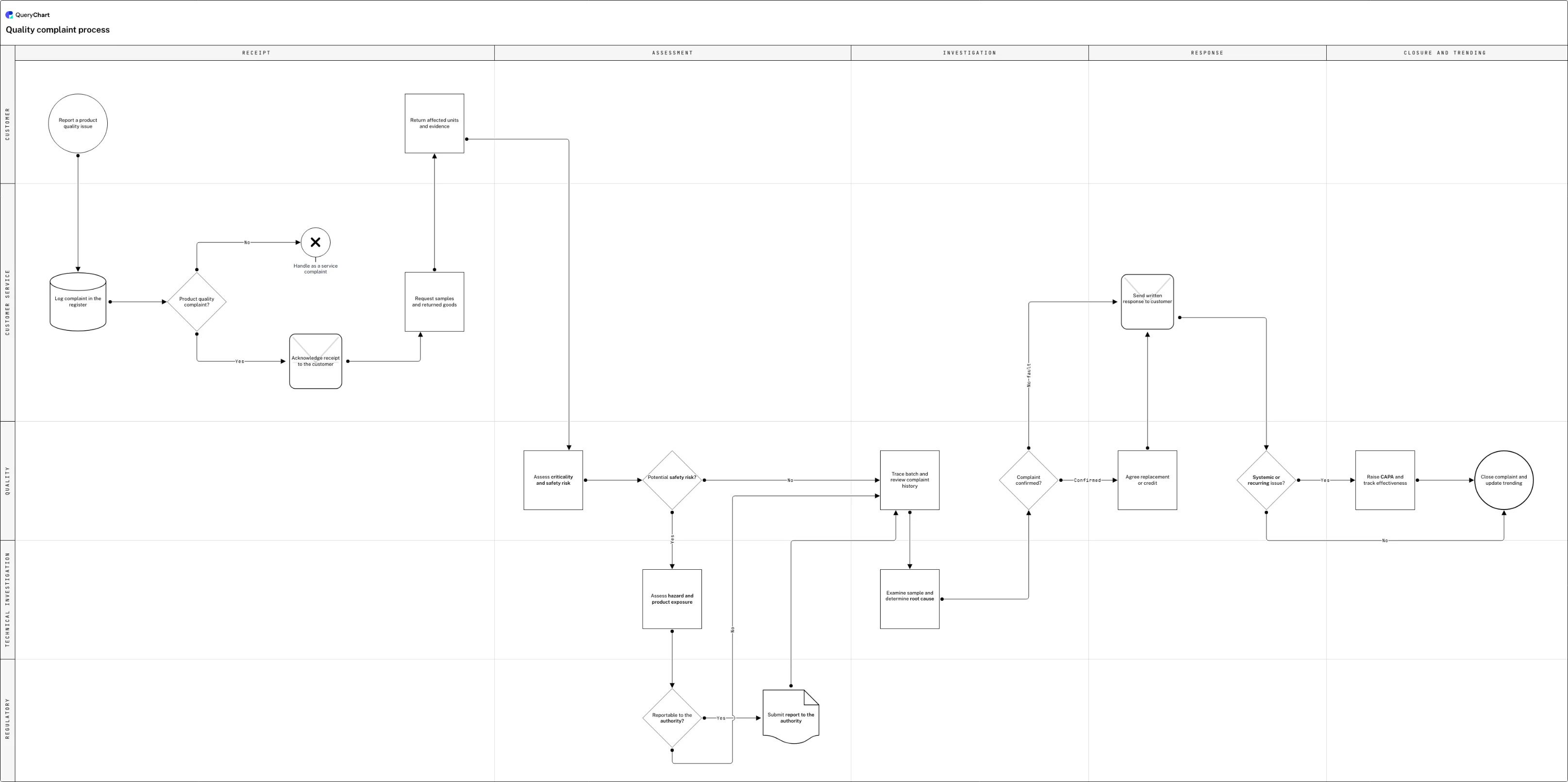
The example below is a quality complaint process across five lanes including a regulatory function. It separates the acknowledgement clock from the investigation, routes safety-related complaints through a hazard assessment and a reportability decision, and ends with an explicit systemic-cause gate into CAPA.
Receipt to trended closure
A quality complaint process across five lanes. Watch the safety assessment happen before the investigation.
Log, triage, acknowledge
Logged in the register, a decision on whether this is a product quality complaint or a service one, then acknowledgement to the customer. Routing early matters: service complaints handled through a quality process are slow, and quality complaints handled through a service one are unreported.
Get the product back
Samples and returned goods requested, then returned with evidence. An investigation without the affected unit is limited to what the customer could describe, which is why the request goes out before anyone starts analysing.
Safety before analysis
Criticality assessed, then a safety-risk decision routing to hazard assessment and a reportability decision with its own submission step. This sits before the investigation deliberately: the reporting deadline does not wait for your root cause.
Investigate the product
Batch traced, complaint history reviewed, sample examined, root cause determined, then a confirmation decision and the customer response. Reviewing history at this point is what turns a single complaint into a recognised pattern.
Systemic or not
An explicit decision on whether the cause is systemic, routing to CAPA with effectiveness tracking, then closure and trending. Without that gate, every complaint either becomes a CAPA or none does.
How it works
Define what counts as a complaint
Write it down and make it wide: any expression of dissatisfaction about your product or service, however it arrives. Narrow definitions produce good statistics and bad information, because the complaints that never enter the register are exactly the ones nobody is acting on.
Set and separate the two clocks
Acknowledgement within a stated period (two working days is a common commitment) and resolution on a longer one, tracked separately. Most complaint escalation is caused by silence rather than by the original problem, and the two targets fail for different reasons.
Put the safety and reportability assessment early
Immediately after intake, as a decision with criteria, before any investigation. Reporting deadlines in regulated sectors are counted from awareness, not from conclusion, so an assessment that waits for the root cause has already consumed the window.
Request the sample as part of intake
Make returning the affected unit a step in the process with a route for when it is not available. A complaint investigated without the product is limited to the customer's description, and that limitation should be recorded rather than quietly absorbed.
Investigate the product, not the customer
The default hypothesis in most complaint investigations is misuse, and it is right often enough to be dangerous. Require the batch record, the history review and the physical examination before a no-fault-found conclusion is available.
Gate the CAPA and trend everything
Make the systemic-cause decision explicit with criteria: recurrence, severity, a pattern in the trend data. Then review the trend on a cadence: three complaints with one cause are a systemic issue that no individual investigation would have identified.
Mistakes to avoid
Acknowledgement folded into resolution
A customer waiting for a fix will wait; a customer hearing nothing escalates. Track the two separately.
Reportability assessed after the investigation
Regulatory clocks run from awareness. An assessment that waits for root cause has already spent the deadline.
No-fault-found as a first resort
It is the cheapest conclusion and the least examined. Require the evidence steps before it becomes available.
Closing without trending
Individually minor complaints with a shared cause only become visible in aggregate, and only if someone looks.
Create your own complaint process
Open the complaint example as your own chart, set your acknowledgement target, and write in your reportability criteria.
Related guides
Frequently asked questions
What are the steps in a complaint handling process?
Receive and log, triage the complaint type, acknowledge to the customer, request the affected product, assess criticality and safety, decide reportability, investigate including batch trace and history, determine the cause, respond to the customer, decide whether the cause is systemic, and close with trending. The order matters in one specific place: the safety and reportability assessment belongs before the investigation, because regulatory deadlines start at awareness.
How quickly should a complaint be acknowledged?
Within one to two working days is the common commitment, and the specific number matters less than having one and meeting it. Acknowledgement is a separate promise from resolution and should be measured separately: customers accept an investigation taking time, and they escalate when nothing arrives at all. In regulated sectors the acknowledgement clock also sits alongside a reporting clock that runs regardless.
When does a complaint need to be reported to a regulator?
It depends entirely on your sector and jurisdiction: medical devices, pharmaceuticals, food and financial services each have their own criteria and deadlines, typically triggered by harm, potential harm, or a defect that could lead to either. What every regime shares is that the clock starts when you become aware, so the assessment must be an early decision with written criteria and a named decision-maker, not something reached at the end of an investigation.
Should every complaint trigger a CAPA?
No. Gate it on criteria (severity, recurrence, evidence of a systemic cause) and handle the rest as individual corrections with trending. The trending is where most of the value is: complaints that individually look minor and unrelated frequently share a cause that only appears in aggregate, and a process that closes each record without adding it to a trend cannot see it.