Quality complaint process flowchart template
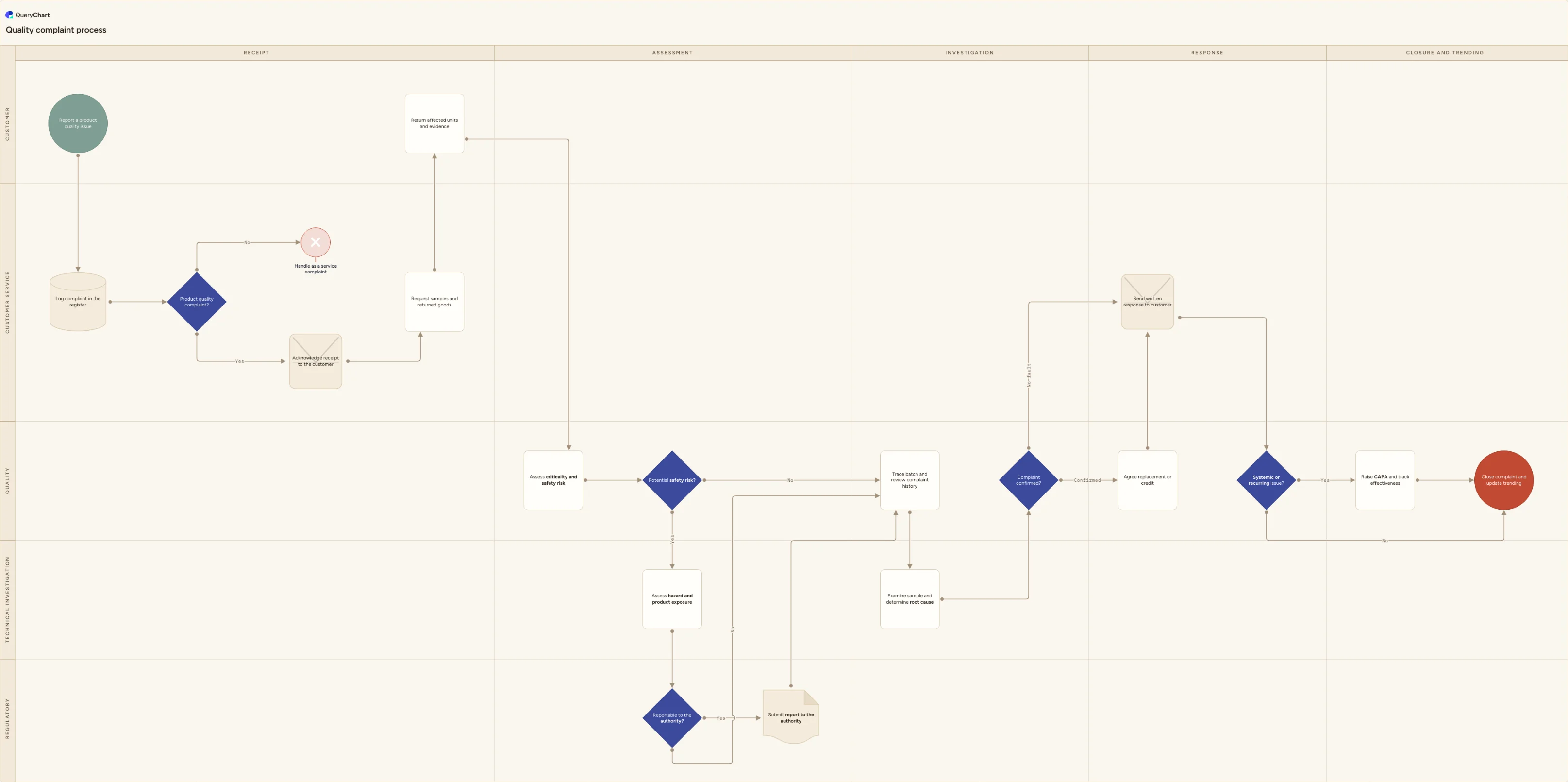
A quality complaint process flowchart across five lanes: logging and acknowledgement, safety and reportability checks, investigation, remedy, CAPA and closure.
What the quality complaint process flowchart process is
A quality complaint says the product itself is wrong: contamination, a failed seal, the wrong strength, a component out of tolerance. That makes it a different animal from a service complaint about a late delivery or an incorrect invoice. The goods are physical evidence, the batch is traceable, and the answer has to come from the batch record and the returned sample rather than from a customer service script.
Two clocks start the moment the complaint arrives. The customer clock is commercial: acknowledge quickly, say what happens next, come back with a decision. The regulatory clock is legal, and it normally runs from the date the organisation first became aware of the issue, not from the date the investigation confirms a defect. Mapping the process makes both visible, and it forces the safety question into the right place - early, before the technical work, rather than after it.
Complaint handling is a required process in most quality management systems. ISO 9001 reaches it through customer feedback (9.1.2) and corrective action (10.2, which explicitly covers nonconformities arising from complaints); ISO 13485 clause 8.2.2 requires a documented complaint-handling procedure for medical devices; EU GMP Chapter 8 covers complaints and quality defects for medicines. This template is a starting map, not evidence of compliance - the lanes, grades and timings still have to match your own authorised procedure.
What this flowchart covers
In this template
- Five role lanes - Customer, Customer service, Quality, Technical investigation and Regulatory - across five phases: receipt, assessment, investigation, response, and closure and trending.
- A triage decision at intake, "Product quality complaint?", which routes delivery, billing and service issues out to the service complaint process rather than into the quality register.
- Receipt handled by customer service: logging the complaint with batch and lot detail, acknowledging receipt to the customer, and requesting samples and returned goods.
- The safety branch: criticality and safety assessment by Quality, a hazard and product exposure assessment by Technical investigation, and a "Reportable to the authority?" decision that files a report before the investigation continues.
- Investigation: batch traceability and complaint history review, sample examination and root cause, then a "Complaint confirmed?" decision splitting replacement or credit from a no-fault response.
- Closure: a "Systemic or recurring issue?" decision that raises a CAPA with an effectiveness check, then closes the complaint and updates complaint trending.
When to use this template
- You are writing or revising a complaint-handling procedure and want the flow agreed before anyone drafts the wording.
- Quality complaints and service complaints arrive through the same inbox, and product defects are being answered by whoever picked up the phone.
- You need to show an auditor or a customer how a complaint moves from receipt to closure, and who decides on reportability.
- Complaints are being closed with a replacement but no root cause, so the same defect keeps coming back.
- You are training new customer service or quality staff on what they may decide themselves and what has to escalate.
How it works
Rename the lanes to your organisation
Replace the five role lanes with the functions that actually exist for you. Small manufacturers often merge Quality and Technical investigation into one lab lane; regulated sites usually keep Regulatory separate because the reporting decision is not Quality's to make.
Set the acknowledgement and closure targets
Put your real timings on the receipt and closure steps, for example acknowledge within one working day and close within thirty calendar days. If the target differs by criticality grade, say so in the label or in the note on the assessment step.
Define the criticality grades and the safety trigger
Decide what counts as critical, major and minor, and write down exactly what makes a complaint a potential safety risk. The "Potential safety risk?" decision is only as good as that definition, and it is the box people argue about after the fact.
Confirm the reportability rule with your regulatory lead
Name the regulation, the deadline and the person authorised to decide on the "Reportable to the authority?" branch. Record the decision not to report with its rationale, not just the reports you file - the negative decision is what gets questioned in an inspection.
Agree when a complaint raises a CAPA
Set the threshold for the "Systemic or recurring issue?" decision: a repeat on the same batch, a trend across a line or supplier, or any safety-related confirmation. A one-off with a clear cause and effective containment can close on correction alone.
Publish the map alongside the procedure
Keep the diagram under the same version control as the written procedure, so the approved version and the picture on the wall do not drift apart. Review it whenever the trending data shows the flow is being worked around.
Frequently asked questions
What is the difference between a quality complaint and a customer service complaint?
A quality complaint alleges a defect in the product: contamination, damage, wrong specification, a failure in use. A service complaint concerns how the organisation behaved - a late delivery, a billing error, poor communication. The distinction matters because a quality complaint pulls in physical evidence, batch traceability, a technical investigation and possibly a report to a regulator, while a service complaint is resolved by the service function. That is why the template puts a triage decision immediately after logging: everything that is not a product defect leaves for the service complaint process before it reaches the quality register.
Who should own the quality complaint process?
Split ownership by activity, not by department politics. Customer service normally owns intake, acknowledgement and all communication with the customer, because that relationship already exists. Quality owns the record itself, the criticality grading, the investigation decisions, the remedy and closure. Regulatory owns the reportability decision. The common failure is letting the function that answers the customer also decide whether the complaint is confirmed - the answer then gets shaped by what is commercially easiest to say.
When does a quality complaint become reportable to an authority?
That depends entirely on your sector and jurisdiction - medical device vigilance, pharmaceutical quality defects, food safety and consumer product safety all have their own criteria and deadlines. The general shape is consistent: a complaint that indicates a potential risk of harm, or a defect that affects product already released, triggers an assessment against the reporting criteria, and the deadline usually runs from the date the organisation first became aware rather than the date the investigation concludes. Agree the criteria with your regulatory lead in advance and record both outcomes, including the decision not to report.
Does every confirmed complaint need a CAPA?
No, and raising one every time is a reliable way to build a backlog nobody works. A single confirmed defect with a known cause and effective containment can be closed on the correction alone. Raise a CAPA where the cause is systemic: repeats on the same batch, line or supplier, a trend visible in the complaint data, or anything with a safety dimension. Close the CAPA on evidence that it worked, not on the action being marked done - which is what the effectiveness check in the closure lane is for.
Where this process fits
In most operations this process follows Returns process flowchart template (RMA to refund) and hands off to CAPA process flowchart (corrective and preventive action).
Comes before
- Returns process flowchart template (RMA to refund) — Returns process flowchart template covering the RMA route from return request and policy check through inspection and disposition to refund or replacement.
- Returns management process flowchart (reverse logistics) — Returns management process flowchart template covering goods receipt against an authorisation, inspection and grading, disposition, supplier claims and credit.
Comes after
- CAPA process flowchart (corrective and preventive action) — A CAPA process flowchart in five swimlanes: log and grade the issue, contain it, investigate the root cause, correct and prevent, then verify before closure.
- Product recall process flowchart (recall vs withdrawal) — Product recall process flowchart: health risk assessment, recall or withdrawal, classification, regulator and public notice, retrieval, effectiveness check.