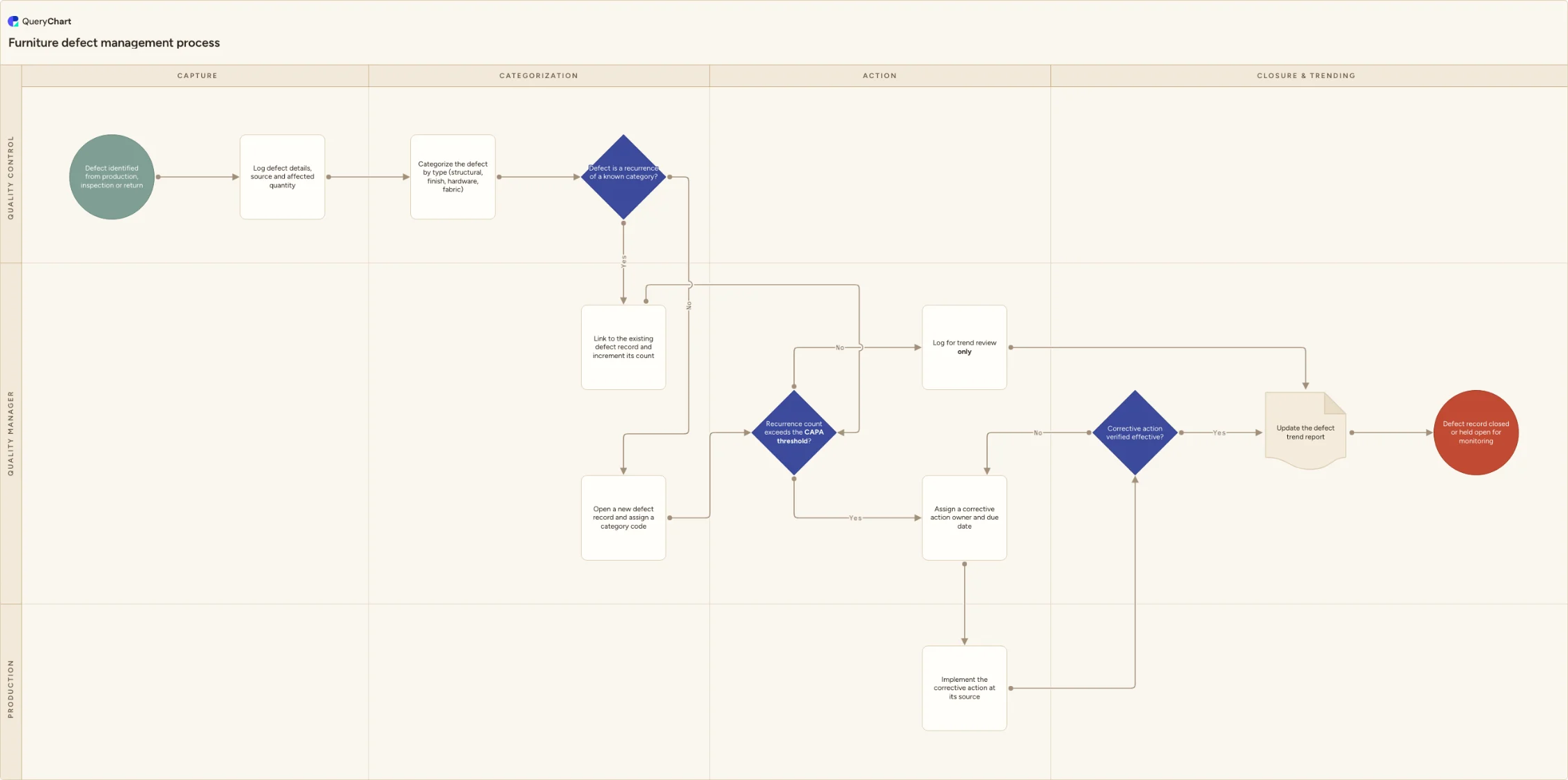
Furniture defect management process flowchart
A furniture defect management process flowchart covering defect capture and categorization, a CAPA threshold, corrective action, and trend reporting.
What the furniture defect management process is
Individual quality inspections catch individual defects; defect management is the system that notices when the same defect keeps happening. Without it, a factory can pass every inspection at every station and still ship a recurring problem indefinitely, because no single inspection is positioned to see the pattern across shifts, batches and weeks that a trend report reveals immediately.
The categorization step is what makes trending possible at all. A defect logged as free text — 'finish problem' one week, 'coating issue' the next — never links up as the same recurring category, while a defect logged against a stated category code accumulates into a count a threshold can actually be checked against.
The process runs across four phases (capture, categorization, action and closure/trending) and three lanes (Quality control, Production and Quality manager), with a recurrence-count threshold that separates a one-off logged for trend visibility from a repeating pattern that triggers assigned corrective action with an effectiveness check before closure.
What this flowchart covers
In this template
- Defect capture from any source — production, inspection or customer return — into one system rather than separate logs per source.
- Categorization by defect type, with a recurrence check that links a repeat defect to its existing record rather than creating a disconnected new one.
- A recurrence-count threshold that separates a logged-for-trend one-off from a pattern requiring assigned corrective action.
- Corrective action with a named owner and due date, implemented at its actual source rather than logged as an intention.
- An effectiveness verification that can send an ineffective corrective action back for reassignment, and a trend report updated regardless of outcome.
When to use this template
- You are documenting how defects get tracked across your factory and the current approach is separate, disconnected logs per department or inspection point.
- The same defect keeps recurring despite individual instances being caught and corrected at the time, suggesting no one is tracking the pattern across instances.
- You need a documented CAPA threshold, so corrective action is triggered consistently rather than based on whoever happens to notice a pattern.
- You want defect trend data available for management review or customer quality reporting, not scattered across inspection records nobody aggregates.
How it works
Capture every defect in one system regardless of source
A defect found at incoming inspection, in-process, at final inspection, or in a customer return should all feed the same log. Separate systems per source is exactly what prevents a pattern from being visible.
Categorize consistently, not as free text
"Categorize the defect by type" needs a stated set of category codes, applied consistently, so a recurrence check can actually match this defect against previous ones logged under the same category.
Set the CAPA threshold as a real number
"Recurrence count exceeds the CAPA threshold?" needs an actual stated count — three occurrences in a month, for example — not a judgment call about when a pattern feels significant enough to act on.
Verify effectiveness before closing, not after implementing
A corrective action that's been implemented isn't the same as one that's been confirmed to work. "Corrective action verified effective?" should check actual results — has the defect recurred since — before the record closes.
Frequently asked questions
How is defect management different from the furniture rework process?
Rework is the physical fix applied to one specific nonconforming piece. Defect management is the system that tracks defects across many pieces and instances, over time, to notice when a category is recurring and needs a systemic fix rather than another individual repair. A piece can go through rework and the defect still recur on the next piece if nothing tracks the pattern — that's what this process is for.
Why does defect categorization matter so much?
Because trending only works if defects are logged consistently enough to be counted against each other. A defect described in free text — 'finish problem' one week, 'coating issue' the next — never links up as the same recurring category even if it's the identical underlying issue, which means a real pattern stays invisible.
What should trigger a CAPA (corrective and preventive action) versus just logging for trend review?
A stated recurrence threshold — a specific count within a specific time window — should be the trigger, not a subjective sense that something is becoming a problem. Below the threshold, log it for trend visibility; above it, assign an owner and due date for corrective action.
How does this connect to the nonconforming product process and customer quality complaints?
Both feed into defect management as sources — a nonconformance disposition and a customer complaint's root cause both get logged and categorized here, alongside defects caught during production or inspection. Defect management is the aggregation point that turns individually handled incidents from every source into a trend that corrective action can actually target.
Where this process fits
In most operations this process follows Customer quality complaint process flowchart (furniture).
Comes before
- Customer quality complaint process flowchart (furniture) — A customer quality complaint process flowchart covering warranty checks, remote versus field diagnosis, root cause determination, and a parts, repair or replacement resolution.