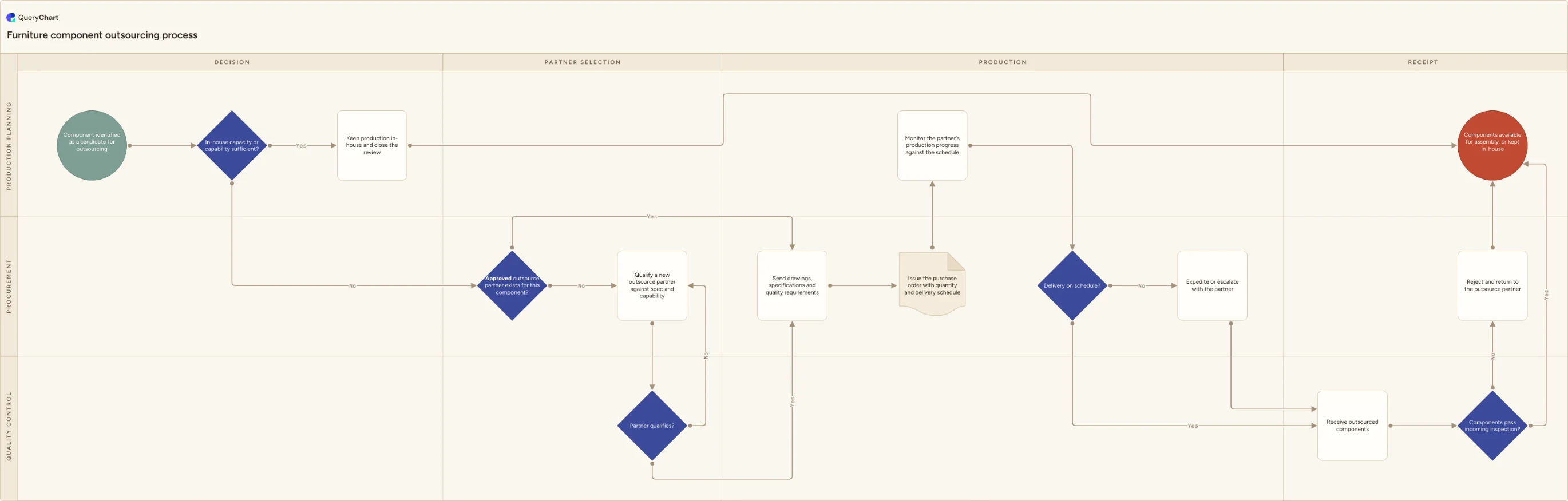
Furniture component outsourcing process flowchart
A furniture component outsourcing process flowchart covering the make-or-buy decision, partner qualification, spec transfer, production monitoring, and incoming inspection.
What the furniture component outsourcing process is
Outsourcing a component is a decision with a real alternative, not a default fallback for anything the factory happens to be busy with — which is why this template starts with an explicit make-or-buy check rather than assuming a capacity crunch automatically means outsourcing is the answer. Keeping production in-house is a legitimate outcome of this process, not a failure to find a partner.
The partner qualification loop inside this process mirrors general supplier qualification but for a manufacturing relationship rather than a materials purchase — an outsource partner isn't just supplying a material, they're executing part of your production process on your behalf, which is a different and generally higher bar than approving a materials supplier.
The process runs across four phases (decision, partner selection, production and receipt) and three lanes (Production planning, Procurement and Quality control), monitoring the outsourced production against schedule and inspecting delivered components before they're released to assembly, rather than trusting an external partner's own quality claims.
What this flowchart covers
In this template
- An explicit make-or-buy decision at the start, keeping in-house production as a genuine outcome rather than assuming outsourcing whenever capacity is tight.
- Partner qualification for a component with no existing approved outsource source, distinct from and more rigorous than a general materials supplier check.
- Specification and drawing transfer as its own step, ensuring the partner is building to the same standard as in-house production would.
- Production monitoring against the delivery schedule while the partner is manufacturing, not just tracking a promised ship date.
- Incoming inspection of outsourced components on receipt, with a reject-and-return path, before they're released to assembly alongside in-house-produced parts.
When to use this template
- You are formalizing a make-or-buy decision process for components and the current approach defaults to outsourcing without a documented comparison to in-house capability.
- You need a documented process for qualifying and monitoring outsource manufacturing partners, distinct from qualifying a materials supplier.
- Outsourced components have arrived not matching specification, and you need drawing and spec transfer treated as a distinct, verified step.
- You want outsourced components inspected on receipt with the same rigor as materials from any other supplier, rather than trusted without verification.
How it works
Make the in-house-versus-outsource comparison explicit
"In-house capacity or capability sufficient?" should be a genuine assessment, not a step everyone expects to answer no. Keeping production in-house is a legitimate and often preferable outcome when capacity actually allows it.
Qualify a manufacturing partner more rigorously than a materials supplier
An outsource partner executes part of your production process, which is a different relationship than buying a material. "Partner qualifies?" should assess their manufacturing capability and quality system, not just their pricing and delivery reliability.
Send complete specifications, not just a general description
"Send drawings, specifications and quality requirements" needs to give the partner everything an in-house team would have — dimensions, tolerances, material specs, quality criteria — not a general description that leaves interpretation up to them.
Inspect outsourced components with the same rigor as any other purchased material
"Components pass incoming inspection?" should apply the same specification-based check used for any other incoming material, not a lighter touch because the partner is trusted or the relationship is established.
Frequently asked questions
How is outsourcing a component different from general procurement of raw materials?
Raw material procurement buys inputs your own process then transforms. Component outsourcing has a partner execute part of your manufacturing process on your behalf, using your drawings and specifications to produce something closer to a finished component. That's a deeper relationship requiring more rigorous partner qualification and specification transfer than buying a standard material.
Why does 'keep production in-house' need to be a real decision point rather than assumed?
Because outsourcing is sometimes reached for by default when capacity feels tight, without a genuine comparison to what in-house capability could actually handle. Making the make-or-buy assessment explicit keeps in-house production as a real, considered outcome rather than something bypassed under time pressure.
What makes partner qualification for outsourcing different from qualifying a materials supplier?
A materials supplier's qualification checks whether they can consistently deliver a specified material. An outsource partner's qualification needs to assess their manufacturing capability, tooling, and quality system — since they're effectively running part of your production process, the qualification bar for their process control and consistency is generally higher.
Why inspect outsourced components on receipt if the partner is already qualified?
Because qualification confirms a partner CAN produce to specification consistently, not that every individual delivery necessarily did. Incoming inspection on outsourced components applies the same discipline as any other purchased material, catching a specific delivery's defects regardless of how well the partner performed historically.