Customer sample approval process flowchart (furniture)
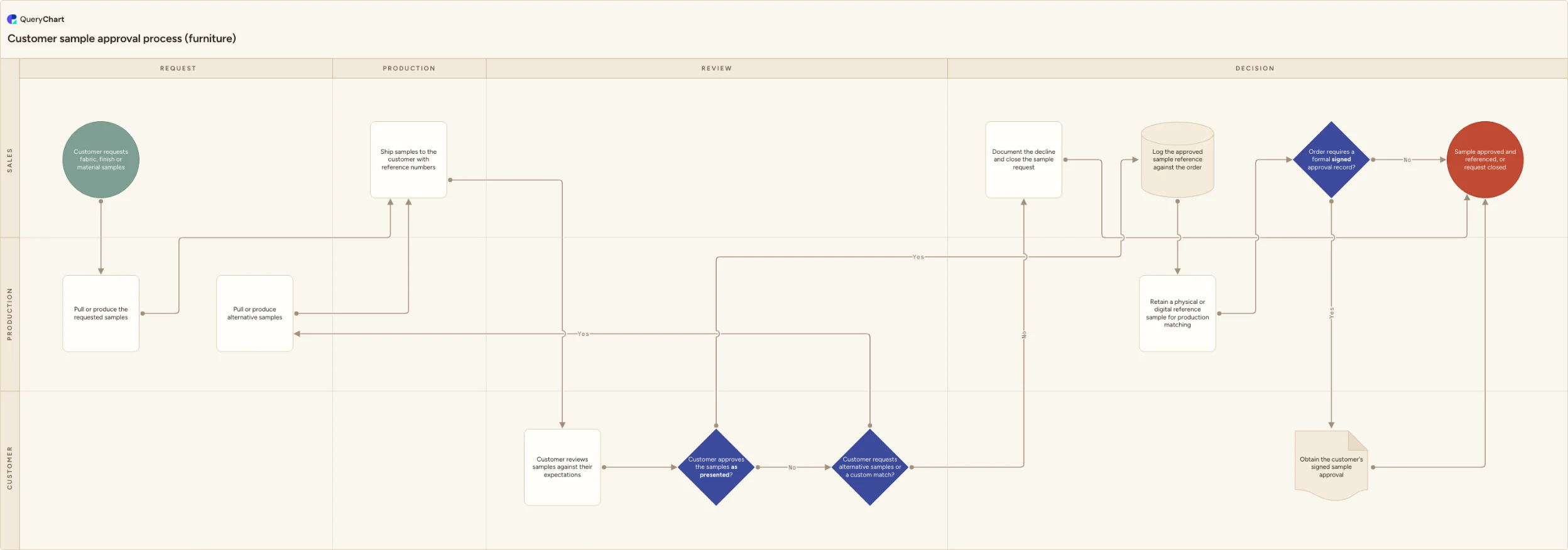
A customer sample approval process flowchart covering sample production, an alternative-sample loop, a reference sample retained for matching, and a signed approval option.
What the customer sample approval process flowchart (furniture) process is
A customer approving a sample and production later matching that exact sample are two different guarantees, and the gap between them is where color and finish disputes come from. A customer who approved a swatch under their own lighting, viewed on a screen or in person weeks before production, has a specific reference in mind — and production needs that same physical reference, not a general description of what was approved, to actually match it.
That's why this template retains a physical or digital reference sample specifically for production matching, as its own step distinct from simply logging that approval happened. The approval record says a decision was made; the retained sample is what lets production actually reproduce what was approved.
The process runs across four phases (request, production, review and decision) and three lanes (Sales, Production and Customer), looping back through alternative sample production when the customer wants a different option rather than treating the first round as final regardless of the result.
What this flowchart covers
In this template
- Sample production or pulling from stock, shipped to the customer with reference numbers for unambiguous identification.
- A customer decision branch distinguishing outright approval from a request for alternative samples or a custom color match.
- An alternative-sample loop that returns to production rather than treating the first round of samples as the only option offered.
- A retained physical or digital reference sample specifically for production matching, distinct from simply recording that approval occurred.
- An optional formal signed approval record for orders that require documented sign-off beyond an informal customer decision.
When to use this template
- You ship fabric, finish or material samples for customer approval and the current process doesn't retain a reference for production to actually match against.
- Color or finish disputes have arisen because production worked from a description of the approved sample rather than the physical sample itself.
- Customers regularly want alternative samples, and the current process treats the first round as final rather than accommodating a genuine iteration.
- Some orders need a formal signed approval record while others don't, and you need that distinction handled explicitly rather than applied inconsistently.
How it works
Ship samples with unambiguous reference numbers
"Ship samples to the customer with reference numbers" matters because a customer describing 'the blue one' after reviewing several options is not a reliable enough identifier for what production needs to match — a reference number is.
Retain the actual approved sample, not just a record that approval happened
"Retain a physical or digital reference sample for production matching" is the step that actually enables accurate matching. A logged approval without the retained sample leaves production working from a description rather than the real thing.
Offer alternative samples as a genuine loop, not a one-shot process
"Customer requests alternative samples or a custom match?" should route back into producing new samples when the answer is yes, rather than treating the first round of samples as the only opportunity for approval.
Reserve formal signed approval for orders that actually need it
"Order requires a formal signed approval record?" should be a genuine decision based on order value, complexity or customer requirement — not applied uniformly to every sample approval regardless of whether the extra documentation step is warranted.
Frequently asked questions
Why does production need the actual retained sample rather than a record that approval happened?
Because color and finish can be perceived differently depending on lighting, screen calibration, or simply memory — a written record that a customer 'approved the blue fabric' gives production nothing concrete to match against. The physical or digital reference sample retained from the actual approved item is what lets production reproduce exactly what the customer signed off on, not their or anyone else's recollection of it.
What happens if a customer doesn't like any of the initial samples?
The chart routes back to producing alternative samples or a custom match, rather than treating the first round as a final, take-it-or-leave-it offer. This keeps the process accommodating genuine customer preference without abandoning documentation and reference tracking along the way.
When does an order need a formal signed sample approval versus an informal one?
This depends on order value, complexity, or specific customer requirements — some businesses require signed approval on every custom order as standard practice, while others reserve it for higher-value or higher-risk orders. What matters is that the decision is made consistently rather than applied arbitrarily per order.
How does sample approval relate to the custom furniture design approval process?
Design approval covers the overall design, form and structure of a custom piece. Sample approval is specifically about material, fabric or finish — the customer confirming the physical look and feel of what will actually be used, which is a separate decision often made alongside or shortly after the design itself is approved.
Where this process fits
In most operations this process follows Custom furniture design approval process flowchart and hands off to Bill of materials (BOM) management process flowchart.
It is one step in Custom furniture orders.
Step 2: Custom furniture design approval process flowchart
A custom furniture design approval process flowchart covering concept presentation, a bounded revision loop, and a formal signed sign-off with deposit.
Step 3: Customer sample approval process flowchart (furniture) You are here
A customer sample approval process flowchart covering sample production, an alternative-sample loop, a reference sample retained for matching, and a signed approval option.
Step 4: Bill of materials (BOM) management process flowchart
A bill of materials management process flowchart covering creation, buildability verification, release as a controlled version, and engineering change control.