Furniture installation process flowchart (on-site assembly)
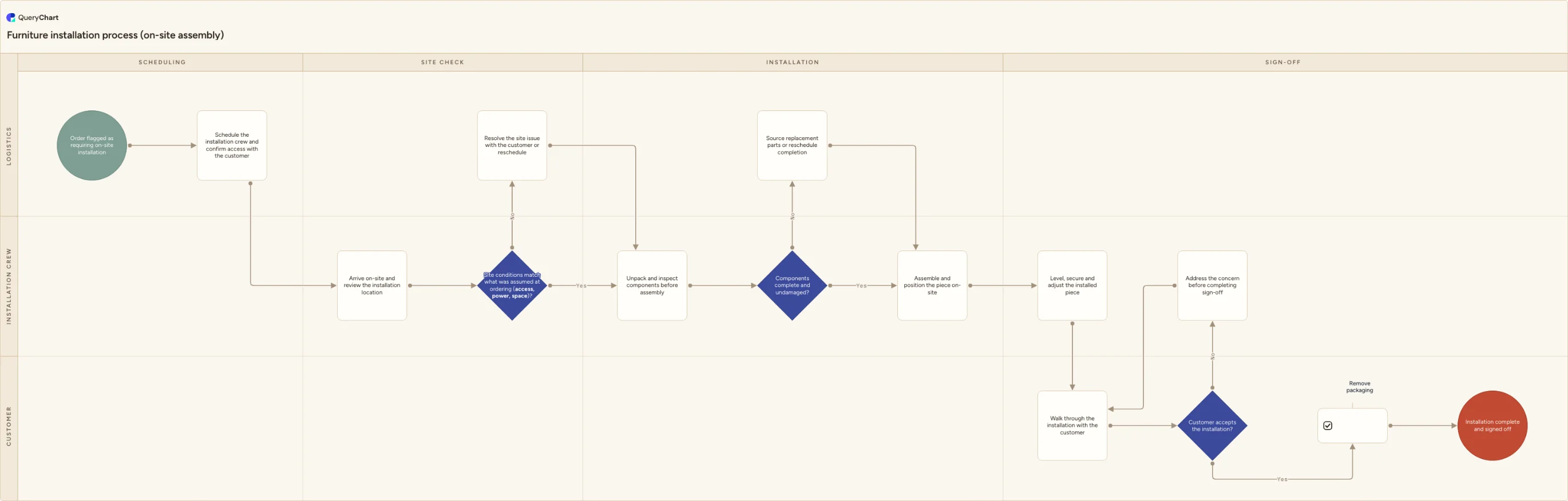
A furniture installation process flowchart covering a site-condition check, a component-completeness check, on-site assembly, and a customer walkthrough sign-off.
What the furniture installation process flowchart (on-site assembly) process is
Installation is where an assumption made weeks earlier at the point of sale — that the doorway is wide enough, that there's power where it's needed, that the space matches the floor plan — gets tested against physical reality, with a crew and a customer both standing there when it does. That's why this template checks site conditions as a distinct step right after arrival, before anything is unpacked, rather than discovering a mismatch mid-assembly.
The component-completeness check before assembly begins exists because discovering a missing or damaged part once assembly is underway is a worse position than catching it beforehand — a crew that's already started can't simply pause and wait for a replacement part without leaving a half-assembled piece in the customer's space.
The process runs across four phases (scheduling, site check, installation and sign-off) and three lanes (Logistics, Installation crew and Customer), ending in a customer walkthrough with a real opportunity to raise a concern before sign-off, rather than treating installation as complete once the crew has finished assembling.
What this flowchart covers
In this template
- A site-condition check against what was assumed at ordering — access, power, space — as a distinct step right after arrival.
- Component completeness and damage verification before assembly begins, not discovered partway through.
- On-site assembly, leveling and securing as distinct steps, since a piece can be assembled but not properly leveled or secured.
- A customer walkthrough before sign-off, giving a real opportunity to raise a concern rather than treating assembly completion as automatic acceptance.
- Debris removal as part of the closing sequence, not an afterthought left for the customer to handle.
When to use this template
- You install furniture on-site and the current process has no distinct check for site conditions before unpacking and assembly begins.
- Installations have stalled mid-assembly because a missing or damaged component was discovered only after starting.
- You need a documented customer walkthrough before sign-off, rather than treating assembly completion as automatic acceptance.
- You want debris removal built into the standard process rather than left inconsistent between crews.
How it works
Check site conditions before unpacking anything
"Site conditions match what was assumed at ordering?" should be verified immediately on arrival — access, power, space — before any components are unpacked, since a mismatch discovered here is far easier to resolve than one found mid-assembly.
Verify components complete before starting assembly
"Components complete and undamaged?" needs to be checked before assembly begins. A crew that discovers a missing part mid-assembly is stuck with a half-built piece and no good options.
Separate assembly from leveling and securing
A piece can be fully assembled and still not properly leveled or secured to a wall or floor where that matters. Treat these as distinct steps rather than assuming assembly completion implies the piece is properly installed.
Give the customer a real walkthrough before sign-off
The walkthrough should be a genuine opportunity to raise a concern, with an actual path — "Address the concern before completing sign-off" — rather than a formality that happens right before the crew leaves regardless of what the customer says.
Frequently asked questions
Why check site conditions again on arrival if they were already discussed when the order was placed?
Because what was described or assumed at the point of sale — doorway width, available power, floor space — doesn't always match physical reality once a crew is actually on-site with the piece. Checking on arrival, before anything is unpacked, catches a mismatch while it's still simple to address rather than discovering it mid-installation.
Why verify components before starting assembly rather than during?
Because a crew that discovers a missing or damaged part partway through assembly is in a much worse position — they can't simply pause and wait for a replacement without leaving a half-assembled piece in the customer's home or space. Checking completeness first means any gap can be resolved before assembly commits the crew to a specific piece.
What's the difference between assembly and leveling/securing?
Assembly is putting the components together into the finished piece. Leveling and securing is making sure that assembled piece sits correctly on an uneven floor or is properly anchored where stability or safety requires it — a piece can be fully assembled and still wobble or pose a tipping risk if this step is skipped.
Why does the customer walkthrough need to happen before sign-off, not after?
Because a walkthrough after sign-off has already been given removes the customer's practical leverage to have a concern addressed — once signed, the installation is considered accepted. Walking through before sign-off, with a real path to address any concern raised, is what makes the walkthrough meaningful rather than a formality.
Where this process fits
In most operations this process follows Furniture delivery process flowchart.
It is one step in Furniture delivery.
Step 4: Furniture packaging and loading process flowchart (dispatch logistics)
Step 5: Furniture delivery process flowchart
A furniture delivery process flowchart covering route execution, a customer-availability check, an installation branch, and an at-delivery condition inspection.
Step 6: Furniture installation process flowchart (on-site assembly) You are here
A furniture installation process flowchart covering a site-condition check, a component-completeness check, on-site assembly, and a customer walkthrough sign-off.