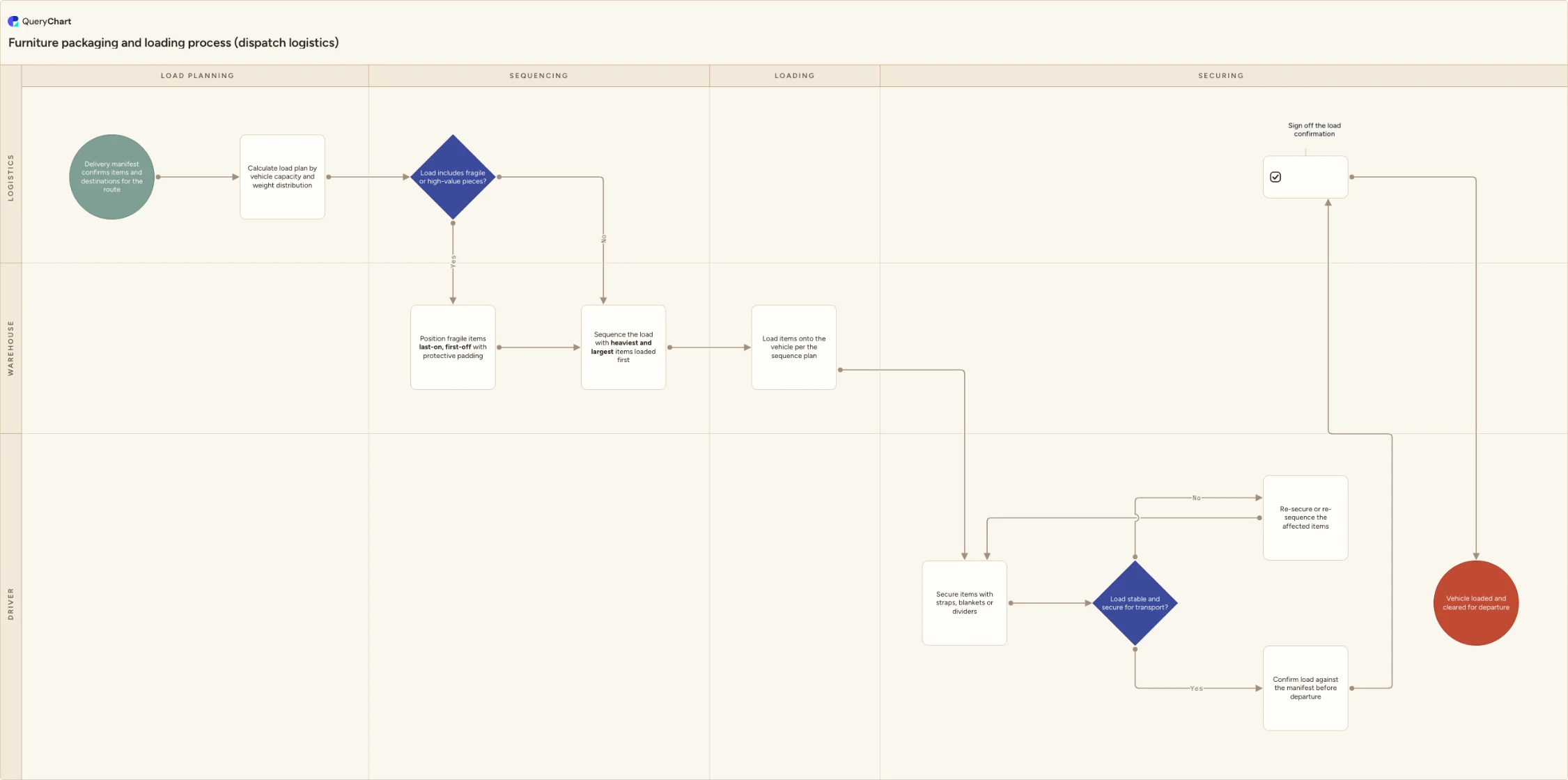
Furniture packaging and loading process flowchart (dispatch logistics)
A furniture packaging and loading process flowchart covering vehicle load planning, weight-and-fragility sequencing, and a load-security verification.
What the furniture packaging and loading process flowchart (dispatch logistics) process is
This is a logistics process, not a packing-station one — it picks up after each piece is already individually packaged and focuses entirely on how those packed pieces get arranged and secured inside a vehicle for a specific route. That distinction matters because loading failures are a different category of problem than packaging failures: a well-packaged piece can still arrive damaged if it was loaded and sequenced badly.
The load sequencing this template documents — heaviest and largest items first, fragile items last-on-first-off — exists because loading order determines both how stable the load is in transit and how efficiently items can be unloaded at each stop without having to move other pieces out of the way first.
The process runs across four phases (load planning, sequencing, loading and securing) and three lanes (Logistics, Warehouse and Driver), with a stability check after securing that can trigger re-sequencing rather than departing with a load that isn't actually stable for transport.
What this flowchart covers
In this template
- Load planning by vehicle capacity and weight distribution, calculated before any physical loading begins.
- A fragile-or-high-value item check that determines last-on-first-off positioning with protective padding, distinct from standard sequencing.
- Heaviest-and-largest-first sequencing as the base loading order, before fragile-item positioning is layered on top.
- A load stability verification after securing, with a re-sequence-or-re-secure loop rather than departing on an assumption that securing alone made the load safe.
- A departure checklist and manifest confirmation, closing the loop before the vehicle actually leaves.
When to use this template
- You are documenting how furniture gets loaded for delivery routes and the current process has no distinct load sequencing logic beyond 'fit it in.'
- Transit damage is occurring despite individually well-packaged items, suggesting the problem is in loading and securing rather than packaging itself.
- Deliveries at early stops on a multi-stop route require moving other items out of the way, indicating loading sequence didn't account for unload order.
- You need a documented stability check before departure rather than assuming securing straps alone guarantee a safe load.
How it works
Calculate the load plan before loading starts
"Calculate load plan by vehicle capacity and weight distribution" should happen as planning, not worked out ad hoc while items are being physically loaded onto the vehicle.
Sequence for both weight distribution and unload order
Heaviest and largest items loaded first generally means they're positioned toward the front or bottom of the load — but also consider which stop each item is destined for, so early-route deliveries aren't buried behind later ones.
Give fragile items real protective positioning, not just placement
"Position fragile items last-on, first-off with protective padding" needs both the sequencing (loaded last so they're accessible first) and actual physical protection — padding, separation from harder items — not just a favorable position in the load order.
Verify stability after securing, don't assume it
"Load stable and secure for transport?" should be an actual check — attempting to shift the load, checking strap tension — not an assumption that using straps automatically means the load is secure.
Frequently asked questions
How is this different from the furniture packaging process?
The furniture packaging process covers preparing an individual piece for shipment — protective wrap, carton or crate, labeling. This process picks up after that's done, focusing on how multiple already-packaged pieces get planned, sequenced and secured together inside a delivery vehicle for a specific route. A piece can be perfectly packaged and still arrive damaged if it was loaded or secured poorly.
Why does loading sequence matter for a multi-stop delivery route?
Because items loaded without considering stop order end up requiring other pieces to be moved out of the way at each delivery, increasing handling and the risk of damage during that extra movement. Sequencing load position to match the unload order at each stop avoids that.
What does 'last-on, first-off' mean for fragile items?
It means fragile or high-value pieces are loaded last, so they end up positioned to be unloaded first — minimizing how long they sit under the weight or proximity of other items in the load, and reducing how much they're handled or shifted during the trip.
Why verify load stability after securing instead of trusting the straps?
Because straps and dividers can be applied without actually achieving a stable, immobile load — tension can be uneven, or the load's shape can still allow shifting despite being nominally secured. An actual stability check, like attempting to move the load or verifying strap tension, catches a load that looks secured but isn't truly stable for transport.
Where this process fits
In most operations this process follows Furniture picking and dispatch process flowchart and hands off to Furniture delivery process flowchart.
It is one step in Furniture delivery.
Step 3: Furniture picking and dispatch process flowchart
A furniture picking and dispatch process flowchart covering pick-list generation, a completeness check, staging verification, and dispatch confirmation.
Step 4: Furniture packaging and loading process flowchart (dispatch logistics) You are here
A furniture packaging and loading process flowchart covering vehicle load planning, weight-and-fragility sequencing, and a load-security verification.
Step 5: Furniture delivery process flowchart
A furniture delivery process flowchart covering route execution, a customer-availability check, an installation branch, and an at-delivery condition inspection.
Step 6: Furniture installation process flowchart (on-site assembly)