Furniture delivery process flowchart
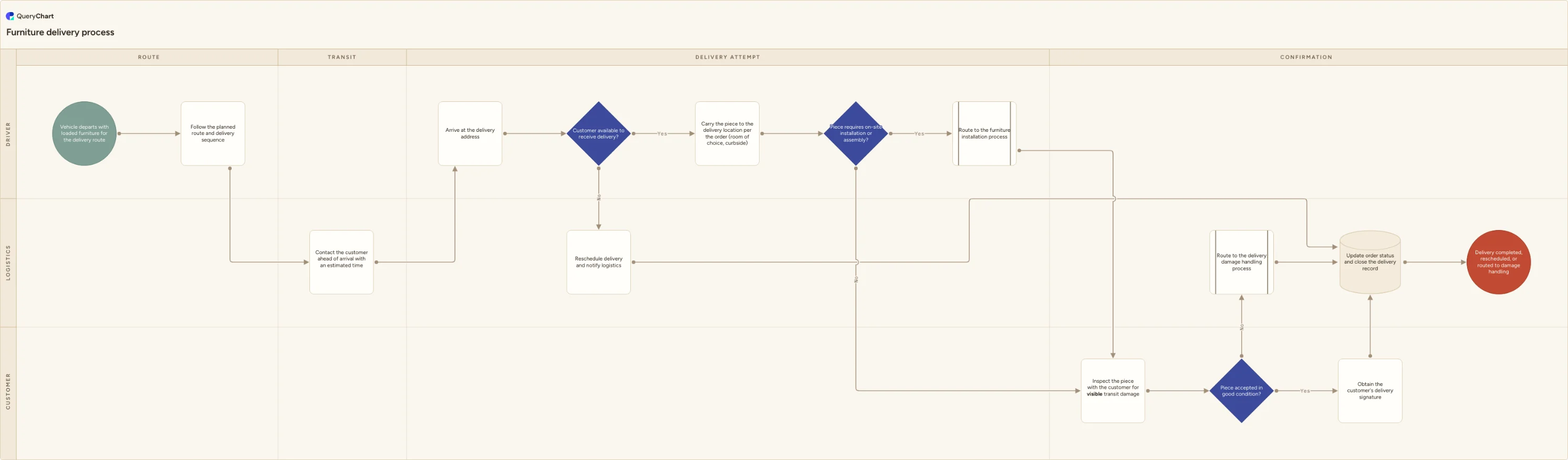
A furniture delivery process flowchart covering route execution, a customer-availability check, an installation branch, and an at-delivery condition inspection.
What the furniture delivery process is
The moment of delivery is the last point a furniture company has direct, in-person contact with a piece before it becomes entirely the customer's — which makes the condition inspection that happens right there, with the customer present, uniquely valuable and uniquely time-limited. A driver who leaves without that joint inspection loses the chance to resolve a transit-damage question on the spot, before it becomes a dispute handled days later over photos and phone calls.
The customer-availability check exists as its own decision because a failed delivery attempt isn't a minor inconvenience for a bulky item — rescheduling has real cost, and this template treats a missed delivery as a distinct branch requiring logistics notification, not a quiet retry with no record of what happened.
The process runs across four phases (route, transit, delivery attempt and confirmation) and three lanes (Driver, Logistics and Customer), branching to the furniture installation process when a piece needs on-site assembly, and to delivery damage handling when the joint inspection finds a problem, before either signature is obtained or the piece is returned.
What this flowchart covers
In this template
- Proactive customer contact ahead of arrival with an estimated time, reducing failed delivery attempts.
- A customer-availability check at arrival, with a reschedule-and-notify path distinct from simply leaving and hoping for better luck next time.
- A branch to the furniture installation process for pieces requiring on-site assembly, rather than treating installation as an afterthought to delivery.
- A joint damage inspection with the customer present, before any signature is requested — the last point a transit issue is easy to resolve.
- A routing decision to the delivery damage handling process specifically, rather than an ad hoc conversation when damage is found.
When to use this template
- You are documenting last-mile furniture delivery and the current process has no structured customer-availability check or damage inspection step.
- Failed delivery attempts are common and costly, and you need a documented reschedule path with logistics notification.
- Transit damage disputes are arising because inspection happens after the driver has already left, rather than jointly at the point of delivery.
- Some deliveries require on-site installation and others don't, and you need that branch made explicit rather than handled inconsistently by drivers.
How it works
Contact the customer proactively, not just on arrival
"Contact customer ahead of arrival with an estimated time" reduces failed delivery attempts by giving the customer a real window to be present, rather than an unannounced arrival that finds nobody home.
Make a missed delivery a recorded event, not a silent retry
"Reschedule delivery and notify logistics" should be a documented step with a record of why the delivery failed, not simply a driver moving on to the next stop with no note of what happened.
Inspect with the customer present, before requesting a signature
The joint inspection needs to happen before, not after, the customer signs for delivery. Once a signature is obtained, resolving a damage claim becomes a dispute rather than an on-the-spot correction.
Route damage discoveries to the dedicated damage handling process
A problem found at the joint inspection should route into the delivery damage handling process specifically — with its cosmetic-versus-structural assessment and carrier-versus-internal attribution — rather than the driver improvising a resolution on the spot.
Frequently asked questions
Why does the driver inspect the piece with the customer before requesting a signature?
Because the signature typically represents acceptance of the delivery in good condition, and once it's given, a subsequent damage claim becomes a dispute about what happened rather than a fact both parties observed together. Inspecting jointly before the signature is the last point a transit issue can be resolved on the spot rather than argued over later.
What happens if the customer isn't available when the driver arrives?
The chart routes to rescheduling and notifying logistics as a distinct, recorded step — not a silent retry or an assumption the driver will simply try again without any record of why the first attempt failed. For bulky furniture, a failed delivery attempt has real cost, which is why it needs documentation rather than an informal workaround.
Why does installation get its own branch rather than being part of every delivery?
Because not every furniture delivery requires on-site assembly — some pieces are ready to use as delivered, while others (built-in units, complex assemblies) need installation. Branching explicitly means the delivery process handles both cases correctly rather than assuming every delivery either does or doesn't need installation.
What's the difference between this process and delivery damage handling?
This delivery process covers the full delivery visit end to end; delivery damage handling is the dedicated sub-process this one routes into specifically when the joint inspection finds a problem — covering the cosmetic-versus-structural assessment, the customer's accept-with-concession-or-refuse decision, and the carrier-versus-internal attribution for the resulting claim.
Where this process fits
In most operations this process follows Furniture packaging and loading process flowchart (dispatch logistics) and hands off to Delivery damage handling process flowchart.
It is one step in Furniture delivery.
Step 4: Furniture packaging and loading process flowchart (dispatch logistics)
A furniture packaging and loading process flowchart covering vehicle load planning, weight-and-fragility sequencing, and a load-security verification.
Step 5: Furniture delivery process flowchart You are here
A furniture delivery process flowchart covering route execution, a customer-availability check, an installation branch, and an at-delivery condition inspection.
Step 6: Furniture installation process flowchart (on-site assembly)
A furniture installation process flowchart covering a site-condition check, a component-completeness check, on-site assembly, and a customer walkthrough sign-off.