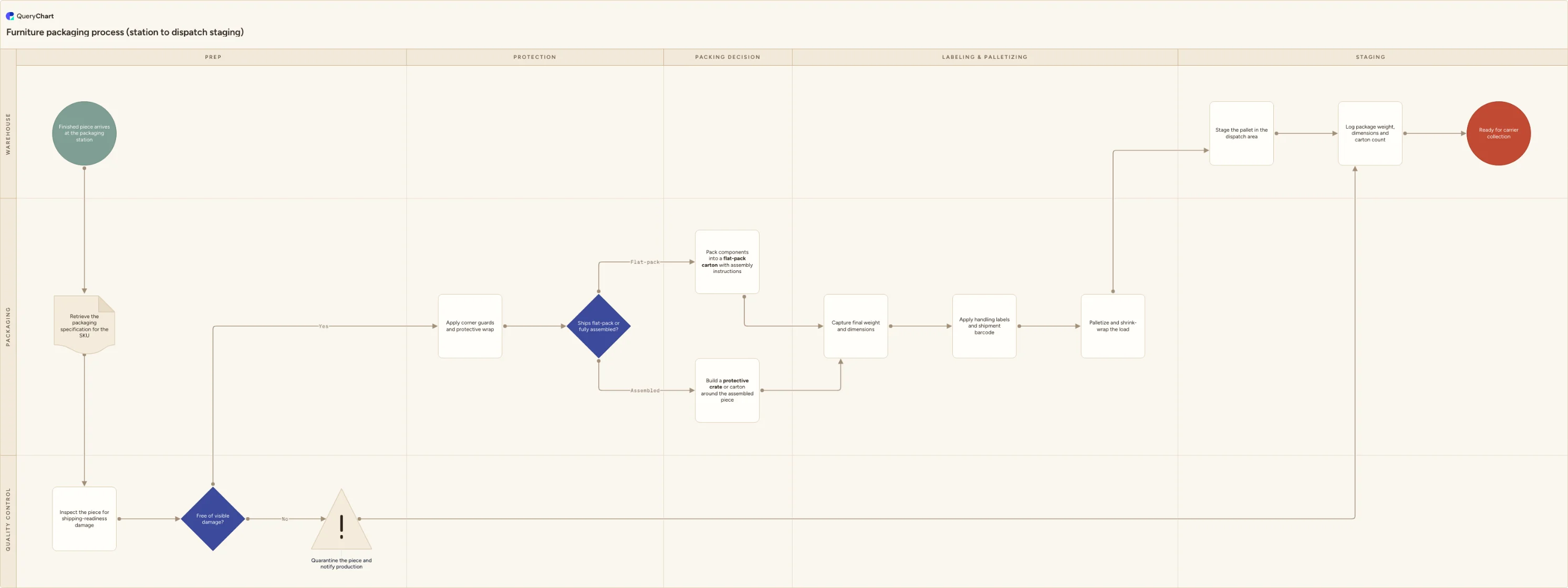
Furniture packaging process flowchart
A furniture packaging process flowchart covering damage checks, flat-pack versus assembled packing, labeling, palletizing and dispatch staging.
What the furniture packaging process is
Packaging is the last point in the factory where a defect can be caught before it becomes a customer's problem — and the point where a perfectly good piece can be damaged by a packing method that doesn't match how it will actually be handled. Flat-pack furniture and fully assembled furniture fail in transit in different ways, and packing both the same way is how a factory ships either damaged flat-pack panels or an assembled piece too fragile for its crate.
The damage check at intake matters because packaging is usually the last human inspection a piece gets. A scratch or a loose joint that reaches this station and gets packed anyway travels all the way to the customer with no further chance for anyone to catch it.
This template runs packaging across five phases (prep, protection, packing decision, labeling and palletizing, and staging) and three lanes (Warehouse, Packaging and Quality control), with a damage check before protection is applied and a flat-pack-versus-assembled branch before the packing method is chosen.
What this flowchart covers
In this template
- A "Free of visible damage?" check at intake, before packaging protection is applied, since this is usually the last inspection point before shipment.
- A "Ships flat-pack or fully assembled?" decision that routes to a different packing method for each, rather than one generic carton spec for every SKU.
- Weight and dimension capture and handling-label application as distinct steps, both needed before a shipment barcode is valid.
- Palletizing and shrink-wrapping as the step that turns individual packed pieces into one load unit for the carrier.
- A logged record of package weight, dimensions and carton count at staging, so a shipping discrepancy can be traced back to what was actually packed.
When to use this template
- You are documenting your packaging station's process and flat-pack and assembled items are currently packed the same way with no documented distinction.
- Transit damage claims keep arriving and you need to see whether the packing method, the protection step, or a missed damage check at intake is the more likely cause.
- You are training new packaging staff and need one picture showing where the damage check and the flat-pack decision sit before any protective materials are used.
- You need weight and dimension data captured consistently for freight costing or carrier billing disputes.
How it works
Keep the damage check as a real gate, not a glance
"Free of visible damage?" is usually the last inspection a piece gets before a customer sees it. Give the packaging operator explicit authority — and criteria — to quarantine rather than pack a piece with a visible defect.
Route flat-pack and assembled items to different packing methods
"Ships flat-pack or fully assembled?" should lead to genuinely different specifications — corner protection and instructions for flat-pack, a rigid crate or corner-post carton for an assembled piece — not the same carton spec applied to both.
Capture weight and dimensions after the load is final
Measure the piece in its final packed state, not before packaging materials are added. A dimension captured before protection is applied under-quotes the shipment and creates a freight billing discrepancy later.
Log what was actually packed, not what the order said
The staging log should record actual carton count, weight and dimensions from this shipment, not the SKU's nominal packaging spec. That is what lets a shipping discrepancy be traced to a real cause instead of assumed to be a carrier error.
Frequently asked questions
Why does packaging need its own damage check if the piece already passed quality control earlier?
Because packaging is usually the last human handling point before a customer receives the piece, and transit staging, movement between stations, and handling since the earlier inspection can introduce new damage. Treating packaging as a pure packing step with no inspection authority means the last chance to catch a defect goes unused.
Why pack flat-pack and assembled furniture differently?
They fail differently in transit. Flat-pack panels are vulnerable to corner and edge damage and need rigid corner protection plus assembly instructions; an assembled piece is vulnerable to racking and joint stress and needs a rigid crate or void-fill that stops it moving inside the carton. A single generic carton spec optimizes for neither.
When should weight and dimensions be measured — before or after packing?
After, on the final packed unit including all protective materials and the carton or crate itself. Measuring before packaging is added understates the shipment's actual freight class and dimensional weight, which shows up later as a billing discrepancy with the carrier.
What should the packaging log record?
The actual carton count, weight and dimensions of what was packed for this specific shipment — not the SKU's standard packaging specification. When a shipping discrepancy or damage claim comes back, the log needs to describe what left the building, not what was supposed to.
Where this process fits
In most operations this process follows Final upholstery inspection process flowchart and hands off to Finished furniture warehouse process flowchart.
It is one step in Furniture delivery.
Step 1: Furniture packaging process flowchart You are here
A furniture packaging process flowchart covering damage checks, flat-pack versus assembled packing, labeling, palletizing and dispatch staging.
Step 2: Finished furniture warehouse process flowchart
A finished furniture warehouse process flowchart covering climate-controlled storage assignment, periodic condition checks, and order allocation.
Step 4: Furniture packaging and loading process flowchart (dispatch logistics)
Step 6: Furniture installation process flowchart (on-site assembly)