Engineering-to-production handoff process flowchart
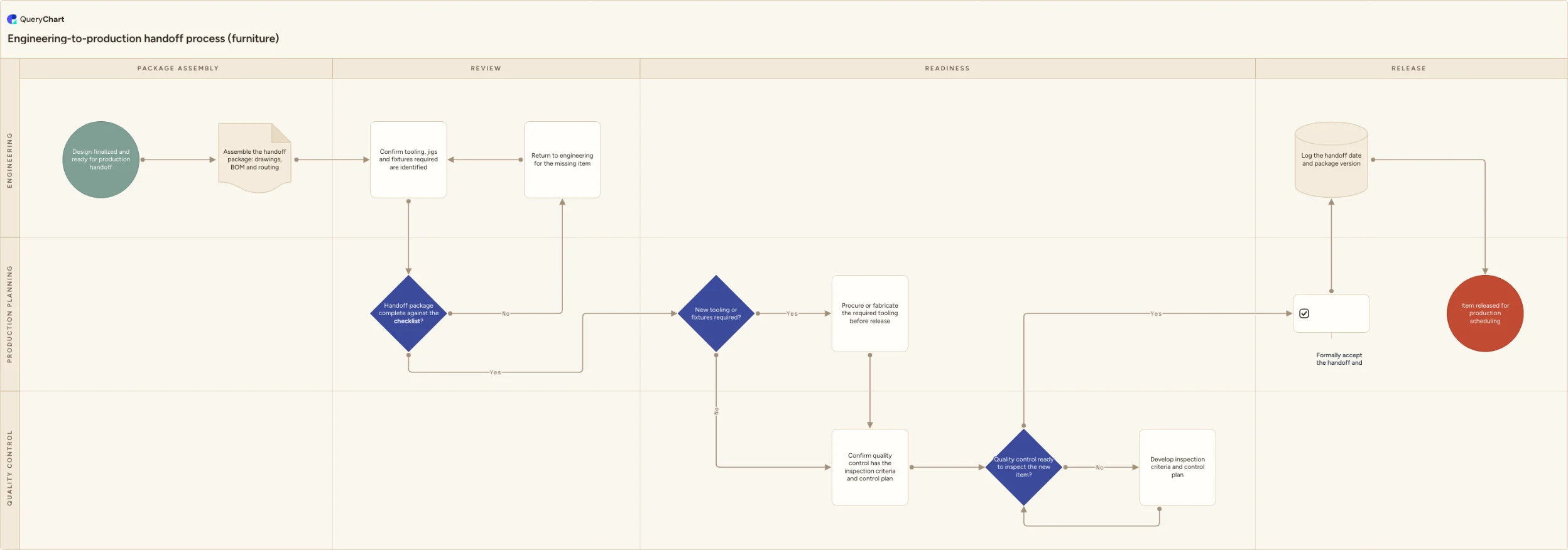
An engineering-to-production handoff process flowchart covering a completeness checklist, tooling readiness, quality control readiness, and formal acceptance.
What the engineering-to-production handoff process is
A finished design isn't automatically a producible one. Between engineering's last drawing revision and production actually starting, three separate things have to be confirmed ready: the documentation package itself (drawings, BOM, routing), any new tooling the item requires, and quality control's ability to actually inspect it. Skipping any one of the three doesn't stop production from starting — it just means production discovers the gap mid-build instead of before.
The tooling-readiness check matters because a new component design can require a jig, fixture or tool that doesn't exist yet, and discovering that need after the item is already scheduled means either delaying the whole schedule or attempting the job without the tooling it actually needs.
The process runs across four phases (package assembly, review, readiness and release) and three lanes (Engineering, Production planning and Quality control), with a formal acceptance step that makes the handoff a recorded decision rather than production simply starting once drawings happen to be available.
What this flowchart covers
In this template
- A handoff package — drawings, BOM and routing — assembled and checked against a completeness checklist before anything moves to production.
- A tooling and fixture readiness check, distinct from documentation completeness, catching a new tooling need before the item is scheduled.
- A quality control readiness check confirming inspection criteria and a control plan exist for the new item, not assuming QC will improvise one when the first piece arrives.
- Formal acceptance of the handoff as a recorded decision, rather than production starting informally once drawings are technically available.
- A logged handoff date and package version, giving a clear record of exactly what was released and when.
When to use this template
- You are documenting the transition from design to production and the current process is informal, with production starting whenever drawings happen to be ready.
- New items have reached production without the tooling they need, discovered only once the job was already scheduled.
- Quality control has had to improvise inspection criteria for a new item because nothing was prepared before the handoff.
- You need a documented, checklist-based handoff gate rather than an assumption that 'engineering is done' means production can start.
How it works
Use a real checklist for package completeness, not a general sense of 'done'
"Handoff package complete against the checklist?" needs an actual stated checklist — specific drawings, BOM format, routing detail — not a subjective judgment that engineering has probably covered everything.
Check tooling readiness as its own distinct question
"New tooling or fixtures required?" should be assessed explicitly for every new item, since a documentation package can be complete while the physical tooling the design assumes doesn't exist yet.
Confirm QC readiness before, not during, the first production run
"Quality control ready to inspect the new item?" should be answered before release, not discovered when the first piece reaches inspection and nobody has criteria to check it against.
Make acceptance a recorded decision, not an assumption
"Formally accept the handoff" should be an explicit, logged step — production scheduling then knows definitively that the item is cleared, rather than inferring readiness from drawings simply being available in a shared folder.
Frequently asked questions
Why does the handoff need a formal acceptance step rather than production starting once drawings exist?
Because 'drawings exist' isn't the same as 'this item is ready for production.' Tooling might be missing, quality control might have no inspection criteria yet, or the package itself might be incomplete against what production actually needs. A formal acceptance step forces those checks to happen before production starts, rather than production discovering gaps mid-build.
What should be checked for tooling readiness specifically?
Whether the new design requires a jig, fixture, or tool that doesn't already exist in the plant — and if so, whether it's been procured or fabricated before the item is scheduled. Discovering a tooling gap after scheduling either delays the whole schedule or forces an attempt at the job without the tooling it needs.
Why does quality control need to be involved in the handoff before production starts?
Because inspecting a new item requires criteria and a control plan specific to it — what to measure, what tolerances apply, what a pass looks like. Without that prepared in advance, the first pieces off the line either get inspected against improvised, inconsistent criteria or aren't meaningfully inspected at all.
How does this connect to the BOM management process?
The BOM management process governs how a bill of materials is created, verified and version-controlled. This handoff process is the gate where that already-released BOM, along with drawings, routing and tooling readiness, is confirmed complete and accepted specifically for production to begin — it's a downstream checkpoint that assumes the BOM itself is already controlled.
Where this process fits
In most operations this process follows Furniture quotation process flowchart and hands off to Furniture production planning process flowchart.
It is one step in Custom furniture orders.
Step 3: Customer sample approval process flowchart (furniture)
Step 4: Bill of materials (BOM) management process flowchart
Step 5: Furniture quotation process flowchart
A furniture quotation process flowchart covering cost buildup from the BOM and routing, a discount approval threshold, and quote validity tracking.
Step 6: Engineering-to-production handoff process flowchart You are here
An engineering-to-production handoff process flowchart covering a completeness checklist, tooling readiness, quality control readiness, and formal acceptance.