How to plan a QMS implementation timeline as a Gantt chart
Plan a quality management system or ISO 9001 implementation as a Gantt chart: sequence gap analysis, procedures, training and audits, and show the certification body's audits as waits you do not control.
A QMS implementation plan is mostly internal work in a sensible order, followed by audits whose dates belong to someone else. This guide shows how to lay that out as a Gantt chart without promising an outcome the chart cannot give.
The short version
- A timeline schedules work; it does not make a system conform or guarantee an audit result.
- Order the internal work by what each step needs: documents before procedures, records before an internal audit, audit results before the management review.
- Use start-to-start links with a lag where training and procedure writing genuinely overlap.
- Show the certification body's audits as lags or waits, and pin dates only once they are confirmed.
- Keep durations labelled as estimates and review them after the gap analysis.
What a QMS timeline can and cannot tell you
A Gantt chart for a quality management system answers scheduling questions: what has to happen before what, which tasks can overlap, and how long the preparation might take if the durations are right. It does not answer whether the system conforms to a standard such as ISO 9001. That depends on how the organisation works and on the audit, and a plan that finishes on schedule can still end with findings.
The shape of the work is fairly stable. You assess where you are, agree scope and policy, map the processes, set up document control, write procedures, train people, run the system long enough to produce records, audit yourself, fix what you find and hold a management review. Only then does an external certification body come in. Each step needs something from the one before: procedures need somewhere to be controlled, an internal audit needs records, and a management review needs the audit results.
The external audits are different in kind. You can ask for dates, but you cannot set them, and the time between your readiness and their visit is a wait. In a Gantt chart that is best shown as a lag on the audit task, replaced by a fixed start once the body confirms. Mark every duration you enter as an estimate, because nobody knows in advance how long a first-time system takes in a given company.
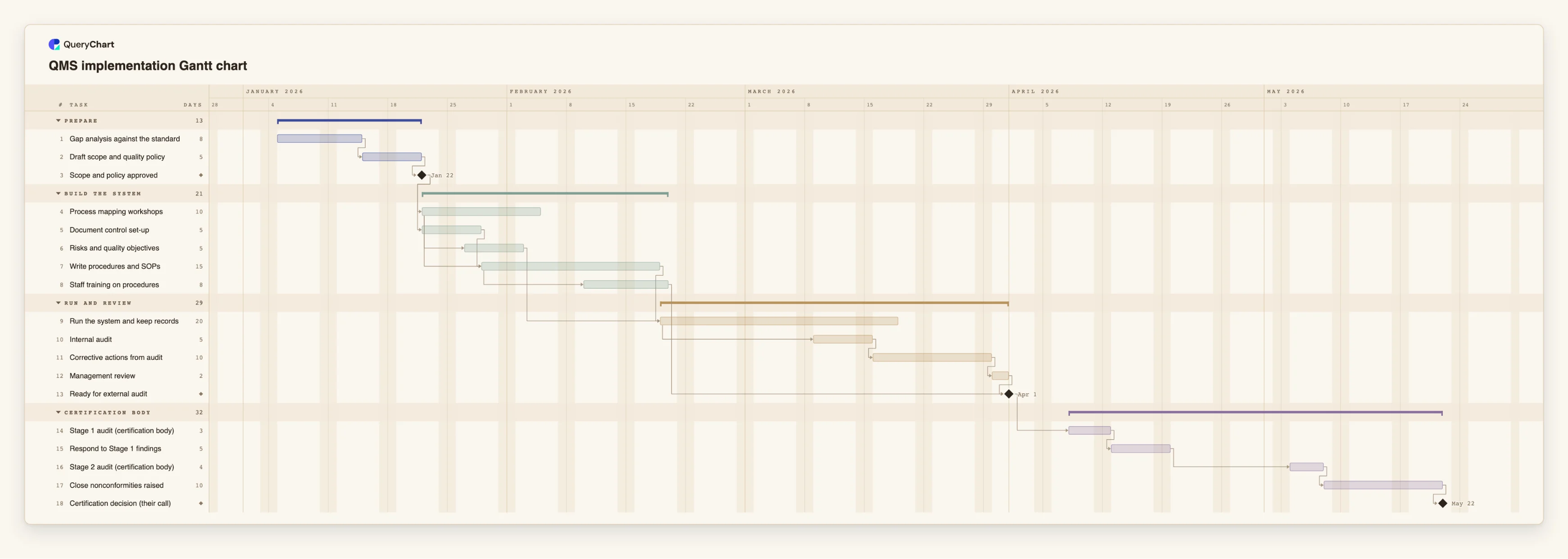
The example is the QMS implementation template, built up in four stages. Open the spreadsheet panel to see the rows.
A QMS implementation plan, built in four stages
Eighteen tasks in four groups. Open the spreadsheet panel to see the rows behind each stage.
Assess and decide
"Gap analysis against the standard" takes 8 working days, "Draft scope and quality policy" 5 more, and "Scope and policy approved" is a milestone of length 0 that the build work will wait for.
Build and train in overlap
"Process mapping workshops" and "Document control set-up" start together after approval. "Write procedures and SOPs" starts 5 days into mapping and also waits for document control, and "Staff training on procedures" starts 8 days into the writing.
Run, audit and review
"Run the system and keep records" lasts 20 days, "Internal audit" starts 12 days into it, and "Corrective actions from audit" and "Management review" follow in order. The milestone "Ready for external audit" waits for the review and the training.
External audits as waits
"Stage 1 audit (certification body)" starts 5 working days after readiness and "Stage 2 audit (certification body)" 10 days after "Respond to Stage 1 findings". The lags stand in for the body's calendar, and "Certification decision (their call)" is a milestone you do not control.
How it works
List the internal work in the order it depends
Write the tasks from gap analysis to management review and link each to what it needs. Document control comes before procedures, and records come before the internal audit.
Add an approval milestone
Give scope and policy a milestone of length 0. Building starts only after someone has decided, and the milestone makes that visible.
Overlap only where work really overlaps
Link training to procedure writing with a start-to-start dependency and a lag, written for example as 7SS+8 in the Depends on column. Do not overlap steps that need the previous result.
Model the certification body as a wait
Put the body's audits at the end with a lag after your readiness milestone. When dates are confirmed, pin the Start of those tasks.
Turn on the critical path and test the estimates
Switch on View, Critical path, then lengthen the records and corrective action tasks. These are the tasks most likely to take longer than planned.
Share it as an estimate
Share the chart with management and label the durations as estimates. Update them after the gap analysis.
Mistakes to avoid
Presenting the end date as a certification date
Presenting the end date as a certification date. The chart can show when your preparation could finish, not when or whether a body certifies.
Starting the internal audit before there are records
Starting the internal audit before there are records. An audit of a system that has barely run has little to examine.
Treating the body's audit as a normal task
Treating the body's audit as a normal task with a fixed length. Its dates are theirs, so show a wait and replace it when confirmed.
Leaving no time for corrective actions
Leaving no time for corrective actions. Audits find things, and the plan should have room to fix them before the management review.
Open the QMS Gantt template
Open the template, replace the durations with your own estimates and share the plan.
Related guides
Frequently asked questions
Can a Gantt chart show that we are compliant?
No. It shows planned work and dates. Conformity is judged against the standard by an audit, and the chart does not affect that.
How long does a QMS implementation take?
It varies with company size, existing documentation and available time. The durations in the template are illustrative; use your gap analysis to set your own.
How do I show the certification body's schedule?
Use a positive lag on the audit tasks as a wait, then pin a fixed Start on each once the body confirms the date.
Which related plans should I read?
For the audit itself see /templates/iso-9001-internal-audit-process, and for findings see /templates/capa-process. For general dependency use see /guides/gantt-chart-dependencies.