QMS implementation Gantt chart template for an ISO 9001 style project
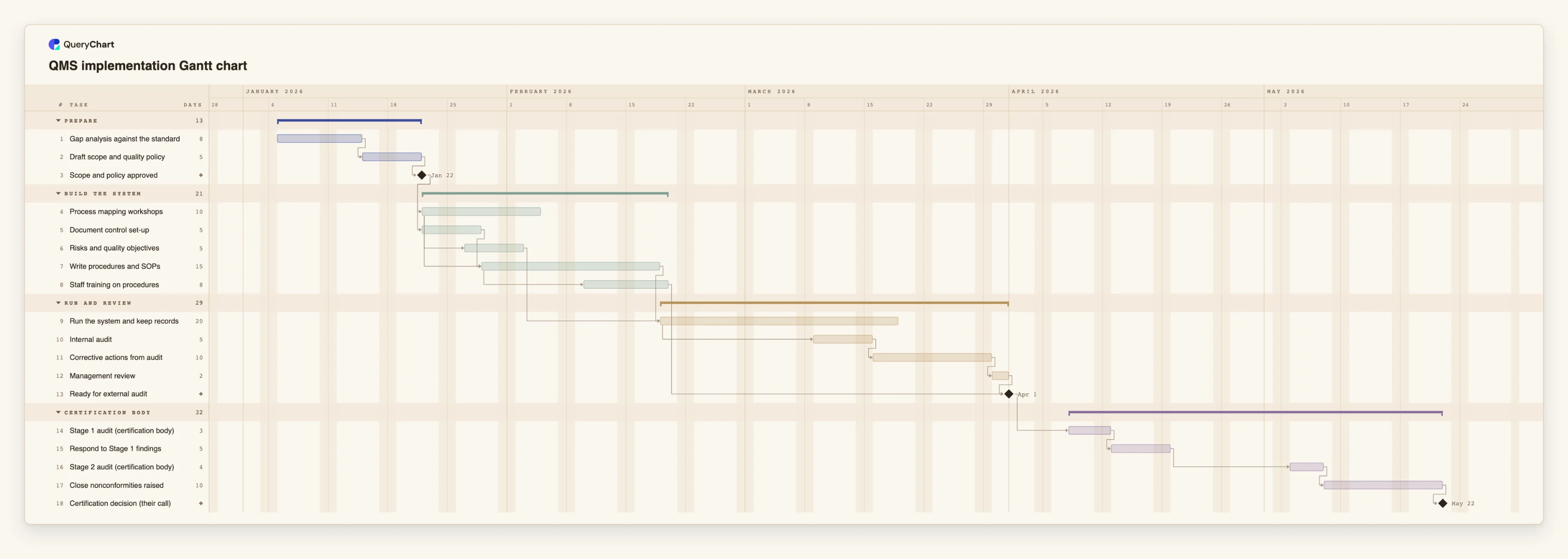
An editable Gantt chart for implementing a quality management system: gap analysis, policy, process mapping, procedures, training, internal audit, management review and the external audit as waits.
What the QMS implementation gantt chart template for an ISO 9001 style project process is
A timeline schedules work. It does not make a management system conform to a standard, and it cannot promise that an external audit will be passed. What it can do is show whether the preparation fits the time you have, which tasks hold up the rest, and where the plan depends on someone outside the company. A schedule that reaches "Certification decision (their call)" on a given day is a plan, not a result.
This template has four groups: Prepare, Build the system, Run and review, and Certification body. "Gap analysis against the standard" takes 8 working days and "Draft scope and quality policy" 5 more, ending at the milestone "Scope and policy approved". After it, "Process mapping workshops" (10 days) and "Document control set-up" (5 days) start together. "Risks and quality objectives" starts 3 days into the mapping, and "Write procedures and SOPs" starts 5 days into it but also waits for document control, so the procedures have somewhere to live.
"Staff training on procedures" starts 8 days into the writing rather than after it, so people are taught as procedures settle. "Run the system and keep records" (20 days) waits for the procedures and the risk work, because an internal audit needs records to look at. "Internal audit" starts 12 days into that period, then "Corrective actions from audit" (10 days) and "Management review" (2 days) follow in order. "Ready for external audit" is a milestone that waits for the review and the training.
The last group is the certification body. "Stage 1 audit (certification body)" starts 5 working days after readiness, "Respond to Stage 1 findings" follows it, and "Stage 2 audit (certification body)" starts 10 days after that response. Those lags are placeholders for waiting on the body's calendar. Replace them with the dates the body gives you, and treat every duration in this plan as illustrative.
To plan the audit itself in more detail, see /templates/iso-9001-internal-audit-process and /templates/internal-audit-process. For procedure changes see /templates/document-change-control-workflow, and for fixing what the audit finds see /templates/capa-process.
What this flowchart covers
In this template
- Four groups, Prepare, Build the system, Run and review and Certification body, with 18 tasks and three milestones: "Scope and policy approved", "Ready for external audit" and "Certification decision (their call)".
- A preparation chain: "Gap analysis against the standard" (8 days), "Draft scope and quality policy" (5 days) and the approval milestone.
- Overlapping build work: "Process mapping workshops", "Document control set-up" and "Risks and quality objectives", with "Write procedures and SOPs" starting 5 days into the mapping and waiting for document control.
- Training and records in step: "Staff training on procedures" starts 8 days into the writing, and "Internal audit" starts 12 days into "Run the system and keep records".
- External audits as waits: "Stage 1 audit (certification body)" and "Stage 2 audit (certification body)" each carry a lag for the body's availability.
When to use this template
- You are planning a first QMS implementation and need to show how long preparation might take before an external audit.
- You want to see how the internal audit, corrective actions and management review fit before the certification body arrives.
- A certification body has not yet given dates and you want to show the dependency without inventing them.
- You are reviewing an existing plan and want to check that training, records and the internal audit are not squeezed together.
The plan, task by task
Every task in the chart with its length in working days and what it waits for. A dependency is a step number; SS is start-to-start, FF is finish-to-finish, and +n is a lag in working days.
| # | Task | Group | Working days | Depends on |
|---|---|---|---|---|
| 1 | Gap analysis against the standard | Prepare | 8 | |
| 2 | Draft scope and quality policy | Prepare | 5 | 1 |
| 3 | Scope and policy approved | Prepare | Milestone | 2 |
| 4 | Process mapping workshops | Build the system | 10 | 3 |
| 5 | Document control set-up | Build the system | 5 | 3 |
| 6 | Risks and quality objectives | Build the system | 5 | 4SS+3 |
| 7 | Write procedures and SOPs | Build the system | 15 | 4SS+5, 5 |
| 8 | Staff training on procedures | Build the system | 8 | 7SS+8 |
| 9 | Run the system and keep records | Run and review | 20 | 6, 7 |
| 10 | Internal audit | Run and review | 5 | 9SS+12 |
| 11 | Corrective actions from audit | Run and review | 10 | 10 |
| 12 | Management review | Run and review | 2 | 11 |
| 13 | Ready for external audit | Run and review | Milestone | 8, 12 |
| 14 | Stage 1 audit (certification body) | Certification body | 3 | 13+5 |
| 15 | Respond to Stage 1 findings | Certification body | 5 | 14 |
| 16 | Stage 2 audit (certification body) | Certification body | 4 | 15+10 |
| 17 | Close nonconformities raised | Certification body | 10 | 16 |
| 18 | Certification decision (their call) | Certification body | Milestone | 17 |
How it works
Start with the gap analysis
Keep "Gap analysis against the standard" as the first task. Its findings should change the length of the build tasks that follow.
Approve scope and policy before building
Keep the milestone "Scope and policy approved" so process mapping and document control wait for a decision.
Let the build work overlap
Use start-to-start links with a lag in working days so risks, procedures and training begin before the previous task finishes.
Leave time for records
Check that "Run the system and keep records" is long enough for the internal audit to have evidence. Lengthen it if processes run rarely.
Show the certification body as waits
Replace the lags on the two audit tasks with the dates the body confirms. Pin a Start on those tasks only once the dates are fixed.
Add owners and share
Add people to each task and share the chart so management can see what the review and readiness milestone wait for.
Frequently asked questions
Does this plan guarantee certification?
No. A Gantt chart schedules tasks. Whether the system meets the standard is decided by the work and by the certification body, not by the timeline.
Are the durations realistic for my company?
They are illustrative. Company size, how much is already documented and how many sites are involved change them a lot, so enter your own.
How do I show the certification body's dates?
The template uses lags on the audit tasks as placeholders. When the body gives you dates, pin the Start of those tasks and let the rest follow.
Can I use it for a standard other than ISO 9001?
Yes. The structure of gap analysis, build, run, review and external audit fits other management system standards. Rename tasks to match.