Warehouse Exception Management Process
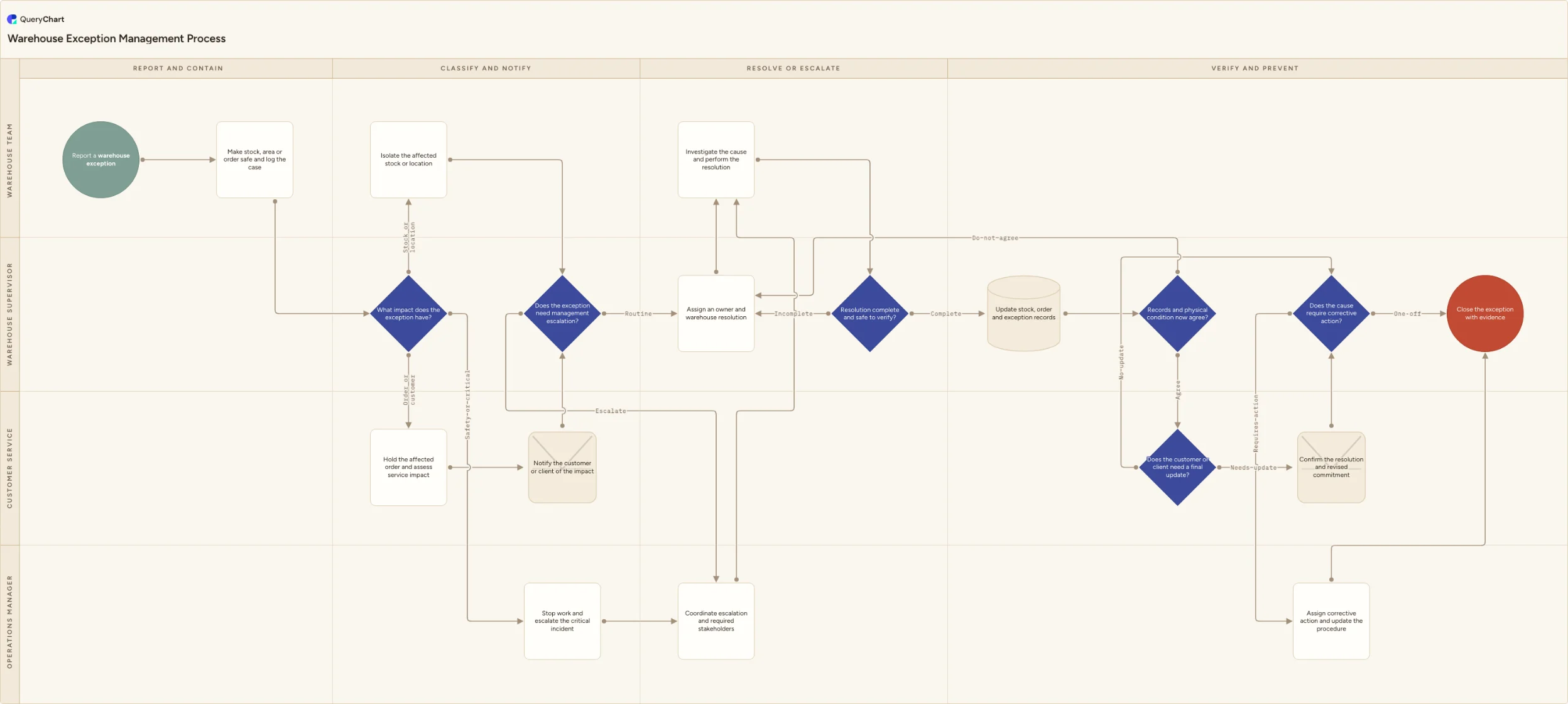
Warehouse exception management process template for impact classification, customer notification, warehouse resolution, escalation, verification and corrective action.
What the warehouse exception management process is
Warehouse exceptions range from a mislocated pallet to an order delay or a safety-critical incident, but each needs the same disciplined beginning: contain the impact and log a case before normal work carries it forward. This template makes the stock, area or order safe, then asks "What impact does the exception have?" Stock and location exceptions route to isolation; order and customer exceptions place the order on hold, assess service impact and notify the customer or client; safety or critical events stop work and escalate. The classification makes the next owner and urgency visible rather than leaving every exception in one generic queue.
The Warehouse supervisor decides whether a routine warehouse resolution is enough or management coordination is needed. The assigned team investigates and resolves the cause, but "Resolution complete and safe to verify?" loops incomplete work back to a named owner instead of closing on an attempted fix. Once stock, order and exception records are updated, the process checks that physical condition and records agree, confirms any final customer commitment, and determines whether the cause needs corrective action. Use this template to establish the common path above specialist procedures for inventory, quality, safety, transport or customer claims.
What this flowchart covers
In this template
- Immediate containment through "Make stock, area or order safe and log the case", so an exception cannot continue unnoticed into picking, loading, dispatch or unsafe work
- A three-way impact classification for stock or location, order or customer, and safety or critical events, with each route reaching the responsible warehouse or service action
- A customer or client notification step for affected orders, followed by a final-update decision once the verified resolution and revised commitment are known
- A routine-resolution versus management-escalation decision, with incomplete work looping back to an assigned warehouse resolution rather than becoming a closed exception
- Physical-and-record verification plus a corrective-action decision, so a repeatable failure produces a named prevention task instead of just an incident log
When to use this template
- Your warehouse handles shortages, stock damage, location errors, order delays and operational incidents through different informal channels and needs one first-response process
- Customers or clients hear about affected orders too late because warehouse containment and service notification are not connected
- Routine exceptions are consuming manager time while genuinely critical issues do not have a clear escalation trigger or stakeholder route
- Cases are closed when a team attempts a fix, without verifying the stock, order and physical condition or capturing corrective action for recurring causes
How it works
Define the exception categories
Start with the stock, order/customer and safety/critical categories in the chart, then add only categories that change containment, ownership or escalation. Keep the initial classification short enough for a shift team to apply consistently.
Map containment to system controls
For each category, identify the WMS, ERP or physical control that holds stock, blocks an order, restricts an area or stops a task. A case log alone does not prevent an exception from progressing through normal work.
Set notification authority and messages
Name who tells a customer or client about an affected order, the time limit for doing so and the information they may promise. The warehouse should provide verified facts; service teams should own the external commitment.
Define escalation thresholds
Set the value, safety, service, regulatory or repeat-frequency triggers that send a case to management. The threshold should change the response, not merely add another person to every routine exception.
Close only after verification and prevention review
Require evidence that the physical condition, stock status and order record now agree. For repeatable causes, assign a corrective action owner and due date, then review whether the changed control actually prevents recurrence.
Frequently asked questions
What is a warehouse exception management process?
It is the common method for reporting, containing, classifying, resolving and closing operational problems that interrupt warehouse work. A useful process connects the physical response, system holds, customer communication, escalation and final verification, rather than treating an exception as only a note in a shift log.
When should a warehouse notify a customer or client about an exception?
Notify when the exception changes an order's availability, shipment, delivery commitment or another agreed service outcome. The message should follow an assessment of the actual impact and, where possible, include the revised commitment. This template makes the notification explicit for order or customer exceptions and checks whether a final update is needed after verification.
What is the difference between resolving an exception and corrective action?
Resolution restores the affected stock, area, task or order to a safe and controlled condition for the current case. Corrective action addresses the repeatable cause that made the case possible, such as a location-label failure, scanning gap or unclear procedure. A case can be resolved today while its corrective action remains open for follow-up.
Where this process fits
In most operations this process hands off to CAPA process flowchart (corrective and preventive action).
Comes after
- CAPA process flowchart (corrective and preventive action) — A CAPA process flowchart in five swimlanes: log and grade the issue, contain it, investigate the root cause, correct and prevent, then verify before closure.