Performance improvement plan flowchart (PIP decision tree)
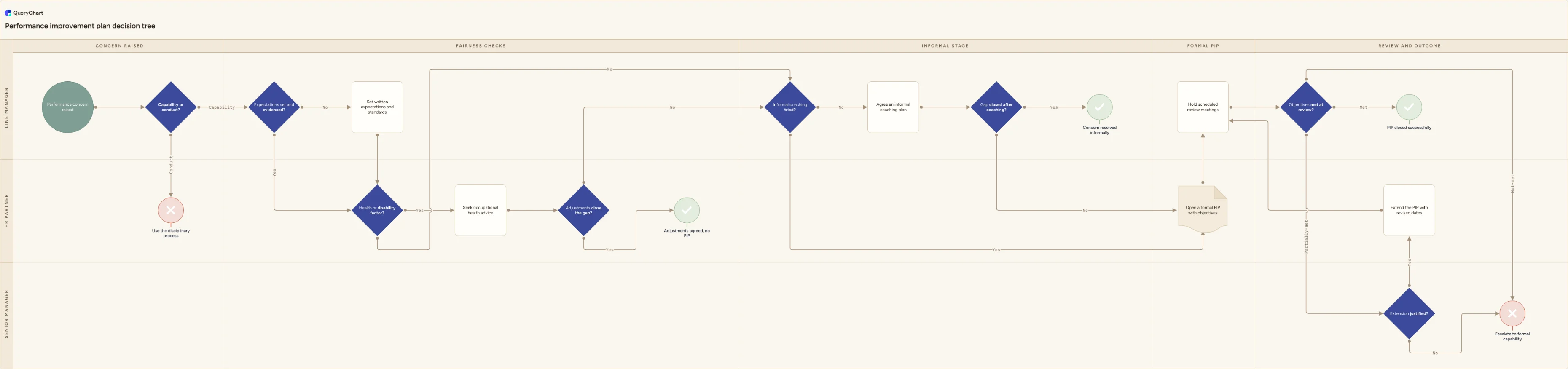
Performance improvement plan flowchart: a decision tree covering capability or conduct, expectations, health factors, coaching and how a PIP review ends.
What the performance improvement plan flowchart (PIP decision tree) process is
Most PIP templates start at the point where the decision has already been made: here is the form, fill in the objectives. The harder part comes before that. Is this actually a capability gap, or is it conduct wearing a capability label? Were the expectations ever written down and communicated? Is there a health or disability factor that changes the route entirely? Has anyone tried coaching first? This chart puts those questions in order and gives each one an owner.
It is deliberately a decision tree, not a process map. A process map answers 'what happens next, and who does it'. A decision tree answers 'which option do we choose, and who decides'. Every box here is either a question, a short action taken because of an answer, or a named ending. If you want the end-to-end cycle in which a performance concern surfaces in the first place, use the performance review process template at /templates/performance-review-process, which runs from cycle launch through self-assessment, calibration and appeal, and hands off to this chart at the point where an improvement plan is opened.
Nothing here is a legal standard. What a PIP must contain, how long it runs and what notice is required come from your own policy and from local employment law, and they differ considerably between countries. What a written decision tree gives you is consistency: the same questions asked in the same order, the criteria recorded next to the question rather than in someone's head, and a record of who decided what. That is what holds up when a manager, an employee or a tribunal later asks why this route was chosen over another.
What this flowchart covers
In this template
- Eight decision points rather than a task chain: 'Capability or conduct?', 'Expectations set and evidenced?', 'Health or disability factor?', 'Adjustments close the gap?', 'Informal coaching tried?', 'Gap closed after coaching?', 'Objectives met at review?' and 'Extension justified?'.
- A conduct branch that leaves the chart immediately at 'Use the disciplinary process', so a will-not problem is never run as a can-not problem, and a 'No' on evidenced expectations that routes through 'Set written expectations and standards' before anything formal can open.
- A health route owned by the HR partner: 'Seek occupational health advice', then an 'Adjustments close the gap?' test whose Yes branch ends at 'Adjustments agreed, no PIP' rather than opening one anyway.
- An informal stage that is allowed to finish the matter - 'Agree an informal coaching plan' followed by 'Gap closed after coaching?', ending at 'Concern resolved informally' on Yes and joining the formal PIP on No.
- A three-way review branch: Met closes the plan at 'PIP closed successfully', Partially met goes to the senior manager's 'Extension justified?' question, and Not met skips the extension entirely and goes to escalation.
- Five distinct endpoints across three decision-rights lanes (Line manager, HR partner, Senior manager), plus an extension loop where 'Extend the PIP with revised dates' returns to the scheduled review meetings instead of creating a second plan.
When to use this template
- A manager has asked to put someone on a PIP and you want the instrument tested before any paperwork is drafted.
- Capability and conduct are being handled through the same route in your organisation, and cases fall apart when the wrong procedure is challenged.
- You are writing or rewriting a capability policy and want the questions, the decision rights and the possible endings agreed before anyone argues about wording.
- PIPs where you work only ever end one way, and you need the informal, adjustment and successful-close routes drawn as legitimate outcomes.
- You are briefing first-time managers and want one page showing which questions they answer, which HR answers and which need a level above them.
How it works
Open the template and set the decision rights
The three lanes - Line manager, HR partner and Senior manager - are the point of the chart. Rename them to the roles you actually have, then check each question sits with the person who is genuinely allowed to answer it. If your line managers cannot authorise a PIP alone, move 'Open a formal PIP with objectives' into the HR or senior lane before you publish.
Write your own test into 'Capability or conduct?'
This is the branch that most often goes wrong, so replace the comment with your organisation's wording. The usual test is cannot versus will not: a skill, knowledge or capacity gap is capability, while rule-breaking or refusal is conduct. Mixed cases exist; state who decides them and record the reasoning.
Set the evidence bar for 'Expectations set and evidenced?'
Decide what a Yes requires on file - the standard in writing, evidence the employee was told, and dated examples of the shortfall. Anything less and the No branch applies: set the expectations, allow a fair period, then re-enter the chart. This single gate prevents most unfair PIPs.
Agree the health and adjustments route with HR
Confirm when advice is sought, who may see it, and what happens while it is pending. Keep the 'Adjustments agreed, no PIP' ending visible - it is a real outcome, not a delay - and note that a No on adjustments does not erase the adjustments, it carries them into whatever comes next.
Fix the PIP length, review cadence and extension rule
Put your own figures on 'Open a formal PIP with objectives' and 'Hold scheduled review meetings'. There is no standard duration; plans commonly run somewhere between one and three months with reviews every two to four weeks, but pick what a genuine improvement would take in this role. On 'Extension justified?', state that an extension needs measurable progress and a defined new end date.
Publish it with the version history intact
Share the chart as the controlled version and keep the edit history. When an outcome is questioned months later, being able to show which version of the decision tree was in force, and who approved it, is worth more than recalling what was intended at the time.
Frequently asked questions
What is the difference between a PIP decision tree and a performance review process flowchart?
They answer different questions. The performance review process flowchart at /templates/performance-review-process is a cross-functional process map: it shows what happens next and who does it, running from cycle launch through self-assessment, calibration, the review meeting and the appeal route. This page is a decision tree: it shows which option is chosen and who chooses it, so almost every box is a question with answer-labelled branches. Use the process map to run a review cycle. Use this chart at the moment somebody says the words 'performance improvement plan', to establish whether that is the right instrument at all.
When should a performance improvement plan not be used?
This chart routes four situations away from a PIP. Conduct, meaning will not rather than cannot, leaves at 'Use the disciplinary process' - running a rule-breaking issue as a capability matter is unfair to the employee and usually unsafe for the employer. Expectations that were never set in writing or never evidenced go to 'Set written expectations and standards' first, because you cannot fairly measure someone against a standard they were not given. A health, disability or adjustment factor goes to occupational health advice, and if adjustments close the gap the chart ends at 'Adjustments agreed, no PIP'. And where informal coaching has never been tried, the chart tries it before anything formal opens.
How long should a PIP run, and when is an extension justified?
There is no standard length and no legal figure to quote - it depends on the role, the size of the gap and your own policy. In practice plans commonly run somewhere between one and three months, with reviews every two to four weeks, chosen so that a genuine improvement would be visible within the period. On extensions, the test in this chart is whether progress is measurable and whether a further defined period could realistically close the remaining gap. Extend once, with a revised end date and a written note of what changes, and route the extension back through the same review meetings rather than starting a second plan. Extending because the conversation is uncomfortable is the failure mode to avoid.
What outcomes should a PIP have besides escalation?
Five endings are drawn here, and only one of them is escalation. 'Use the disciplinary process' takes conduct out at the top. 'Adjustments agreed, no PIP' ends the matter where reasonable adjustments close the gap. 'Concern resolved informally' ends it where coaching worked. 'PIP closed successfully' ends it where the agreed objectives were met - this is the outcome most templates forget to draw, and drawing it changes how the plan is received. 'Escalate to formal capability' is the last branch, reached from Not met at review or from a refused extension, and it sits in the senior manager lane because it should not be a line manager's call alone.
Who should own each decision in the chart?
The lanes carry the decision rights. The line manager owns the evidence-based questions closest to the work: capability or conduct, whether expectations were set, whether coaching was tried and whether the objectives were met at review. The HR partner owns the questions that change the procedure - the health and disability factor, whether adjustments close the gap, and the formal opening of the plan. The senior manager owns the two decisions with the most consequence: whether an extension is justified and whether the case escalates to a formal capability process. Keeping those last two outside the reporting line is what makes the outcome defensible.
Where this process fits
In most operations this process follows Employee performance review process flowchart template and hands off to Employee disciplinary process flowchart template.
Comes before
- Employee performance review process flowchart template — A swimlane flowchart of the employee performance review process, from cycle launch through self-assessment and calibration to rating, appeal and outcome.
Comes after
- Employee disciplinary process flowchart template — Employee disciplinary process flowchart: informal stage, investigation, suspension branch, hearing, an outcome from no action to dismissal, and appeal.