Employee disciplinary process flowchart template
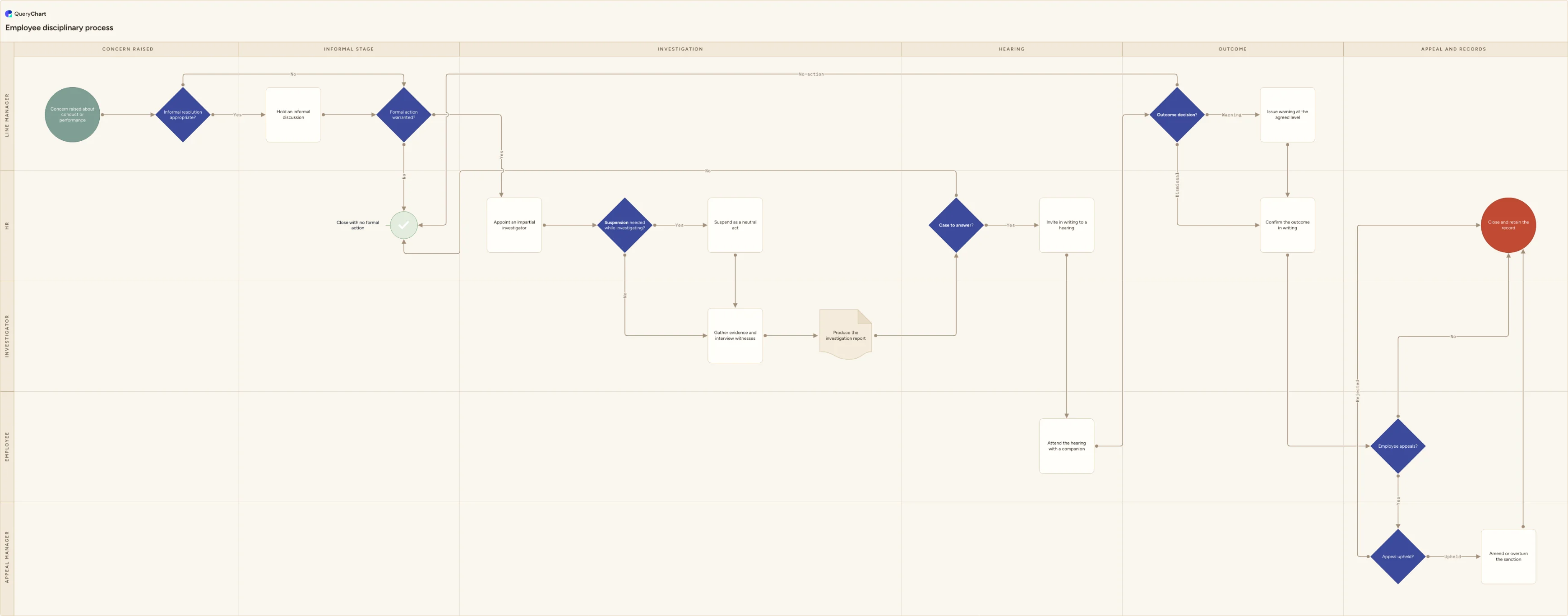
Employee disciplinary process flowchart: informal stage, investigation, suspension branch, hearing, an outcome from no action to dismissal, and appeal.
What the employee disciplinary process flowchart process is
An employee disciplinary process is the route an employer takes when a concern is raised about someone's conduct or performance: an informal attempt to put it right where that is appropriate, an investigation, a hearing, a decision, and an appeal heard by someone who was not involved. Most organisations already have those stages written down somewhere. What the policy usually leaves vague is the routing: who decides the informal stage is over, who investigates, who may authorise a suspension, who chairs the hearing, and who is allowed to hear the appeal. Those hand-offs are what a challenged decision turns on, and they are what this chart pins down.
This is the employer-initiated route, and it is worth being clear about what it is not. If the employee is the one raising the complaint, that is a grievance and it runs in the opposite direction: use the employee complaint process at /templates/employee-complaint-process. If the problem is genuinely capability rather than conduct, someone who cannot do the job rather than someone who will not follow the rules, the first instrument is normally a performance improvement plan, and the decision tree at /templates/performance-improvement-plan tests that before any disciplinary route opens. This chart takes over at the point where a formal conduct or performance case is opened against an employee, and it stops at the retained record: if the outcome is a departure, the mechanics of notice, handover, access revocation and final pay sit in the employee offboarding process at /templates/employee-offboarding-process.
Nothing on the chart is a legal standard, and disciplinary law differs considerably between countries. What it maps is the procedural fairness that is widely accepted in practice: tell the employee what is alleged and let them see the evidence, investigate before deciding rather than after, keep the investigation separate from the decision, hold a hearing the employee can prepare for and be accompanied at, confirm the outcome in writing with reasons, and offer a genuine appeal to someone new. In the UK those expectations are set out in the Acas Code of Practice on disciplinary and grievance procedures, and an employment tribunal can adjust compensation by up to 25% where an employer has unreasonably failed to follow it. Check your own obligations locally before you publish the process.
What this flowchart covers
In this template
- Five lanes (Line manager, HR, Investigator, Employee and Appeal manager) across six phases: Concern raised, Informal stage, Investigation, Hearing, Outcome, and Appeal and records.
- Two gates before anything formal starts: 'Informal resolution appropriate?' routes minor concerns to 'Hold an informal discussion', and 'Formal action warranted?' either opens the formal route or ends at 'Close with no formal action'.
- A suspension branch inside the investigation: 'Suspension needed while investigating?' sends the Yes branch to 'Suspend as a neutral act' before both branches rejoin the same evidence-gathering step, so suspension is a decision with an owner rather than a reflex.
- Investigation held apart from the decision: HR appoints an impartial investigator, who gathers evidence, interviews witnesses and produces the investigation report; 'Case to answer?' can close the matter without a hearing on the No branch.
- A hearing the employee can prepare for: 'Invite in writing to a hearing' feeds 'Attend the hearing with a companion' in the Employee lane, making the right to be accompanied a visible step rather than a line in the handbook.
- A three-way 'Outcome decision?' (No action, Warning or Dismissal) then written confirmation, an 'Employee appeals?' gate, an 'Appeal upheld?' decision in a separate Appeal manager lane that can amend or overturn the sanction, and a final 'Close and retain the record'.
When to use this template
- You are writing or revising a disciplinary policy and want the routing and decision rights agreed before anyone drafts the wording.
- Managers handle conduct inconsistently (some go straight to a hearing, others let a problem run informally for months) and you need one page showing where the line sits.
- An allegation is serious enough that suspension is being discussed and nobody is certain who authorises it, what it means for pay, or when it gets reviewed.
- You need to show an adviser, an auditor or an employee representative that investigation, decision and appeal sit with different people.
- You are briefing first-time managers on what they can decide alone and at which point HR or a more senior manager takes over.
How it works
Rename the lanes to your real roles
Replace Line manager, HR, Investigator, Employee and Appeal manager with the roles you actually have. Smaller organisations often merge Investigator into HR — if you do, state who investigates when HR or the manager is a witness. Keep the Appeal manager lane separate even if the same person usually fills it, because the one rule that cannot bend is that the appeal is decided by someone who was not involved in the original decision.
Write your own test into 'Informal resolution appropriate?'
This branch decides how the whole case is handled, so replace the comment with your own wording. The usual approach is that minor, first-time or performance concerns start informally, while alleged gross misconduct, harassment, discrimination or a safeguarding risk goes straight to the formal route. Record the reason for the choice on either branch, because the question people ask later is why this case was treated differently from another.
Set the suspension rule before you need it
On 'Suspension needed while investigating?', name who may authorise suspension, what alternatives must be considered first — temporary redeployment, a change of duties, supervised working — and how often the suspension is reviewed. State in the policy that suspension is a neutral act rather than a sanction and is normally on full pay, and keep it as short as the investigation allows.
Fix what the invitation letter must contain
'Invite in writing to a hearing' is where most unfair outcomes originate. Decide what a compliant invitation includes: the allegations, the evidence the decision will be based on, enough notice for the employee to prepare, the possible outcomes including dismissal where that is in scope, and confirmation of the right to be accompanied. Name a chair who was not the investigator.
List your sanction levels and who may apply them
Expand 'Outcome decision?' into the levels your policy actually uses — commonly no action, a first written warning, a final written warning and dismissal — and record how long each warning stays live; six or twelve months are common choices, but there is no fixed figure, so pick one and apply it consistently. State which role holds authority to dismiss, since that is rarely the line manager alone.
Agree retention, then publish the version
Decide how long disciplinary papers are kept, where the restricted file lives and who may see it, and agree all three with whoever owns data protection in your organisation. Then approve and date the map as the version your written procedure refers to. If an outcome is disputed months later, what matters is which version was in force at the time, so keep the revision history rather than editing in place.
Frequently asked questions
What is the difference between a disciplinary process and a grievance process?
Direction. A disciplinary process is opened by the employer about an employee's conduct or performance, which is the flow on this page: concern raised, investigation, hearing, outcome, appeal. A grievance is raised by an employee about their own treatment at work, and it runs the other way — the employee submits it, the employer investigates and decides, and the employee appeals. That process is mapped separately at /templates/employee-complaint-process. The two can meet: an employee facing disciplinary action sometimes raises a grievance about how it is being handled, and your policy should say whether the disciplinary case pauses while the grievance is dealt with, whether the two are heard together, or who decides that.
When should a concern go through a performance improvement plan instead?
The usual test is cannot versus will not. A skill, knowledge or capacity gap is capability and normally belongs in a performance improvement plan, with objectives, support and review meetings. Rule-breaking, refusal or dishonesty is conduct and belongs in the disciplinary route mapped here. Running a capability problem as misconduct is unfair to the employee and rarely survives challenge; running a conduct problem as a PIP simply delays the point. The decision tree at /templates/performance-improvement-plan works through that choice, including the health, disability and adjustments questions that change the route entirely, and it hands over to this chart when the answer is conduct.
Do we have to suspend someone while we investigate?
No. Suspension is one option among several and the chart deliberately makes it a branch rather than a step. It is usually reserved for allegations where the person's continued presence would put people, evidence or the investigation at risk. Consider the alternatives first — temporary redeployment, a change of duties, restricted system access or supervised working — and record why they were rejected if you suspend. Where suspension is used, treat it as a neutral act rather than a sanction, keep it as short as possible, normally on full pay, and review it at a set interval. A long open-ended suspension is itself a risk, both to the employee and to the employer.
Who should hear the appeal, and can the outcome get worse?
The appeal should be heard by a manager who had no part in the investigation or the original decision, and ideally one who is more senior. That is why the chart puts 'Appeal upheld?' and 'Amend or overturn the sanction' in their own Appeal manager lane. The employee should be able to state their grounds at an appeal meeting and, as at the original hearing, to be accompanied. On whether the outcome can worsen: many policies state that a sanction will not be increased on appeal, on the reasoning that the risk of a worse result deters people from appealing at all. Whichever position you take, write it into the policy so nobody discovers it at the appeal meeting.
How long should a disciplinary process take?
There is no single fixed timetable and no figure worth inventing. The widely accepted expectation is that each stage is dealt with promptly and without unreasonable delay, and in the UK the Acas Code of Practice on disciplinary and grievance procedures sets that expectation; a tribunal can adjust compensation by up to 25% where an employer has unreasonably failed to follow it. In practice, put your own timescales next to 'Invite in writing to a hearing', the hearing itself, 'Confirm the outcome in writing' and the appeal, and say where each clock starts. Anchoring to a logged date rather than to when someone opened the file is what makes the commitment measurable, and delay is easier to defend when the reason for it is recorded on the case file.
Where this process fits
In most operations this process follows Performance improvement plan flowchart (PIP decision tree) and hands off to Employee offboarding process flowchart.
Comes before
- Performance improvement plan flowchart (PIP decision tree) — Performance improvement plan flowchart: a decision tree covering capability or conduct, expectations, health factors, coaching and how a PIP review ends.
Comes after
- Employee offboarding process flowchart — A cross-functional offboarding flowchart with HR, manager, IT, payroll and facilities lanes: notice, handover, exit interview, access revocation, final pay.