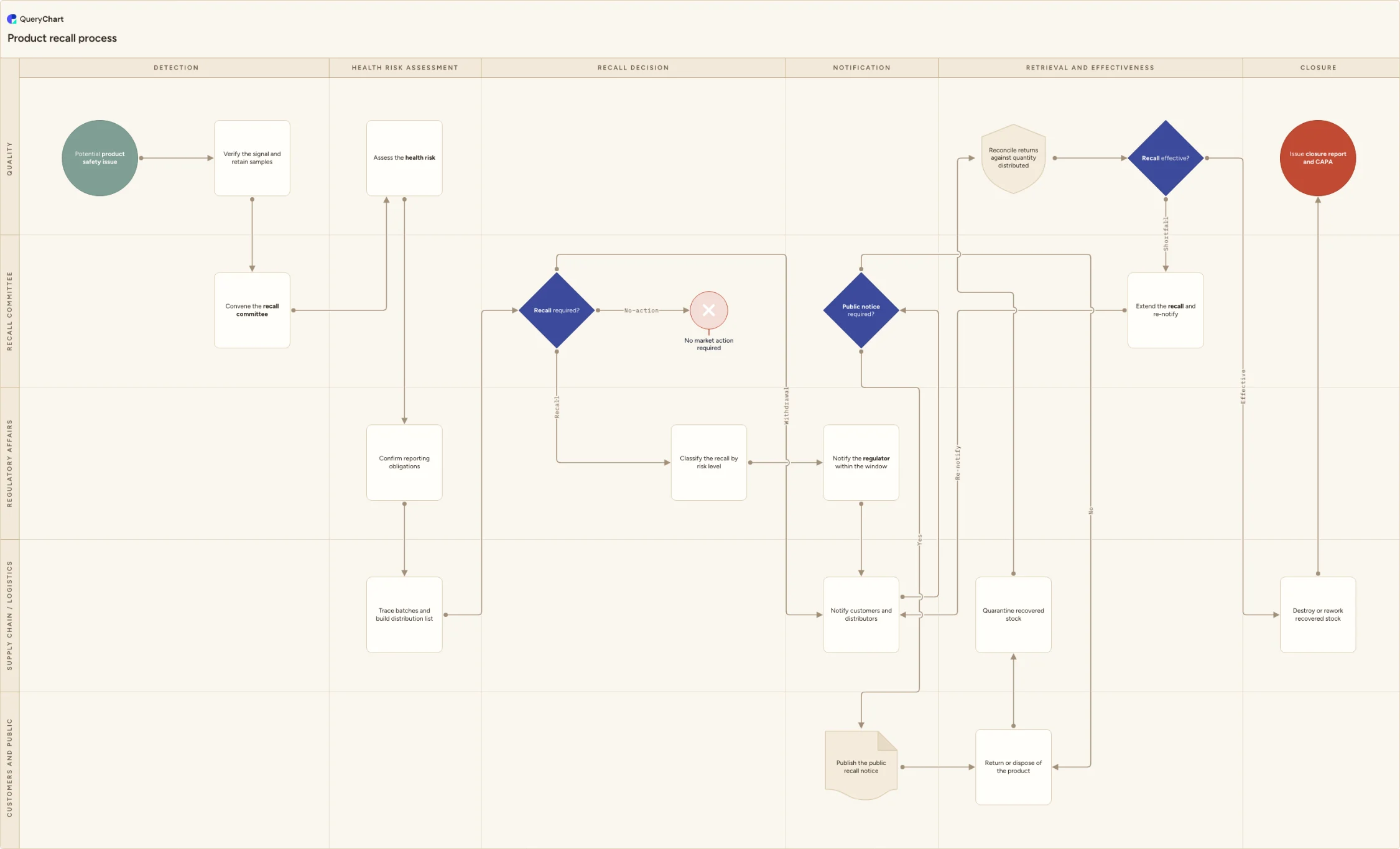
Product recall process flowchart (recall vs withdrawal)
Product recall process flowchart: health risk assessment, recall or withdrawal, classification, regulator and public notice, retrieval, effectiveness check.
What the product recall process flowchart (recall vs withdrawal) process is
A recall starts from an uncomfortable position: the product has already left your control. It is on shelves, in vans, in warehouses you do not own, and possibly in someone's kitchen or medicine cabinet. Everything the process does is an attempt to reach it again, quickly, and to be able to show afterwards how much of it came back. That is why the two things worth designing carefully are the health risk assessment at the front, which sets how far the action has to reach, and the effectiveness check at the back, which is the only evidence that it did.
This is not the process for handling one customer's complaint about a defective item, and it is not the process for a batch that has failed inspection while still in your warehouse. A quality complaint is an input to this process rather than the process itself; a batch caught before release is a deviation or a nonconformance and never becomes a market action. The commercial mechanics of taking goods back from an individual customer belong to the returns and RMA process. And the permanent fix is deliberately out of scope here: this chart ends by handing the cause into root cause analysis and CAPA, because a recall is a containment action, not a correction.
The chart below runs from a safety signal to a closed recall record across five lanes and six phases. Quality verifies the signal and assesses the health risk. The recall committee makes the market-action call. Regulatory affairs classifies the recall and notifies the authority. Supply chain and logistics hold traceability, notification to trade customers, quarantine and disposition. The Customers and public lane holds the two steps you do not control, receiving the notice and returning the product, which is exactly why the effectiveness check exists. Treat it as a starting map for your own recall procedure, not as evidence of compliance in itself.
What this flowchart covers
In this template
- Five swimlanes (Quality, Recall committee, Regulatory affairs, Supply chain / Logistics, Customers and public) across six phases: Detection, Health risk assessment, Recall decision, Notification, Retrieval and effectiveness, and Closure.
- Detection and assessment before any decision: verify the signal and retain samples, convene the recall committee, assess the health risk, confirm reporting obligations with Regulatory affairs, and trace the affected batches into a distribution list.
- A three-way "Recall required?" decision owned by the recall committee. Recall goes on to classification and the full notification route, Withdrawal skips classification and stops at direct customers, and No action ends the flow at "No market action required".
- Notification split by audience: Regulatory affairs classifies the recall by risk level and notifies the regulator within the window, Supply chain notifies customers and distributors, and a "Public notice required?" decision decides whether a public recall notice is published.
- Retrieval in the Customers and public and Supply chain lanes: product is returned or disposed of, recovered stock is quarantined, and Quality reconciles what came back against the quantity distributed.
- A "Recall effective?" decision whose Shortfall branch extends the recall and re-notifies rather than closing on a low recovery rate, then disposition of recovered stock and a closure report handed into CAPA.
When to use this template
- You are writing or revising a recall procedure and need the routing, the decision owners and the escalation path agreed before anyone drafts the prose.
- Your organisation has no written test for when an issue becomes a recall rather than a withdrawal, so the call depends on who is in the room.
- You are running a mock recall or a traceability exercise and want a diagram people can follow under time pressure, with the notification and effectiveness steps visible.
- An auditor, customer or regulator has asked how recall decisions are made, who notifies the authority and how you evidence that recovered stock was reconciled.
- You are training a recall committee that meets rarely, and need the first two hours of the process to be unambiguous to people who have never run one.
How it works
Rename the lanes to your real roles
Replace Quality, Recall committee, Regulatory affairs, Supply chain / Logistics and Customers and public with the functions you actually have. Small manufacturers usually merge Regulatory affairs into Quality; distributors often split Supply chain into a warehouse lane and a customer service lane. Keep the Customers and public lane even though it holds only two nodes, because it marks the boundary where you stop controlling the process and start measuring it.
Write the recall-or-withdrawal test onto the decision
The "Recall required?" node is the one that decides how far the action reaches, so it needs criteria rather than judgement. The usual test is whether the product has reached end users or consumers and whether there is a risk to health. Record who may make the call, who deputises out of hours and how they are contacted, because this decision is often needed on a Friday evening.
Set the notification window and name the authority
Add your own deadline and named regulator to "Notify the regulator within the window". Windows are sector-specific and sometimes fixed in law, so cite the instrument you work to rather than a rule of thumb, and note whether the clock starts at awareness or at confirmation. Keep the submitted notification with the recall record, since it is the first thing an inspector asks for.
Decide in advance what triggers a public notice
"Public notice required?" is drawn as a decision because a withdrawal that stops at the trade and a recall that must reach consumers need different communications. Write down the trigger, who signs off the wording, which channels are used (press notice, point-of-sale posters, website, direct contact) and who handles the media and customer enquiries that follow.
Fix the effectiveness target before the recall starts
"Reconcile returns against quantity distributed" only works if the distribution list is complete and the target is agreed up front. Decide the contact level (every consignee, a defined sample, or none for the lowest-risk cases) and the recovery percentage that counts as effective. Then define what "Extend the recall and re-notify" means in practice, so the shortfall branch is a real action rather than a shrug.
Close the loop into CAPA and rehearse the map
The chart ends at "Issue closure report and CAPA" because the recall contained the problem but did not remove its cause. State what the closure report must contain: the risk assessment, the classification, quantities distributed and recovered, the disposition of recovered stock, and the CAPA reference. Then rehearse the map in a mock recall at a set frequency, and version it like a controlled document. If you run it in QueryChart, the approval workflow and version history keep the current authorised version and its sign-off available as evidence.
Frequently asked questions
What are the steps in a product recall process?
A complete recall runs: detect and verify the signal, whether it came from complaints, routine or stability testing, or a supplier alert; retain samples and record the date of awareness; convene the recall committee; assess the health risk; confirm reporting obligations; trace the affected batches and build a distribution list; decide whether the situation calls for a recall, a withdrawal or no market action; classify the recall by risk level; notify the regulator within the applicable window; notify direct customers and distributors; decide whether a public notice is needed and publish it; retrieve and quarantine returned product; reconcile what came back against what was distributed; extend the recall if the recovery falls short; dispose of recovered stock; and close with a report and a CAPA. The chart above keeps the branches teams argue about as real decisions rather than footnotes.
What is the difference between a product recall and a product withdrawal?
A withdrawal removes product from the supply chain while it is still in the trade, so the action stops at your direct customers and distributors. A recall retrieves product that has already reached end users or consumers, which is why it normally needs a public notice and a route for consumers to return or dispose of what they hold. EU and retained UK food law makes this split explicit: Regulation (EC) 178/2002 requires a food business to withdraw non-compliant food from the market, and to inform consumers and recall it when the product has already reached them. In this chart the distinction is the "Recall required?" decision, and it changes the path: the withdrawal branch skips risk classification and the public notice and goes straight to notifying customers and distributors.
How are product recalls classified by risk level?
Classification follows the health risk assessment and sets how urgent and how public the action has to be. In the United States, FDA classifies recalls in three levels: Class I where there is a reasonable probability that use will cause serious adverse health consequences or death, Class II where the consequences are temporary or medically reversible or the probability of serious harm is remote, and Class III where use is not likely to cause adverse health consequences. Other regimes use comparable risk bands and add a depth of recall, meaning how far down the chain the action reaches: wholesale, retail or consumer level. Whichever scheme applies to you, put your own definitions in the comment on the classification node, because consistency matters more to an inspector than which label you chose.
How do you check that a recall was effective?
An effectiveness check verifies that the people who received the product were reached, understood what to do and acted on it. It is measured against the distribution list, not against the volume that happened to come back, which is why an incomplete list caps the recovery rate you can ever evidence. FDA's recall guidance describes effectiveness checks at defined levels of coverage, ranging from contacting every consignee down to no checks for the lowest-risk situations, and the level is normally agreed at the start of the recall rather than at the end. Set both a contact level and a recovery target before the notifications go out, and decide what happens when the target is missed. In this chart the Shortfall branch on "Recall effective?" extends the recall and re-notifies rather than allowing the record to be closed on a low return rate.
Where this process fits
In most operations this process follows Quality complaint process flowchart template and hands off to CAPA process flowchart (corrective and preventive action).
Comes before
- Quality complaint process flowchart template — A quality complaint process flowchart across five lanes: logging and acknowledgement, safety and reportability checks, investigation, remedy, CAPA and closure.
- Medical device complaint process flowchart (intake to vigilance report) — Medical device complaint process flowchart template: complaint definition check, safety screen, US and EU vigilance reportability, device return and evaluation, root cause, field action or CAPA, final report and trending.
- Equipment calibration process flowchart (as-found to return to service) — Equipment calibration process flowchart: recall the instrument, take the as-found reading, calibrate against a traceable standard, assess the impact of an out-of-tolerance result, then certify, label and return it.
Comes after
- CAPA process flowchart (corrective and preventive action) — A CAPA process flowchart in five swimlanes: log and grade the issue, contain it, investigate the root cause, correct and prevent, then verify before closure.