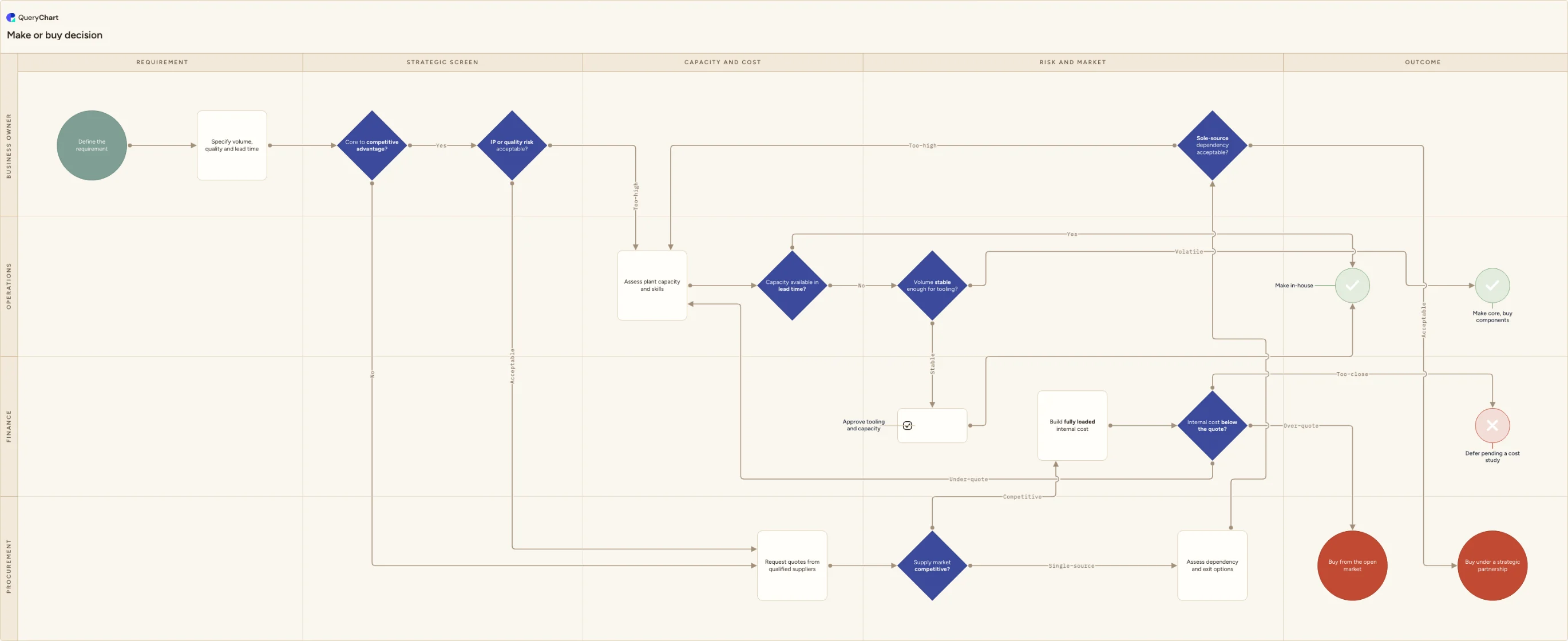
Make or buy decision flowchart (decision tree)
Make or buy decision flowchart: a decision tree on core capability, capacity, fully loaded cost, IP risk and supply market, ending at five named outcomes.
What the make or buy decision flowchart (decision tree) process is
A make or buy decision is the choice between producing a part, component or service inside the organisation and sourcing it from an external supplier. It is not a price comparison with extra steps. The same requirement can be cheaper to buy and still be wrong to buy, because the capability is what the organisation competes on, because a validated quality record cannot be transferred by contract, or because the only supplier able to deliver would then hold the design. Drawing the question as a chart forces those tests into a fixed order, so the answer stops depending on who is in the room and which number they brought.
This template is a decision tree, not a cross-functional process map. It answers which option the organisation should choose and who is entitled to decide each test, so every path ends at a named outcome instead of rejoining a common flow. If what you need is the end-to-end operational sequence - need, specification, funding, route to market, tender, award, contract, delivery and supplier review - that is the Procurement process flowchart template on this site, where make or buy appears as a single node. Here that node is the whole diagram, opened up into the seven questions it hides.
The chart runs across five assessment stages and four lanes that name who answers each question: Business owner, Operations, Finance and Procurement. Decision rights matter as much as the criteria, because most make-or-buy arguments stall when operations and finance answer different questions with different numbers and nobody has agreed which answer is binding. Five outcomes are drawn explicitly: make in-house, buy from the open market, buy under a strategic partnership, make the core and buy the components, or defer pending a cost study.
What this flowchart covers
In this template
- A strategic screen before any pricing: "Core to competitive advantage?" sends Yes to "IP or quality risk acceptable?", so a capability the organisation competes on is never outsourced on unit price alone, while No goes straight to the market.
- An internal feasibility arm owned by Operations: "Capacity available in lead time?" routes Yes to the "Make in-house" outcome and No to "Volume stable enough for tooling?", where Stable funds tooling and capacity investment through Finance and Volatile ends at the hybrid outcome, "Make core, buy components".
- An external arm owned by Procurement: request quotes from qualified suppliers, then "Supply market competitive?" splits Competitive into the cost comparison and Single source into a dependency and exit assessment.
- The pivotal cost test, "Internal cost below the quote?", carrying three answers rather than two: Under quote returns to the capacity assessment, Over quote ends at "Buy from the open market", and Too close ends at "Defer pending a cost study" so a gap inside the estimating error is not reported as a finding.
- The sole-source path: "Sole-source dependency acceptable?" ends at "Buy under a strategic partnership" when the exposure can be contracted and exited, and sends the requirement back into the internal capacity assessment when it cannot.
- Criteria written onto the decisions themselves as notes: what counts as core, what makes a supply market competitive, what a fully loaded internal cost must absorb against a landed external price, and the forecast horizon a tooling investment needs.
When to use this template
- Settling a specific make-or-buy question - a component, a subassembly, a service line, or a function such as payroll or first-line support - where the argument has stalled between operations and finance.
- Writing the rule rather than the answer, in an outsourcing or vertical integration policy that has to say which tests apply and who is authorised to conclude each one.
- Preparing a capital or tooling submission, where the paper has to show that buying was evaluated and priced properly before the investment was requested.
- Reviewing an existing outsourcing arrangement at renewal, running the same questions against current volumes, current quotes and the supply market as it is now rather than as it was at award.
- Bringing new commercial, engineering and procurement staff up to speed on where their evidence enters the decision and which question it answers.
How it works
Name the decision-makers, not the departments
The four lanes are decision rights: Business owner answers what is core and what risk is tolerable, Operations answers capacity, Finance answers cost and investment, Procurement answers the market. Replace them with the roles that actually hold those answers in your organisation, and merge lanes rather than inventing them. If nobody owns a lane, the questions in it get answered by whoever argues hardest.
Write down what counts as core
Fill in the note on "Core to competitive advantage?" with your own test. Common criteria are that the capability differentiates the product, is hard for a competitor to copy, or carries intellectual property the organisation sells. Performing something well is not the same as it being core, and that confusion is the most common reason a capability stays in-house long after it should have moved.
Agree the cost basis before any numbers arrive
Both sides of "Internal cost below the quote?" have to be built on the same basis. The internal estimate should carry direct labour and materials, absorbed overhead, tooling and capital depreciation, scrap and quality cost and the cost of capital. The quote should be taken at landed cost, including freight, duty, inventory held to cover lead time and the effort of managing the supplier. Agree the band inside which the two count as equal, so the Too close branch is defined in advance rather than argued afterwards.
Set the capacity and market tests
Capacity means free hours, qualified people and available tooling within the required lead time, without displacing work already committed to customers. Say that on the step, so "we could fit it in" is not accepted as evidence. For "Supply market competitive?", record how many qualified suppliers must be able to meet the specification, and what switching would cost once re-qualification, tooling transfer and first-article approval are priced.
Fix the tooling payback rule
"Volume stable enough for tooling?" needs a rule, not a judgement call. Use the payback period or hurdle rate your finance function already applies to capital, and require a demand forecast that holds for longer than it. Where the forecast moves more than the payback can absorb, the Volatile branch is the honest answer and the hybrid outcome keeps that capacity variable.
Record the outcome and re-test it at renewal
Capture the chosen outcome with the evidence behind each answer, the date, and who approved it. Where you operate a quality management system, outsourcing does not transfer responsibility for conformity: ISO 9001 clause 8.4 expects the organisation to determine criteria for evaluating, selecting, monitoring and re-evaluating external providers, and to retain records of those activities. Keep the approved version of the chart under version control and run the questions again at contract renewal.
Frequently asked questions
What is a make or buy decision flowchart?
It is a decision tree that takes a defined requirement through a fixed sequence of tests - is the capability core, is the internal capacity there, is the fully loaded internal cost below the quote, is the IP or quality risk tolerable to outsource, is the supply market competitive, is the volume stable enough to justify tooling - and ends each path at a named outcome. In this template the outcomes are make in-house, buy from the open market, buy under a strategic partnership, make core and buy components, or defer pending a cost study. The value is in the order: the strategic screen comes before the pricing, so a capability the organisation competes on is not traded away for a unit-cost saving.
What costs belong in a make-or-buy comparison?
Everything that changes with the decision, on both sides. The internal figure needs direct labour and materials plus absorbed overhead, tooling and capital depreciation, scrap and rework, quality and inspection cost, and the cost of capital tied up in the capacity. The external figure needs the landed price: unit price, freight, duty, packaging, inbound inspection, the inventory carried to cover a longer lead time, and the internal effort of managing the supplier. Comparing a marginal internal cost with a fully landed external price is the classic error, and it always favours making. If the two land inside your estimating error, the chart routes to "Defer pending a cost study" rather than pretending there is a winner.
Should a core capability ever be bought?
Sometimes, which is why the chart puts a second question after the core screen rather than ending there. "IP or quality risk acceptable?" asks whether the design, process know-how or regulated quality record can genuinely be protected by contract, audit and access rights. Where it can, a core requirement is still allowed into the market test, and it often ends at a strategic partnership rather than an arm's-length purchase. Where it cannot, the Too high branch sends the requirement into the internal capacity assessment and the question becomes how to make it, not whether to.
How is this different from the procurement process flowchart?
They answer different questions. This chart is a decision tree: which option do we choose, and who is entitled to decide each test. Its paths end at five distinct outcomes and it stops the moment the choice is made. The Procurement process flowchart is a cross-functional process map: what happens next and who does it, from need and specification through funding, route to market, tender, award, contract, delivery and supplier review. Make or buy is one node inside that process. Use this page to reach the decision and that one to execute it.
What is the hybrid outcome and when does it apply?
"Make core, buy components" keeps the work that carries the differentiation or the intellectual property inside the organisation and sources the rest externally: final assembly, test and calibration in-house, for example, with machined parts bought in. In this chart it is reached when the capability is core but the volume is not stable enough to justify tooling and dedicated capacity, so committing capital would lock fixed cost against an uncertain forecast. It is a deliberate outcome with its own boundary and interface to define, not a compromise between the make and buy paths.
Where this process fits
In most operations this process hands off to Supplier selection decision tree template.
Comes after
- Supplier selection decision tree template — A supplier selection decision tree: seven tests from approved supplier and tender threshold through to cost and risk, ending in five named sourcing outcomes.