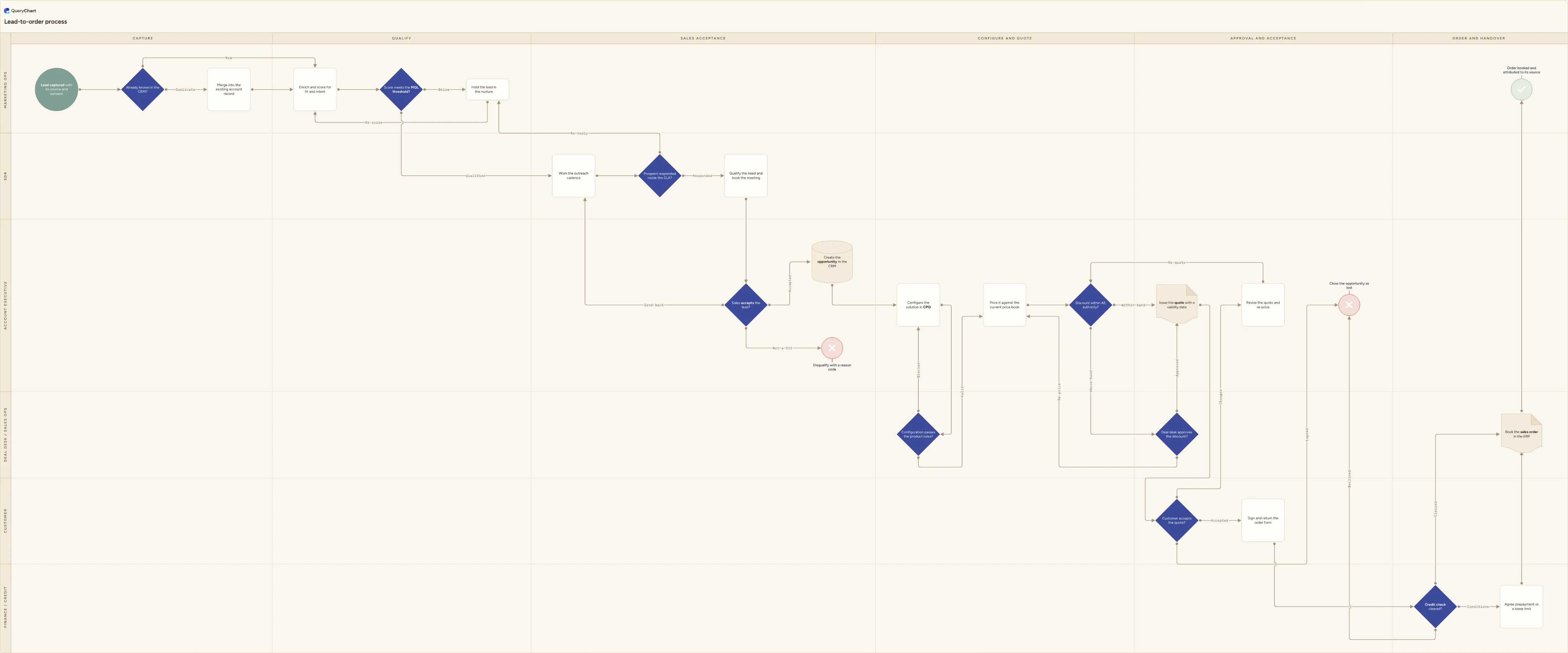
Lead-to-order process flowchart (lead capture to booked order)
Lead-to-order process flowchart template: capture and deduplication, lead scoring and the MQL gate, SDR outreach and sales acceptance, CPQ configuration, discount approval, quote acceptance, credit check and order booking.
What the lead-to-order process flowchart (lead capture to booked order) process is
Lead-to-order is a record chain rather than a selling motion. It begins the moment a lead is captured, whether that is a web form, an event scan, a referral, an inbound call or a list import, and it ends when a signed order is booked and released to fulfilment. What makes it a process and not a funnel picture is that the same commercial fact changes its name and its home four times on the way: a lead in the marketing system becomes a contact and an account in the CRM, becomes an opportunity, becomes a configured quote in the CPQ tool, and finally becomes a sales order in the ERP. The chart below follows one lead through all four. It is captured with its source, checked against what the CRM already holds, enriched and scored, routed to an SDR once it clears the marketing threshold, accepted or sent back by the account executive, configured and priced, approved where the discount exceeds the rep's own authority, issued as a quote with a validity date, signed, credit-checked and booked.
This chart stops at the booked order. Nothing downstream is drawn: picking, dispatch, proof of delivery, invoicing, cash application and collections are the order-to-cash half of the cycle and belong to their own chart, and the deeper commercial machinery around price, a full multi-tier discount ladder, the legal review of non-standard terms and revenue recognition, sits in quote-to-cash. The upstream boundary is just as deliberate. The lead lifecycle inside the CRM, with territory rules, round-robin assignment, cadence design, recycling limits and data hygiene, is a process in its own right and appears here compressed into three boxes. The selling motion is not drawn at all: no stakeholder map, no business case, no mutual action plan, because those belong to the sales pipeline and complex B2B sales charts. What lead-to-order owns, and what its neighbours do not, is the integrity of the record as it crosses those four systems. Does the source survive the conversion? Do the quote and the order agree? Can anyone still say in six months which campaign produced the revenue?
Four decisions carry the chart, and each sits in a particular lane on purpose. 'Already known in the CRM?' is answered in Marketing ops before anything else happens, because a duplicate created here reappears at every later step as a second owner, a second quote and a split attribution. 'Score meets the MQL threshold?' also stays in Marketing ops, because it is marketing's judgement and it is the only gate in the chart where a lead is allowed to wait rather than move. 'Sales accepts the lead?' sits with the Account executive rather than the SDR, because acceptance is the receiving party's word and a handoff the sender declares complete is not a handoff; its three exits keep sending a lead back for more work separate from ruling it out altogether. The two pricing gates sit in two different lanes so that the person who negotiated the price is never the person who approves it, and 'Credit check cleared?' sits in Finance / credit at the very end, where it can still stop an order everybody else has already celebrated.
What this flowchart covers
In this template
- Six swimlanes (Marketing ops, SDR, Account executive, Deal desk / sales ops, Finance / credit and Customer) across six phases: capture, qualify, sales acceptance, configure and quote, approval and acceptance, and order and handover
- Deduplication before enrichment: "Already known in the CRM?" routes a repeat enquiry to "Merge into the existing account record" rather than creating a second lead, so the account keeps one owner, one history and one attribution trail
- A scoring gate with somewhere for a lead to wait: "Score meets the MQL threshold?" sends anything under the line to "Hold the lead in the nurture stream", which re-scores rather than deletes, so a lead that warms up later re-enters at the same gate
- Two-sided acceptance instead of a handoff thrown over the wall: "Prospect responded inside the SLA?" governs the SDR's first-touch window, and "Sales accepts the lead?" has three exits, one of which is "Disqualify with a reason code"
- Quote build with two independent gates: "Configuration passes the product rules?" sends an invalid build back to the account executive, while "Discount within AE authority?" escalates the price alone to "Deal desk approves the discount?" in another lane
- An acceptance loop and a last hard gate: "Customer accepts the quote?" runs changes through "Revise the quote and re-price" back to the discount test, and "Credit check cleared?" can still stop a signed deal before "Book the sales order in the ERP"
When to use this template
- You are wiring marketing automation, a CRM, a CPQ tool and an ERP together and need the record handoffs agreed before anybody maps a field
- Marketing and sales disagree about lead quality and neither side can point at a written definition of what is handed over or what must be done with it
- Quotes take days to leave the building and nobody can say whether the time goes in configuration, in the discount approval or in waiting for the customer
- Orders are being booked that finance would not have approved on credit, or that do not match the quote the customer actually signed
- You are asked which campaigns produced revenue and the answer dies somewhere between the lead record and the sales order
How it works
Rename the lanes to your roles
Replace Marketing ops, SDR, Account executive, Deal desk / sales ops, Finance / credit and Customer with the roles you actually have. Plenty of organisations have neither an SDR nor a deal desk: if the account executive prospects and a sales manager rules on discounts, merge those lanes rather than drawing a handoff nobody performs. Keep the Customer lane whatever else you merge, because its two boxes are the only points where the process leaves your own building.
Write down what qualified and accepted mean
The chart is inert until both qualification gates carry criteria. Write the fit attributes and the intent behaviour that add up to the score, the threshold itself, and separately what an account executive is agreeing to when they accept: usually a named person, a stated need and a plausible timeframe. Agree both definitions with marketing and sales in the same room, record who signed them off, and put a review date on them.
Set the first-touch SLA and the recycling rule
Decide how quickly an SDR must make first contact after routing, how many attempts across which channels count as a worked cadence, and what happens when the window closes. Then agree the recycling rule: how long a lead sits in nurture before it can be scored again, and how many times it may come round before it is disqualified rather than re-scored. Without that second rule the nurture stream becomes the place leads go to die quietly.
Put figures on the discount authority
Give the two pricing gates numbers. Set what an account executive may concede unaided and where that authority stops, and express it as both a percentage off list and an absolute value, so a small percentage on a very large order is not treated as routine. Decide whether the test measures the headline discount or the margin left after delivery cost, and state which price book version the quote is priced against.
Define what an issued quote must carry
List what has to appear on the document: a version number, a validity date, currency and tax treatment, what is in scope and explicitly what is not, and the approvals it carries with the approver and the date. Version revisions rather than overwriting them, so the record still shows which quote the customer signed and what was authorised for it. This is the step that answers the audit question later at almost no cost now.
Agree the credit rule and the booking check
Say who runs the credit check, on what evidence, and above what order value it is required at all. Write down the conditions finance may attach instead of refusing outright, such as prepayment, a reduced limit, a shorter term or a guarantee, and who is allowed to agree them. Then add the booking check: what must match between the signed order form and the sales order before anyone releases it to fulfilment.
Walk it against three real deals
Take a deal that went straight through, one that went round the discount loop twice and one that was disqualified, and trace each of them through the chart with the people who worked them. Any step somebody describes that is not drawn, or drawn but skipped in practice, is the finding worth acting on before you publish. Correct the chart to what happens, not to what the playbook says should happen.
Frequently asked questions
What are the steps in a lead-to-order process?
A lead is captured with its source and consent, checked against the CRM, and either merged into an existing account or carried forward as new. It is enriched and scored for fit and intent, and anything below the marketing threshold waits in the nurture stream to be re-scored rather than deleted. A qualified lead goes to an SDR, who works a cadence inside a first-touch window, qualifies the need and books the meeting. The account executive then accepts it, sends it back for more work, or disqualifies it with a reason code. On acceptance an opportunity is created, the solution is configured and checked against the product rules, and the quote is priced against the current price book. A discount inside the rep's own authority goes straight to issue; anything above it goes to the deal desk. The quote is issued with a validity date, the customer signs, asks for changes or lets it lapse, finance runs the credit check, and the sales order is booked and attributed back to the campaign that produced it.
What is the difference between lead-to-order and quote-to-cash?
They are cut at different points and they answer different questions. Lead-to-order starts at the raw captured lead and ends at the booked order, so its detail sits in everything that has to happen before a deal is commercially real: deduplication, enrichment and scoring, the marketing threshold, the SDR cadence, sales acceptance, the opportunity, the configuration and the quote. Quote-to-cash starts later, at a qualified opportunity, treats the front end as already done, and carries its detail through pricing approval, non-standard terms, invoicing, revenue recognition and collected cash. Order-to-cash starts later still, at an order you have already accepted. If your problem is lead quality, the marketing-to-sales handoff, or the time it takes to get a quote out, use this page. If your problem is approval ladders, billing triggers or getting paid, use the other two.
What is the difference between an MQL, a sales accepted lead and an SQL?
They are three different people's judgements about the same record, and the demand waterfall model popularised by SiriusDecisions (now part of Forrester) exists to keep them apart. A marketing qualified lead has met marketing's own criteria, usually a combination of fit attributes and observed intent, and is considered ready for follow-up. A sales accepted lead is one that sales has looked at and agreed to work, which validates that the marketing criteria were genuinely met. A sales qualified lead is one sales has worked and confirmed as a real opportunity, on evidence such as budget, authority, need and timeframe. In this chart, the marketing threshold produces the first, 'Sales accepts the lead?' produces the second, and the opportunity created immediately afterwards is the third. Charts that collapse the three into one number are why marketing and sales report different pipeline from the same database.
Where does a lead-to-order process usually break?
In four predictable places, and none of them is the selling. Duplicates created at capture, because the deduplication check is skipped or the matching rule is too narrow, and every downstream artefact then exists twice. The marketing-to-sales handoff, where leads are routed but never accepted or rejected, so nobody can say what happened to them and both sides argue from different numbers. The discount approval, where the authority is written as a percentage off list and a concession made through payment terms, a longer ramp or free services passes untested. And the join between the quote and the order, where what was signed and what was booked drift apart because they live in two systems and only one of them is read at invoice time. Each of these is a break at a boundary, which is exactly why they only become visible when the chain is drawn end to end.
What has to be recorded when a lead is captured?
At minimum: the channel and campaign that produced it, the date and time, what the person was told at the point of entry, and the lawful basis on which you intend to contact them. The rules on electronic marketing vary by jurisdiction and by who the contact is. In the UK, the Privacy and Electronic Communications Regulations do not apply the electronic-mail marketing rule to corporate subscribers such as limited companies and LLPs, but the ICO treats sole traders and ordinary partnerships as individual subscribers, so consent or a soft opt-in is needed for them; UK GDPR still applies to a named individual's work address either way, and opt-outs must be honoured. In the United States the CAN-SPAM Act requires that an opt-out request is honoured within ten business days, that the opt-out mechanism works for at least thirty days after sending, and that the message carries a valid physical postal address. This chart is a starting point to adapt under your own procedures and legal advice, not a compliance statement.
Where this process fits
In most operations this process follows Sales pipeline process flowchart: opportunity to closed won and hands off to Order-to-cash process flowchart (order received to cash applied).
It is one step in Sales pipeline.
Step 1: CRM lead management process flowchart (dedupe to conversion)
Step 2: Sales lead qualification process flowchart: MQL to SAL
Step 3: Opportunity management process flowchart (stage exit criteria)
Step 4: Sales pipeline process flowchart: opportunity to closed won
A five-lane sales pipeline process flowchart from qualified opportunity to closed won or lost: discovery, demo, validation, pricing, discount approval, close.
Step 5: Lead-to-order process flowchart (lead capture to booked order) You are here
Lead-to-order process flowchart template: capture and deduplication, lead scoring and the MQL gate, SDR outreach and sales acceptance, CPQ configuration, discount approval, quote acceptance, credit check and order booking.