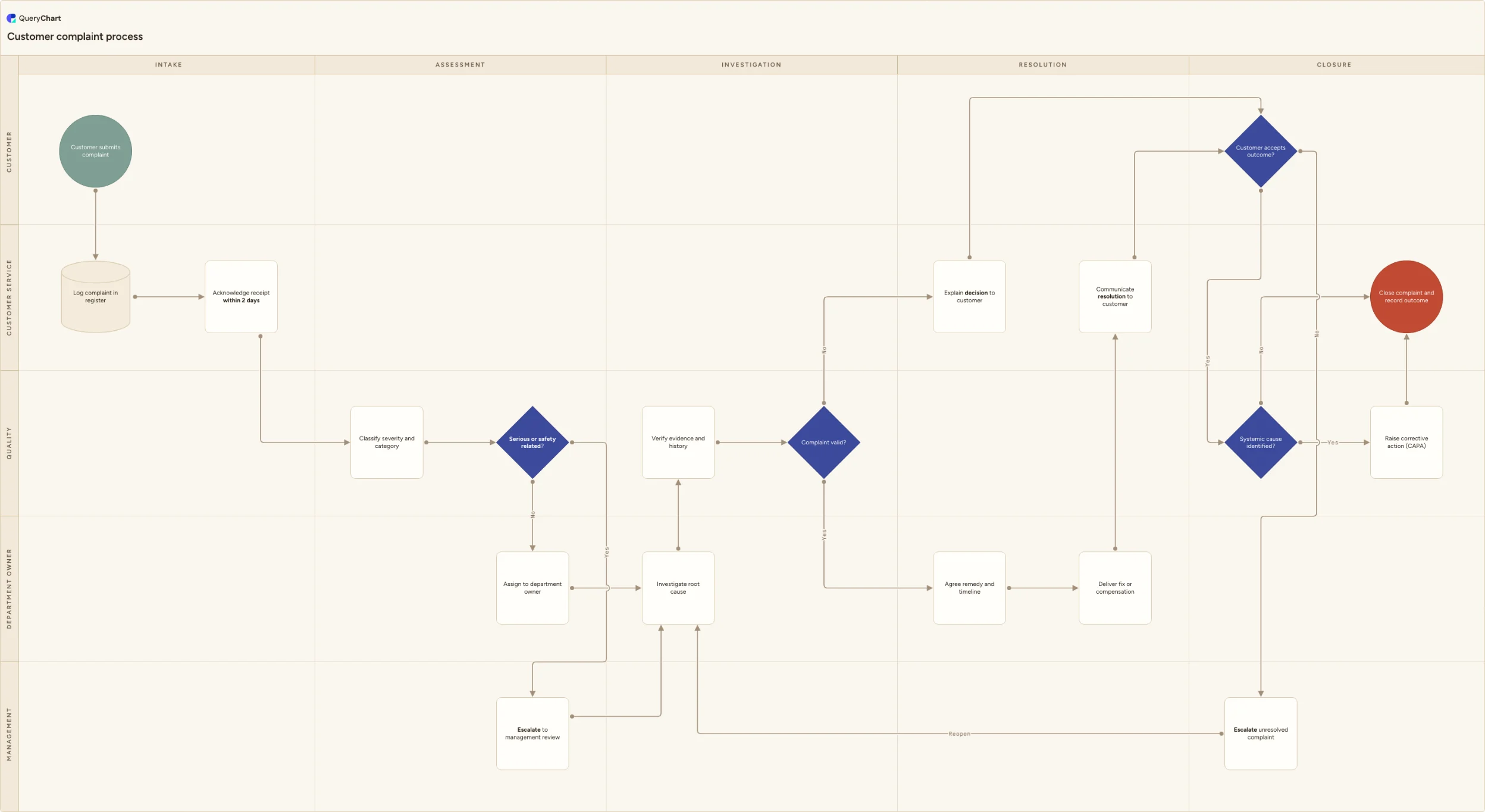
Customer complaint process flowchart
A swimlane customer complaint process flowchart covering intake and acknowledgement, severity triage, investigation, resolution, CAPA, and confirmed closure.
What the customer complaint process is
A customer complaint process is the documented path a complaint takes from the moment it arrives to the moment the customer confirms it is settled. Most organisations already perform these steps informally. Drawing them makes two things visible that prose tends to hide: who owns the complaint at each stage, and how long the customer waits before hearing anything back.
The version mapped below runs across five lanes. Customer Service logs the complaint and sends the acknowledgement. Quality classifies severity, verifies evidence, and later judges whether a systemic cause exists. The Department Owner investigates the root cause and delivers the remedy. Management is pulled in twice: at intake when a complaint is serious or safety related, and again at closure if the customer rejects the outcome. The Customer lane holds only two nodes, submission and acceptance, which is deliberate: those are the two points where the customer actually controls the flow.
Two branches carry most of the weight. The severity check decides whether a complaint gets routine handling or immediate management attention, and it is the step most often left to individual judgement. The systemic-cause check decides whether the fix stops with this one customer or becomes a corrective action that prevents the next complaint. A process that resolves complaints reliably but never asks the second question keeps solving the same problem.
What this flowchart covers
In this template
- Intake across the Customer and Customer Service lanes: the customer submits a complaint, Customer Service logs it in the complaint register, and acknowledges receipt within two business days.
- Severity triage in the Quality lane: complaints are classified by severity and category, then a decision routes them either to a department owner or straight to management review when they are serious or safety related.
- Investigation by the Department Owner, with Quality verifying evidence and complaint history before the valid-or-not decision is made.
- Two resolution paths that both reach the customer: invalid complaints get an explanation of the decision, valid ones get an agreed remedy and timeline, a delivered fix or compensation, and a resolution message.
- Closure gated on customer confirmation: if the customer does not accept the outcome, the complaint is escalated to management and reopened back into investigation rather than closed.
- A CAPA trigger before closure: when Quality identifies a systemic cause, a corrective action is raised, then the complaint record is closed with the outcome documented.
When to use this template
- You are writing or revising a complaints procedure and want the routing and handoffs agreed before anyone drafts the prose.
- Complaints arrive through several channels (email, phone, web form, account manager) and nobody can say who owns one once it has been logged.
- Acknowledgement or resolution times are slipping and you need to see which handoff the delay actually sits in.
- You are training new customer service staff and need one page showing when to escalate rather than resolve.
- The same complaints keep recurring because fixes stop at the individual customer and never reach a corrective action.
How it works
Rename the lanes to your real roles
Replace Customer Service, Quality, Department Owner and Management with the functions that exist in your organisation. Small teams usually merge Quality and Department Owner into one lane; larger or regulated businesses often split Management into a complaints manager and a site or country director. Keep the Customer lane, even if it only holds two nodes, because it shows where the customer is waiting.
Set your acknowledgement commitment
Change 'Acknowledge receipt within 2 days' to the target you actually promise, and state where the clock starts. Anchoring it to the logged receipt date rather than to when someone opens the case is what makes the commitment measurable. Contracts, service level agreements or sector rules may fix this number for you.
Write the criteria behind the severity decision
'Serious or safety related?' needs objective triggers attached to it: injury or safety risk, regulatory exposure, a value threshold, or a repeat of an earlier complaint. Vague criteria are the usual reason escalation happens inconsistently, with one person escalating a complaint that another quietly resolves.
Name the owner of the validity decision
Decide who makes the 'Complaint valid?' call and what evidence standard they apply. Record the reasoning on both branches, because invalid complaints are the ones most likely to be disputed or reopened later.
Point the CAPA trigger at a real register
Link 'Raise corrective action (CAPA)' to the system you actually use for corrective actions, and define when it fires, for example the same root cause appearing on two complaints in a quarter. Without a threshold the step is either skipped entirely or raised for everything.
Agree what counts as customer confirmation
Decide whether closure needs a reply, a signed acceptance, or a no-response window. Then measure it. Complaints marked closed without any confirmation are where satisfaction scores drop without anyone noticing.
Frequently asked questions
How quickly should a customer complaint be acknowledged?
Most customer-facing organisations commit to one to three business days for acknowledgement and roughly 10 to 30 calendar days for a substantive resolution, and some sectors have a specific rule you are obliged to follow. The exact number matters less than making it explicit and starting the clock from a logged receipt date rather than from when someone happens to pick the case up. In this chart, acknowledgement sits immediately after the register entry so both timestamps come from the same record and the commitment can actually be reported on.
What is the difference between resolving a complaint and raising a corrective action?
Resolution fixes the situation for the customer who complained: a replacement, a refund, a repeated service, or a clear explanation. A corrective action, often called CAPA, removes the underlying cause so the same complaint does not arrive from the next customer. They are separate steps with separate owners, which is why this chart puts resolution in the Department Owner lane and the CAPA trigger in the Quality lane. Raising a corrective action for every complaint swamps the system; raising one for none of them guarantees repeats.
When should a complaint be escalated to management?
This chart uses two triggers. The first is severity at intake: safety, regulatory or high-value complaints go to management before investigation starts, so senior awareness is not dependent on how the investigation turns out. The second is failed closure: if the customer does not accept the outcome, the complaint returns to management and is reopened into investigation rather than being closed unilaterally. Both triggers need written criteria, otherwise escalation becomes a matter of individual temperament.
Should complaints that turn out to be invalid still be recorded?
Yes. A complaint found to be invalid still tells you something useful: a misleading product description, an unclear instruction, or an expectation set badly during the sale. In this chart the invalid branch does not vanish. It goes to 'Explain decision to customer' and then through the same customer confirmation and closure steps as a valid complaint, so the record, the reasoning, and the response time are all captured either way.
Where this process fits
In most operations this process hands off to CAPA process flowchart (corrective and preventive action).
Comes after
- CAPA process flowchart (corrective and preventive action) — A CAPA process flowchart in five swimlanes: log and grade the issue, contain it, investigate the root cause, correct and prevent, then verify before closure.