Mastercard Organizational Structure & Org Chart
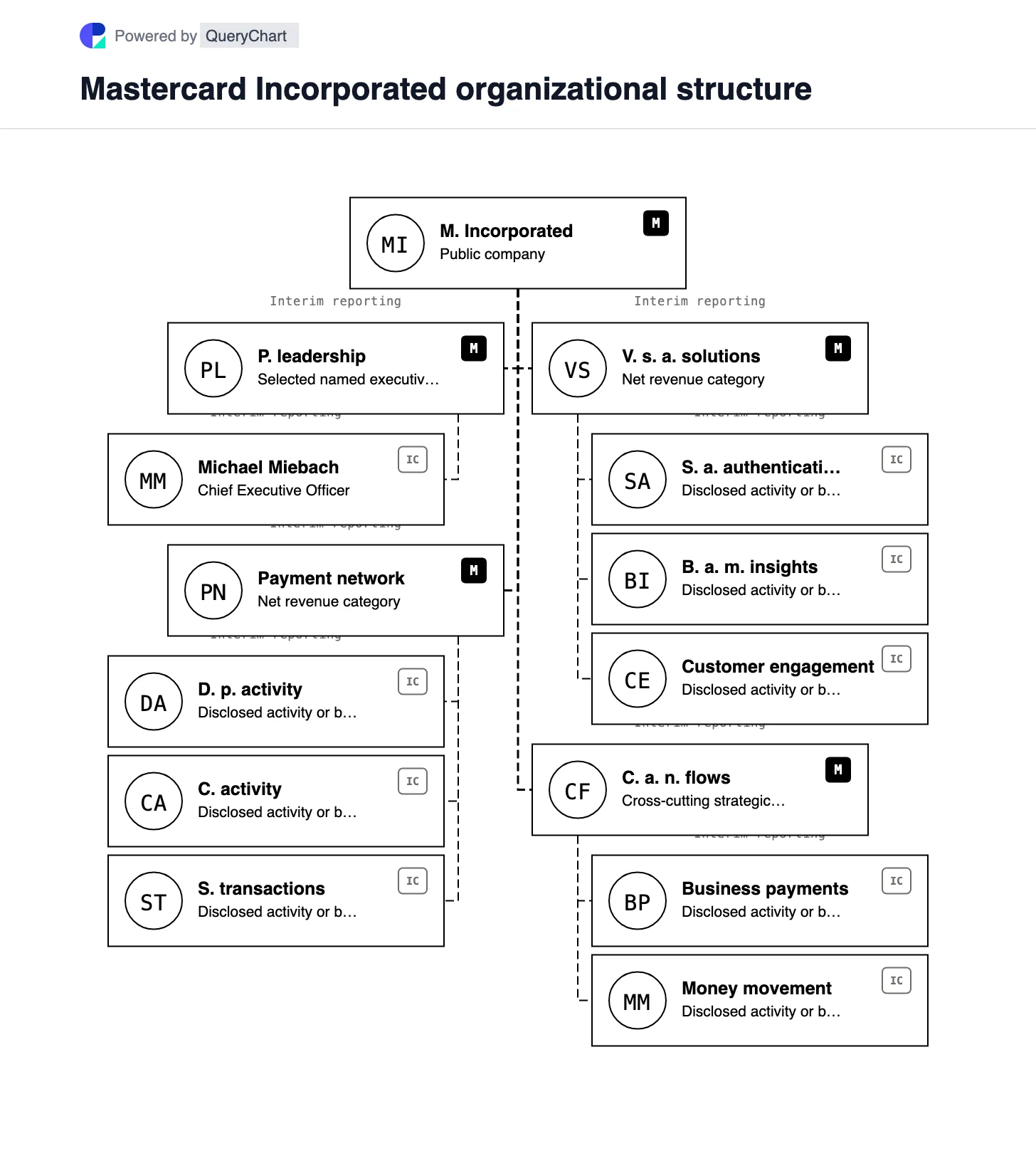
Mastercard's 2025 filing separates net revenue from its payment network and value-added services and solutions. Its strategic priorities also include commercial and new payment flows; those views overlap and should not be mistaken for distinct legal companies.
Mastercard Incorporated organizational chart
Mastercard Incorporated's reporting structure as of 2026-09. Drag to pan, scroll to zoom — or open it in QueryChart and edit it as your own.
- Industry
- Payments technology
- Headquarters
- Purchase, New York, United States
- Founded
- 1966
- Employees
- Approximately 39,800 (year-end 2025)
- CEO
- Michael Miebach
- Revenue
- $32.8B net revenue (2025)
- Ownership
- Public
- Structure as of
- 2026-09
- Structure last reviewed
- 2026-09-24
About the company
Mastercard is a payments network and technology company. Its principal operating subsidiary is Mastercard International Incorporated. The 2025 Form 10-K disaggregates net revenue into payment network and value-added services and solutions, which makes a practical top-level visual for readers.
The business also describes strategic priorities in core payments, commercial and new flows, and services. Those priorities do not align one-to-one with the two revenue categories. The diagram uses the accounting categories as the main branches and explains cross-cutting priorities in text rather than drawing a misleading extra corporate tier.
Payment network and value-added services
Payment network revenue comes from domestic and cross-border payment activity and switched transactions, net of rebates and incentives. Mastercard connects issuers, acquirers, merchants and users; those independent participants are not branches of the company.
Value-added services and solutions cover capabilities such as security, digital authentication, business and market insights, and customer engagement. These can serve network clients and extend the value of payment data and technology. The 2025 filing reports $13.3 billion of revenue in this category, compared with $19.5 billion for payment network.
Commercial and new payment flows appear in Mastercard's strategy, including business payments and money movement. They may use the network and services together. This chart therefore does not place them as an exclusive third accounting segment or imply that every product has one personal reporting parent.
Key leadership roles
Michael Miebach
Chief Executive Officer
How this structure supports the business
The two-category chart makes Mastercard's mix legible and distinguishes core network activity from adjacent services.
A separate explanation of commercial flows captures the company's growth strategy without inventing a third reportable segment or subsidiary.
Advantages and disadvantages
- Network and services can reinforce each other across customer relationships.
- The two revenue categories do not reveal a detailed personnel or product hierarchy.
- The chart separates platform economics from services revenue.
- Some products support both categories, so a tree simplifies how work is actually shared.
Interesting facts
- Mastercard's 2025 net revenue was $32.8 billion.
- Payment network revenue was $19.5 billion in 2025.
- Value-added services and solutions revenue was $13.3 billion.
- Mastercard International Incorporated is the principal operating subsidiary.
- The company employed approximately 39,800 people at year-end 2025.
Related process templates
Related organization charts
Frequently asked questions
What are Mastercard's two revenue categories?
Payment network and value-added services and solutions.
Is Mastercard a bank that issues every card?
No. Issuers and acquirers participate in the payment ecosystem; Mastercard provides network and related services.
Is commercial money movement a third reportable segment?
The chart treats it as a strategic priority that overlaps the disclosed revenue categories, not a separate reported segment.
Use this org chart template
Open the dated Mastercard business map in QueryChart and adapt the editable groups to your own organization.