Lockheed Martin Organizational Structure & Org Chart
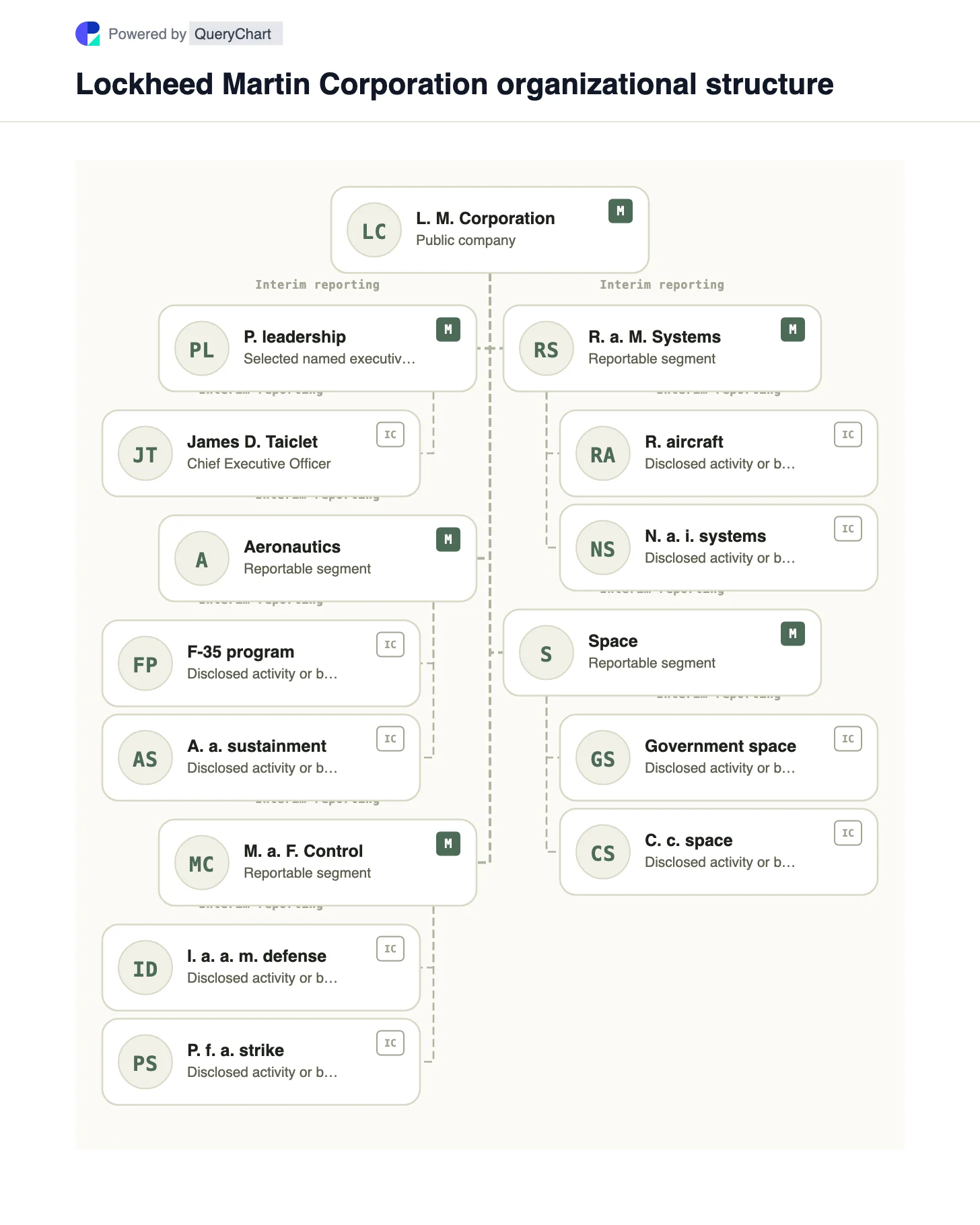
Lockheed Martin reports Aeronautics, Missiles and Fire Control, Rotary and Mission Systems, and Space as four business segments. Programs such as the F-35 sit within those businesses rather than beside them as separate parent companies.
Lockheed Martin Corporation organizational chart
Lockheed Martin Corporation's reporting structure as of 2026-09. Drag to pan, scroll to zoom — or open it in QueryChart and edit it as your own.
- Industry
- Aerospace and defense
- Headquarters
- Bethesda, Maryland, United States
- Founded
- 1995 (Lockheed and Martin Marietta merger)
- Employees
- Approximately 123,000 (company overview, 2026)
- CEO
- James D. Taiclet
- Revenue
- $75.0B net sales (2025)
- Ownership
- Public
- Structure as of
- 2026-09
- Structure last reviewed
- 2026-09-24
About the company
Lockheed Martin develops aircraft, missile systems, integrated defense technology and space systems for government and other customers. Its 2025 Form 10-K describes four reportable segments. Those disclosed business areas form the top level of this editable chart because a complete employee hierarchy or program-level ownership register is not public.
The F-35 is an especially visible program, accounting for a substantial share of Aeronautics sales. Its prominence does not make it a fifth corporate segment. The diagram treats programs and capabilities as examples within the reported businesses, with dotted branches to distinguish a portfolio view from an exact personnel chain.
Four aerospace and defense businesses
Aeronautics includes tactical aircraft, airlift, sustainment and aeronautical research. It includes the F-35 program, which the 2025 annual report describes as the company's largest. The diagram places that program beneath Aeronautics as a selected example.
Missiles and Fire Control covers air and missile defense, strike and precision fires, among other systems. Rotary and Mission Systems spans rotary-wing aircraft, naval systems, integrated warfare capabilities and training. Space covers government and commercial space work.
The four segments can combine technologies and systems for the same customer. The chart does not imply that a missile, aircraft, helicopter or satellite program is a standalone legal subsidiary. Company-level leadership is shown separately from the published segment grouping.
Key leadership roles
James D. Taiclet
Chief Executive Officer
How this structure supports the business
The four-part segment map connects very different program families to accountable reported businesses and allows readers to locate the F-35 or space work without treating programs as subsidiaries.
Shared engineering and technology can span business-area boundaries. The business chart is therefore a useful first view, while program execution and cross-domain collaboration require more than one tree.
Advantages and disadvantages
- Published segments make the broad portfolio readable and comparable with financial results.
- Program teams and shared technologies cross segment boundaries and are simplified in a tree.
- Selected program examples make the chart concrete.
- A program node does not disclose its complete contract, legal entity or management structure.
Interesting facts
- Lockheed Martin reported four business segments in its 2025 Form 10-K.
- The F-35 was its largest program in 2025.
- Aeronautics generated about $30.3 billion in 2025 sales.
- Total company sales were about $75.0 billion in 2025.
- The company overview lists approximately 123,000 employees worldwide.
Related organization charts
Frequently asked questions
What are Lockheed Martin's four segments?
Aeronautics, Missiles and Fire Control, Rotary and Mission Systems, and Space.
Is the F-35 a separate segment?
No. It is a major program within Aeronautics.
Does this chart show every Lockheed Martin program?
No. It uses selected examples to explain the four published businesses.
Use this org chart template
Open the dated Lockheed Martin business map in QueryChart and adapt the editable groups to your own organization.