EDEKA Organizational Structure & Cooperative Chart
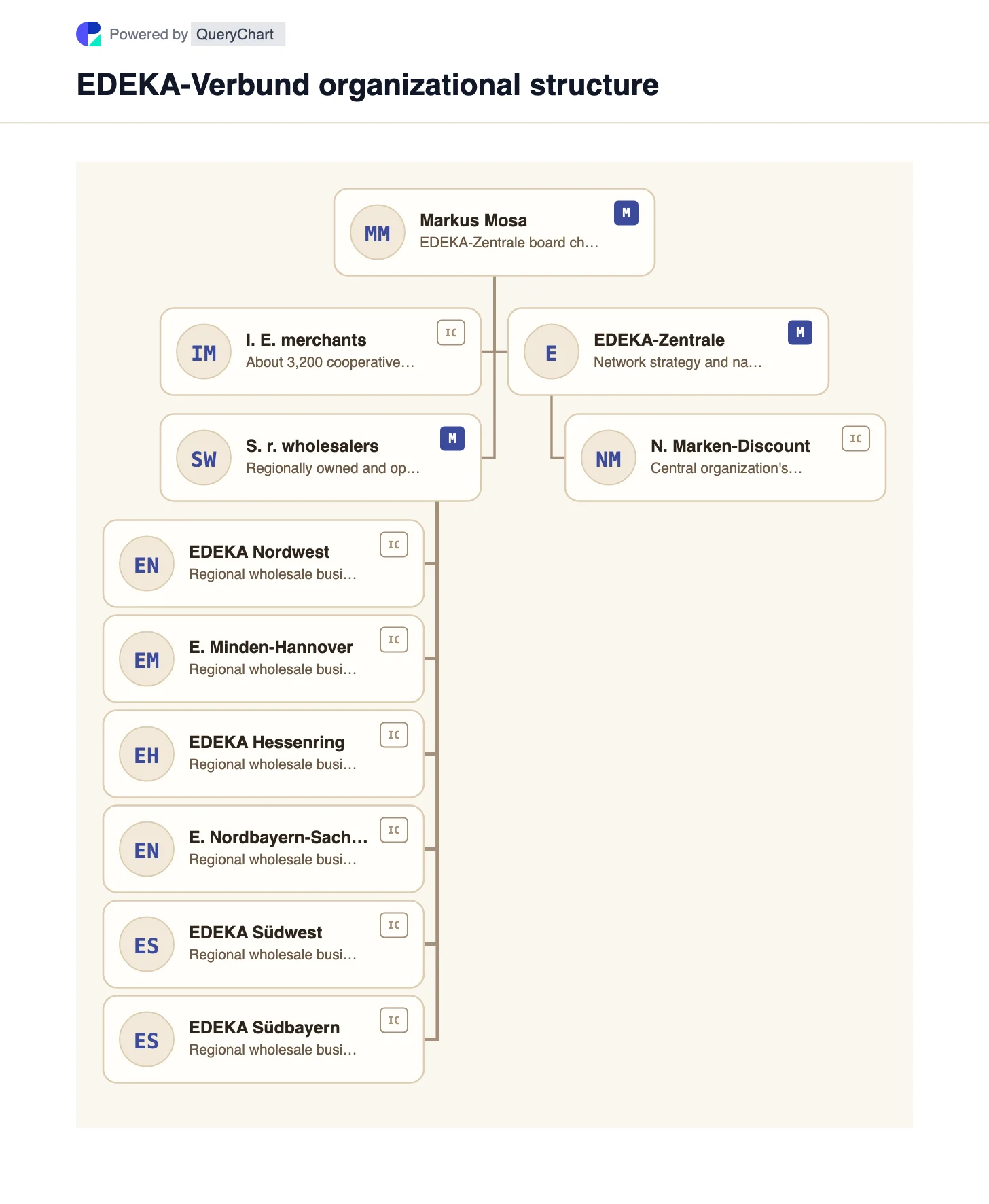
EDEKA's cooperative network works through independent merchants, six regional wholesale companies and the Hamburg central organization. Some merchants own interests upward through regional cooperatives, so a simple top-down control chart would mislead.
EDEKA-Verbund organizational chart
Duplicate and edit this EDEKA chart
EDEKA-Verbund's reporting structure as of 2026-09. Drag to pan, scroll to zoom — or open it in QueryChart and edit it as your own.
- Industry
- Food retail and wholesale
- Headquarters
- Hamburg, Germany (central organization)
- Founded
- 1907 (cooperative roots)
- Employees
- 417,500 across the network (2025)
- CEO
- Markus Mosa
- Revenue
- €77.3 billion combined network sales (FY2025)
- Ownership
- Cooperative
- Structure as of
- 2026-09
- Structure last reviewed
- 2026-09-24
About the company
The EDEKA-Verbund is a cooperative retail network rather than one conventional store company. Its own structure page names three interdependent layers: independent merchants, six regional wholesale businesses and EDEKA headquarters in Hamburg.
The branches below are a map of participating layers and regions. They must not be read as employment reporting lines from the central board to each independent merchant; EDEKA says many merchants are members of regional cooperatives that own interests in regional companies and the central organization.
Independent retailers, six regions and central services
Around 3,200 independent merchants operate local stores. They are the cooperative base of the network and often participate in governance through their regional cooperatives.
Six regional wholesale companies supply and support retailers: Nordwest, Minden-Hannover, Hessenring, Nordbayern-Sachsen-Thüringen, Südwest and Südbayern. These are distinct regional businesses, not six departments inside the Hamburg office.
The EDEKA-Zentrale coordinates network strategy and national product sourcing with the regions. It also develops private labels and shared initiatives. Netto Marken-Discount belongs to the central organization's business and provides the discount channel.
Markus Mosa chairs the three-member board of EDEKA ZENTRALE Stiftung & Co. KG. The 2025 figure of €77.3 billion is combined sales generated by network companies, not revenue of one parent corporation.
Key leadership roles
Markus Mosa
Board chair, EDEKA ZENTRALE Stiftung & Co. KG — Shown at the chart entry point; the network branches do not claim merchants or regional companies report personally to him.
How this structure supports the business
The three-layer map preserves the role of independent retailers and the upward cooperative ownership link, which a generic headquarters-to-stores tree would hide.
Listing all six regions shows why sourcing, logistics and local support happen near merchants while national strategy and Netto sit at the central level.
Advantages and disadvantages
- Represents the cooperative network and all six published regional wholesalers.
- A tree cannot draw the merchants' upward ownership stakes and the full legal relationships at the same time.
Interesting facts
- EDEKA names six regional wholesale companies between its independent merchants and central organization.
- Many merchants participate as members of regional cooperatives with ownership interests upstream.
- Netto Marken-Discount is associated with the EDEKA central organization.
- The 2025 €77.3 billion figure is total sales across companies in the network.
Related organization charts
- REWE Group Organizational Structure & Business Areas Chart
- Schwarz Group Organizational Structure & Company Chart
- Walmart Organizational Structure
- IKEA Organizational Structure
- Home Depot Organizational Structure & Org Chart
- Henkel Organizational Structure & Org Chart
- Otto Group Organizational Structure & Org Chart
- METRO AG Organizational Structure & Org Chart
Frequently asked questions
Is EDEKA a single centrally owned supermarket chain?
No. Its cooperative network includes independent merchants, six regional wholesalers and a central organization.
How many EDEKA regional wholesalers are there?
Six: Nordwest, Minden-Hannover, Hessenring, Nordbayern-Sachsen-Thüringen, Südwest and Südbayern.
Where does Netto Marken-Discount fit?
EDEKA presents Netto Marken-Discount as a subsidiary of its central organization and its discount retail channel.
Use this org chart template
Use the merchant, regional and central layers as a starting point for a cooperative network.