GEA Group Organizational Structure & Org Chart
GEA designs process machinery and integrated plants for food, beverage, pharmaceutical and farming customers. It reduced its divisional structure from five to four at the end of 2025 and began reporting the new structure in 2026.
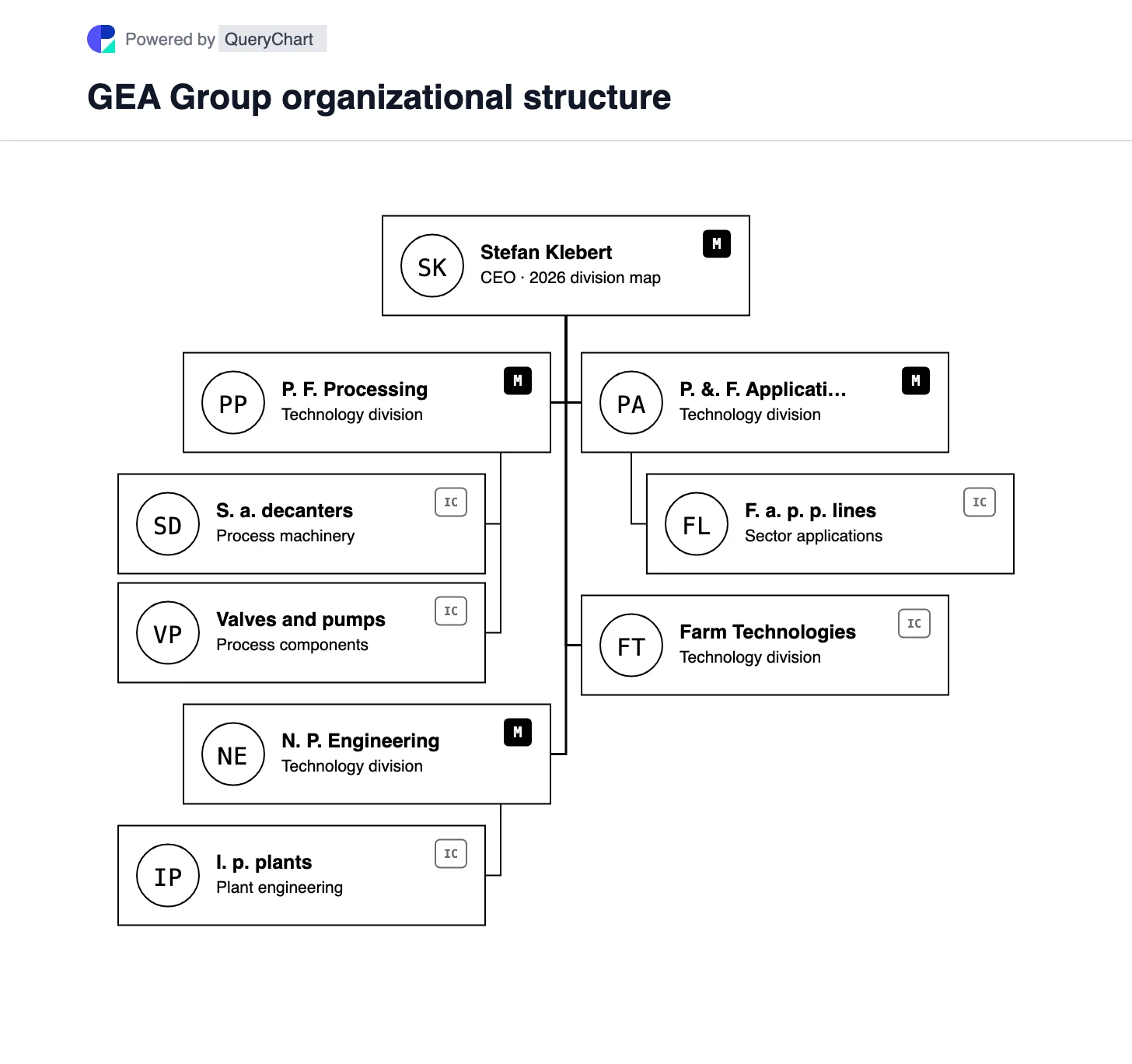
GEA Group organizational chart
Duplicate and edit this GEA Group chart
GEA Group's reporting structure as of 2026-09. Drag to pan, scroll to zoom — or open it in QueryChart and edit it as your own.
- Industry
- Process engineering and food technology
- Headquarters
- Düsseldorf, Germany
- Founded
- 1881
- Employees
- 18,628 FTE (31 Dec 2025)
- CEO
- Stefan Klebert
- Revenue
- €5.5 billion (FY2025)
- Ownership
- Public
- Structure as of
- 2026-09
- Structure last reviewed
- 2026-09-24
About the company
GEA designs process machinery and integrated plants for food, beverage, pharmaceutical and farming customers. It reduced its divisional structure from five to four at the end of 2025 and began reporting the new structure in 2026.
This is the current technology-division map, not the older five-division table in the FY2025 historical results. The chart names selected offerings within divisions rather than claiming a full legal subsidiary chain.
How GEA Group is organized
Pure Flow Processing combines components such as separators, decanters, homogenizers, valves and pumps, including activities moved from the former heating-and-refrigeration division.
Nutrition Plant Engineering combines integrated processing and factory solutions, including former liquid-and-powder activities. Pharma & Food Applications retains the equipment and processing lines formerly reported under Food & Healthcare Technologies.
Farm Technologies remains its own division, serving dairy-farm equipment and related systems. The old Heating & Refrigeration Technologies division ceased as a standalone division at the end of 2025.
Key leadership roles
Stefan Klebert
Chief executive, GEA Group — The chart depicts technology-division membership, not unreported personal reporting lines.
How this structure supports the business
The four branches show the actual redistribution of the former heating and refrigeration business across current units.
Grouping equipment and complete plants separately helps readers see how components, plant engineering and sector-specific applications differ.
Advantages and disadvantages
- The technology-division membership view follows the company's public disclosure.
- A tree cannot show every cross-company function, joint venture or legal entity.
Interesting facts
- GEA reports four divisions from Q1 2026.
- The former Heating & Refrigeration Technologies division was dissolved at year-end 2025.
- Pure Flow Processing includes the former separation-and-flow division.
- Farm Technologies retained its name in the redesign.
Related organization charts
- thyssenkrupp Organizational Structure & Org Chart
- KION Group Organizational Structure & Org Chart
- Bosch Organizational Structure & Ownership Chart
- Siemens Organizational Structure
- BASF Organizational Structure & Business Segments
- Volkswagen Group Organizational Structure & Org Chart
- Bayer Organizational Structure & Divisions
- Rheinmetall Organizational Structure & Divisions Chart
Frequently asked questions
What are GEA Group's main businesses?
Pure Flow Processing, Nutrition Plant Engineering, Pharma & Food Applications, Farm Technologies.
What relationship does this GEA Group chart show?
It shows technology-division membership from the cited company disclosures, with selected activities placed below their published groupings.
Is this a complete legal or employee reporting chart?
No. The diagram stops at the last public level verified in the cited sources.
Use this org chart template
Open the dated structure in QueryChart and adapt its divisions, brands and connections to your own organization.