BASF Organizational Structure & Business Segments
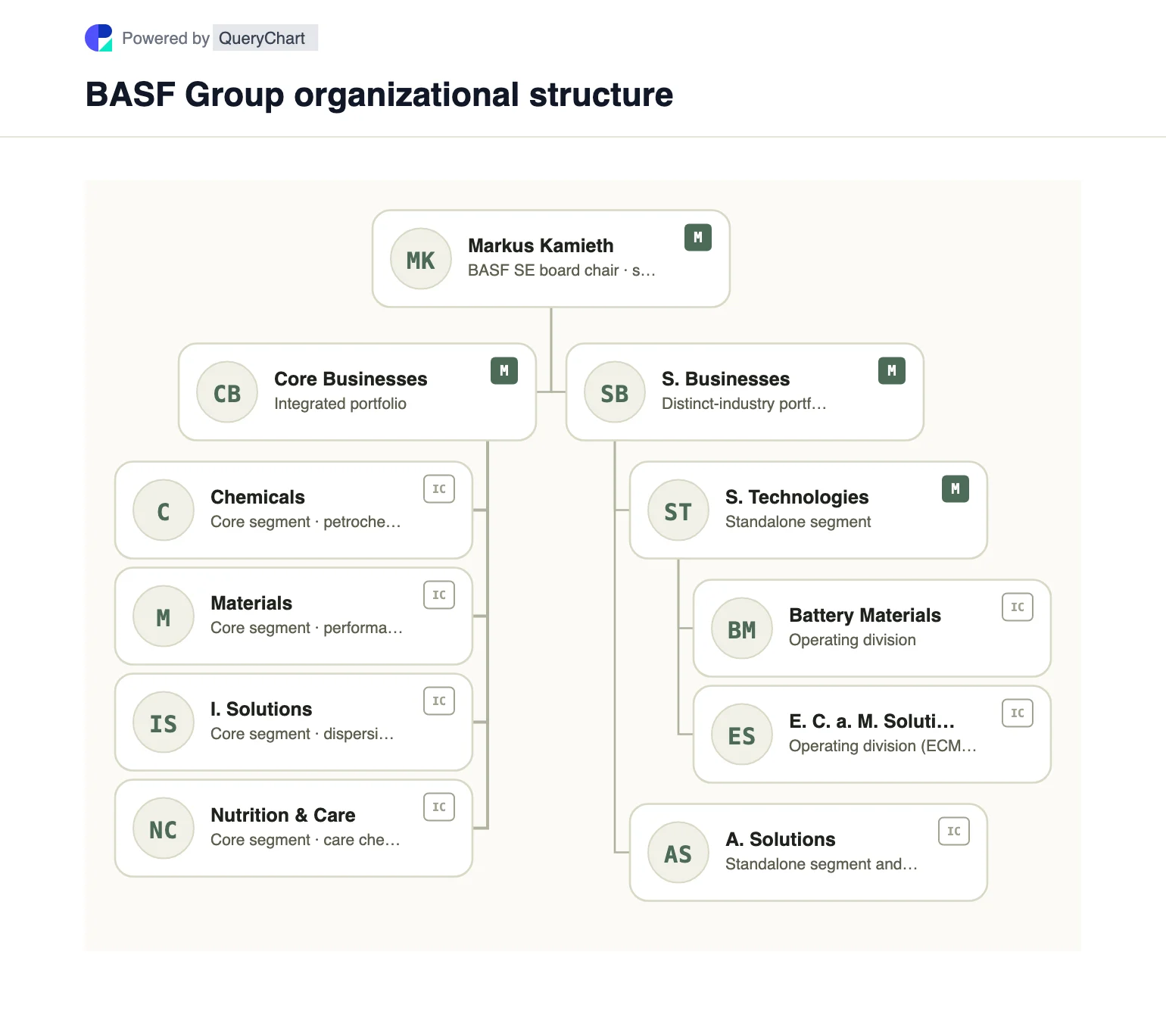
BASF groups six segments into four closely integrated core businesses and two more autonomous standalone businesses. Its 2025 report also changed the perimeter of Surface Technologies.
BASF Group organizational chart
Duplicate and edit this BASF chart
BASF Group's reporting structure as of 2026-09. Drag to pan, scroll to zoom — or open it in QueryChart and edit it as your own.
- Industry
- Chemicals and materials
- Headquarters
- Ludwigshafen, Germany
- Founded
- 1865
- Employees
- 108,251 (31 Dec 2025)
- CEO
- Markus Kamieth
- Revenue
- €59.7 billion (FY2025, continuing operations)
- Ownership
- Public
- Structure as of
- 2026-09
- Structure last reviewed
- 2026-09-24
About the company
BASF SE is a German chemicals group whose Ludwigshafen headquarters exemplifies its integrated production Verbund. The 2025 annual report identifies eleven operating divisions within six business segments.
The most revealing layer is strategic: Chemicals, Materials, Industrial Solutions and Nutrition & Care form the core; Surface Technologies and Agricultural Solutions are standalone businesses with more operational freedom. This chart follows that published classification rather than drawing all six as undifferentiated siblings.
Four core segments and two standalone businesses
The core side contains Chemicals, Materials, Industrial Solutions and Nutrition & Care. They benefit from integrated value chains and BASF's production Verbund; their divisions include petrochemicals, performance materials, dispersions and care chemicals.
Surface Technologies and Agricultural Solutions are standalone businesses. Surface Technologies contains Battery Materials and Environmental Catalyst and Metal Solutions (ECMS) in the 2025 year-end organization. Agricultural Solutions is both a segment and a division.
Coatings is intentionally absent from the Surface Technologies branch. BASF's report says its segment boundary changed in 2025 because of the coatings transactions; using an older chart would preserve a stale relationship.
The chart depicts strategic segment and division groupings, not the corporate legal shareholding list. BASF SE is the listed parent, and the annual report supplies a separate list of consolidated companies.
Key leadership roles
Markus Kamieth
Chairman of the Board of Executive Directors, BASF SE — The branches are the reported portfolio structure, not personal reporting lines.
How this structure supports the business
The core-versus-standalone split conveys a management choice that a flat six-box chart misses: the integrated chemical value chain is steered differently from businesses serving their own distinct industries.
Showing the two current Surface Technologies divisions makes the 2025 perimeter change explicit and prevents a legacy Coatings branch from misleading readers.
Advantages and disadvantages
- The strategic grouping follows BASF's 2025 organization disclosure.
- The diagram omits cross-segment shared services, legal entities and regional production networks.
Interesting facts
- BASF reports eleven operating divisions grouped in six segments.
- Four of the six segments are classified as core businesses.
- Surface Technologies and Agricultural Solutions are classified as standalone businesses.
- Coatings no longer appears in BASF's year-end 2025 Surface Technologies segment.
Related organization charts
- Bayer Organizational Structure & Divisions
- Bosch Organizational Structure & Ownership Chart
- Siemens Organizational Structure
- Schwarz Group Organizational Structure & Company Chart
- Rheinmetall Organizational Structure & Divisions Chart
- thyssenkrupp Organizational Structure & Org Chart
- KION Group Organizational Structure & Org Chart
- GEA Group Organizational Structure & Org Chart
Frequently asked questions
What are BASF's six segments?
Chemicals, Materials, Industrial Solutions, Nutrition & Care, Surface Technologies and Agricultural Solutions.
What is a BASF standalone business?
BASF classifies Surface Technologies and Agricultural Solutions as standalone businesses with more operational freedom than the integrated core segments.
Is Coatings still in Surface Technologies?
No. The 2025 annual report describes coatings transactions that removed it from the reported Surface Technologies segment at year-end.
Use this org chart template
Adapt the core and standalone grouping to a diversified industrial portfolio.