Schwarz Group Organizational Structure & Company Chart
Schwarz Group is more than Lidl and Kaufland: its published ecosystem also includes food and packaging production, recycling, digital infrastructure and shared corporate services.
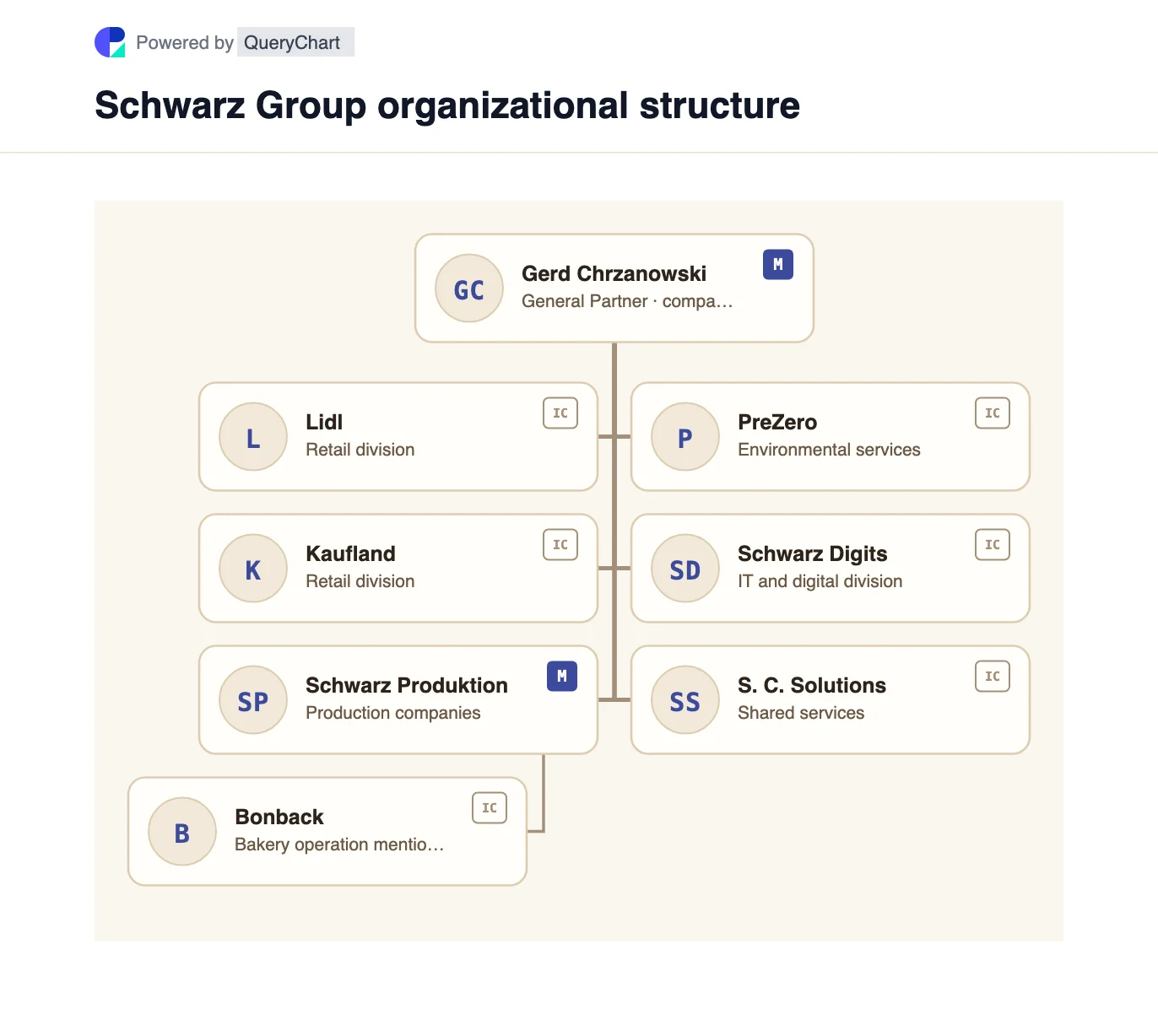
Schwarz Group organizational chart
Duplicate and edit this Schwarz Group chart
Schwarz Group's reporting structure as of 2026-09. Drag to pan, scroll to zoom — or open it in QueryChart and edit it as your own.
- Industry
- Retail, production, recycling and technology
- Headquarters
- Neckarsulm, Germany
- Founded
- 1930 (Lidl & Schwarz wholesale roots)
- Employees
- About 604,000 (FY2025, company figure)
- CEO
- Gerd Chrzanowski
- Revenue
- €185.6 billion total sales volume (FY2025)
- Ownership
- Private
- Structure as of
- 2026-09
- Structure last reviewed
- 2026-09-24
About the company
The companies of Schwarz Group operate discount and hypermarket retail businesses alongside their own production, recycling and technology activities. The group reports roughly 14,500 stores and 604,000 employees in its fiscal 2025 overview.
This map uses the six company areas the group itself presents. It is a business-area chart, not a register of every national company or a claim about the exact ownership chain of each limited partnership.
Retail, production, circular economy, digital and services
Lidl and Kaufland are the two retail pillars. They serve different store formats and appear as sibling company groups rather than one being a subsidiary of the other in this business-area view.
Schwarz Produktion supplies products and packaging, and PreZero handles waste and recycling activities. Together they make the production-to-recycling loop visible beyond the retail storefront.
Schwarz Digits provides digital infrastructure and products. Schwarz Corporate Solutions provides administrative and operational services to companies across the group. Neither is simply a function inside Lidl.
The chart stops at the six published areas because each contains many national and regional companies. Schwarz's sustainability report offers a more detailed legal-entity profile for readers who need those layers.
Key leadership roles
Gerd Chrzanowski
General Partner, Schwarz Group — The group uses a general-partner role; the branches here denote published company areas, not personal reports.
How this structure supports the business
A six-area map reveals why Schwarz can coordinate private-label production, retail distribution and recycling without treating those operations as unrelated vendors.
The separate digital and corporate-solutions branches show that technology and shared services are group-wide businesses rather than hidden teams inside a store chain.
Advantages and disadvantages
- The business-area chart makes the full Schwarz ecosystem visible at a glance.
- It compresses national operating companies and legal entities into six broad areas.
Interesting facts
- Lidl and Kaufland are sibling retail pillars in the group presentation.
- Schwarz Produktion makes food products, packaging and materials for the retail divisions.
- PreZero is the group's circular-economy and environmental-services area.
- Schwarz Digits is presented as an IT and digital division.
Related organization charts
- Walmart Organizational Structure
- Amazon Organizational Structure
- IKEA Organizational Structure
- McDonald's Organizational Structure
- Home Depot Organizational Structure & Org Chart
- EDEKA Organizational Structure & Cooperative Chart
- REWE Group Organizational Structure & Business Areas Chart
- Henkel Organizational Structure & Org Chart
Frequently asked questions
What companies make up Schwarz Group?
Its public business-area overview shows Lidl, Kaufland, Schwarz Produktion, PreZero, Schwarz Digits and Schwarz Corporate Solutions.
Is Kaufland under Lidl?
No. Schwarz Group presents Lidl and Kaufland as separate retail pillars.
What is Schwarz Digits?
It is the group's digital and IT division, providing infrastructure and products across the ecosystem.
Use this org chart template
Adapt this six-area structure to map a retail group with production, technology and recycling businesses.