Warehouse Returns Process
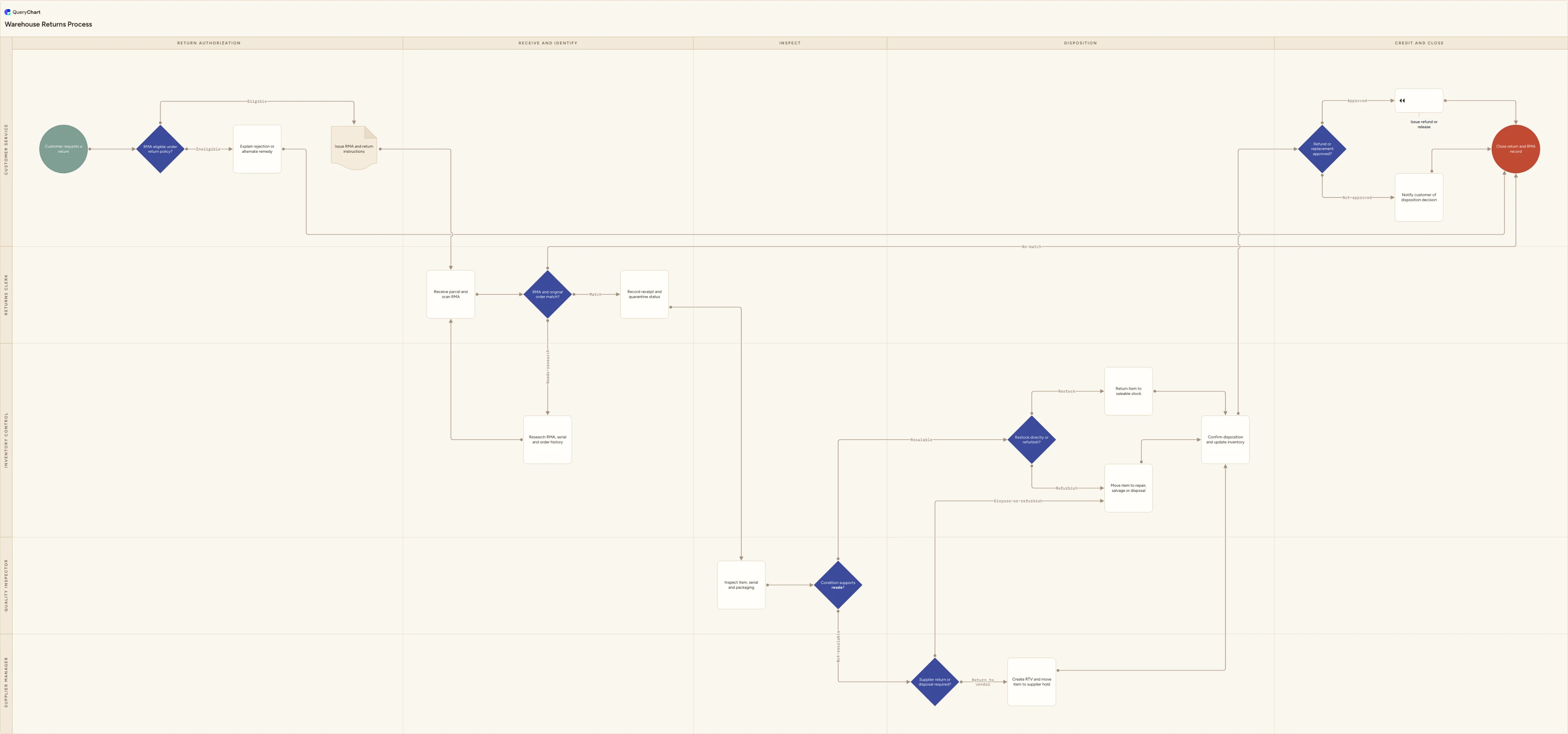
Warehouse returns process template covering RMA eligibility, receipt and identification, inspection, condition-based disposition, restock, return-to-vendor, inventory updates, refunds, and replacements.
What the warehouse returns process is
A warehouse return has two linked outcomes: the physical item must end up in the correct inventory status, and the customer must receive the remedy the return policy authorises. This template begins with customer service deciding whether the request is eligible and issuing a return merchandise authorisation with instructions. At receipt, the returns clerk scans the RMA and matches it to the original order before the item enters quarantine. An unidentified parcel does not join saleable stock by accident; it loops through research of the RMA, serial number and order history until the warehouse can establish the owner or close the case as unmatched.
Inspection determines the inventory route, not the refund by itself. Quality checks the item, serial and packaging, then decides whether the condition supports resale. Resalable goods return to saleable stock or refurbishment; non-resalable goods are routed to return-to-vendor, repair, salvage or disposal according to the supplier agreement and product policy. Only after inventory records the disposition does customer service issue a refund or replacement, or notify the customer why it was not approved. The result is an RMA record that connects the parcel, decision, stock movement and customer outcome rather than allowing each team to close only its own part.
What this flowchart covers
In this template
- Five swimlanes for Customer service, Returns clerk, Quality inspector, Inventory control and Supplier manager across authorisation, receipt, inspection, disposition and closure.
- An RMA eligibility decision and documented return instructions before the warehouse expects a parcel, plus an unmatched-return research loop at receipt.
- Receipt scanning and quarantine status before inspection, keeping unverified returns out of saleable inventory while their order and serial history are confirmed.
- Condition-based disposition between direct restock, refurbishment, repair or disposal, and an explicit return-to-vendor route with a supplier-hold status.
- A final inventory update before refund, replacement or customer notification, so the customer remedy and physical disposition are recorded against the same RMA.
When to use this template
- You are building a returns SOP or WMS returns workflow and need the customer-service, returns-desk, quality, inventory and supplier roles to agree before configuration.
- Returned goods are reaching saleable stock without an inspection, or refund decisions are being made without knowing whether the item was restocked, repaired, scrapped or sent back to a supplier.
- Your warehouse receives parcels without an RMA or clear order reference and needs a controlled research route instead of an anonymous holding area.
- You manage products with serial numbers, supplier warranty recovery or condition grades and need a visible distinction between resale, refurbishment, disposal and return-to-vendor.
How it works
Define RMA eligibility and instructions
Set the return window, product exclusions, proof-of-purchase requirements, shipping instructions and authority limits behind the eligibility decision. Ensure the RMA number, barcode and customer reference travel with the parcel so the receiving step can identify it without guesswork.
Set the unmatched-return investigation limit
Decide how long the returns team researches an unrecognised parcel, what sources they check, and who owns a parcel that still cannot be matched. Give that stock a named hold location and status rather than leaving it in a general returns cage.
Write condition grades and inspection evidence
Define what makes a return unopened, resalable, refurbishable, repairable, unsafe or supplier-returnable. Name the serial, cosmetic, functional, hygiene, tamper and packaging checks required for each product family, and state when photographs or test records are required.
Connect disposition to inventory statuses
Map every disposition to a real WMS status and physical location: quarantine, saleable, refurbishment, repair, salvage, disposal or supplier hold. Do not allow a refund to close the RMA while the unit is still in an unassigned status.
Align remedies with return policy
Specify who may approve a refund, replacement, credit or rejection and when a value, warranty or condition threshold requires escalation. Test the chart using one direct restock, one return-to-vendor and one disputed return to make sure the stock and customer outcomes stay linked.
Frequently asked questions
What are the steps in a warehouse returns process?
Customer service determines whether the return is eligible and issues an RMA. The warehouse receives the parcel, scans the RMA and confirms it against the original order; an uncertain match is researched before the item proceeds. The return is recorded in quarantine, inspected for identity, serial, packaging and condition, then given a disposition. It may return to saleable stock, move to refurbishment, repair, salvage or disposal, or be placed in supplier hold for return-to-vendor. Inventory control records that disposition before customer service issues an approved refund or replacement, or explains the decision and closes the RMA.
What is an RMA and why does the warehouse need one?
An RMA, or return merchandise authorisation, is the reference that connects a customer request to an expected parcel, original order and approved remedy. At the warehouse it gives the clerk something to scan and match before the item enters inventory. Without an RMA, a returned parcel can still be physically real but lacks the identity needed to determine who sent it, what policy applies, whether it is under warranty and whether a refund is owed. The RMA makes those links visible before the parcel is restocked or credited.
When should a returned item be restocked versus returned to the supplier?
Restock only when inspection confirms the item meets your resale condition, identity and packaging requirements and the inventory system assigns it to a saleable status. Return-to-vendor is appropriate when a supplier agreement, warranty, defect, recall, safety issue or quality rule makes the supplier responsible for the item. Products that meet neither route may require refurbishment, repair, salvage or controlled disposal. The decision should rely on written condition and supplier rules, not on whether there is immediate demand for the unit.