Reagent labeling process flowchart
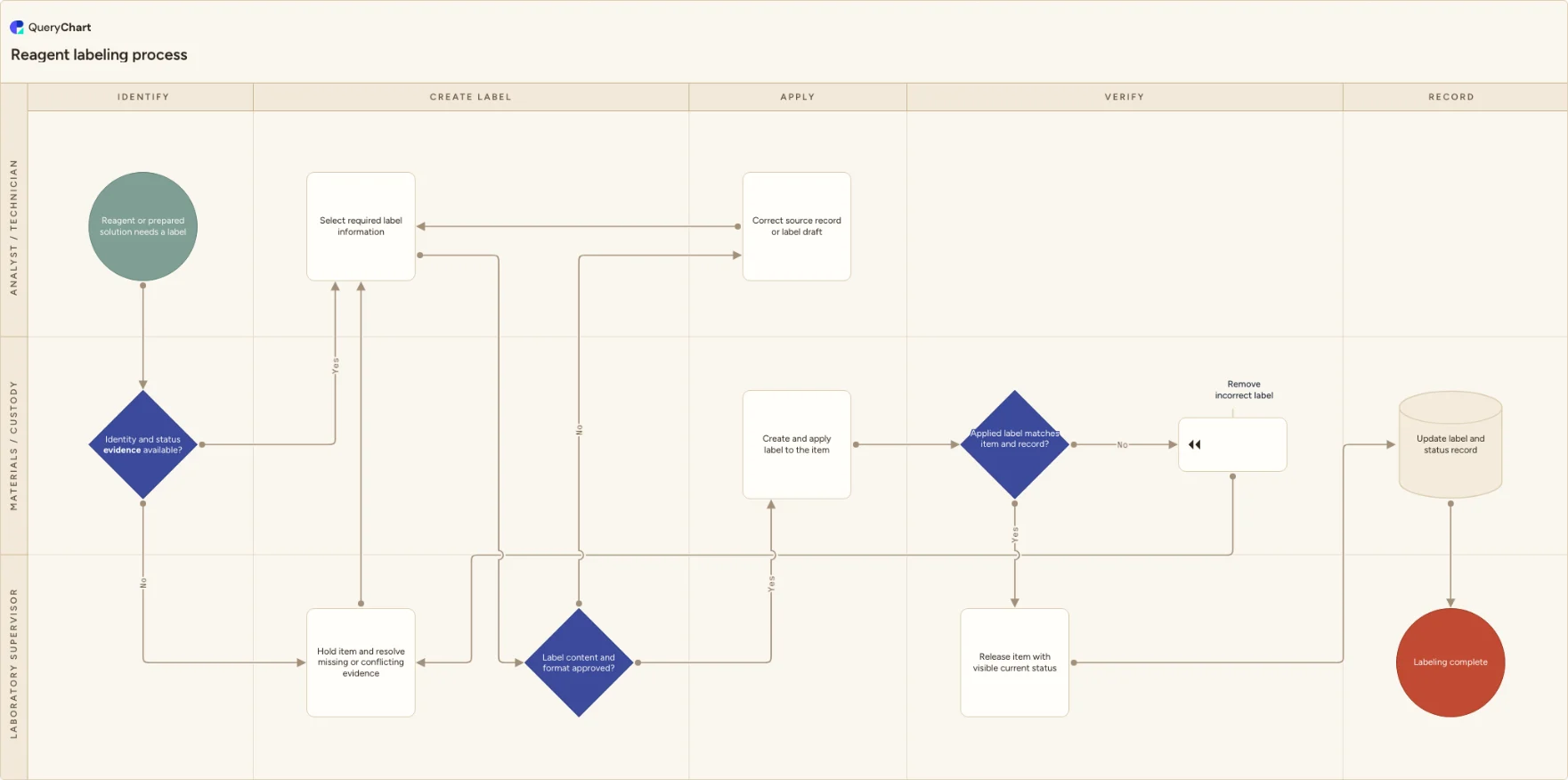
A reagent labeling workflow for confirming identity and status evidence, selecting label information, approving and applying labels, correcting mismatches and updating the status record.
What the reagent labeling process is
Labeling fails when it begins with a printer instead of the evidence behind the label. The first decision in this template asks whether the identity and status basis are available; if not, the item is held while the missing or conflicting evidence is resolved. That avoids turning an unclear container into a confidently labeled one.
The chart has two rework loops because a label can be wrong before or after it is applied. A draft that lacks approved information returns to the source record, and a label that does not match the physical item is removed before the evidence is checked again. Adapt the fields, label media and release authority to the material and environment at your site.
What this flowchart covers
In this template
- An evidence check before selecting the identity and status information that appears on a label.
- A hold route for a missing, unclear or conflicting source record.
- A label-content approval loop that sends an incomplete or unsuitable draft back for correction.
- A physical verification loop that keeps an incorrect applied label from becoming the current status signal.
When to use this template
- You label purchased reagents, prepared solutions, transfers or aliquots and need the physical container tied to a current record.
- Users have found labels that are missing information, attached to the wrong item or inconsistent with the material status.
- You are replacing an informal labeling instruction with a process that makes source evidence and correction ownership visible.
How it works
Define label fields
List the identity, status, preparation, dating, storage or other information your local process requires, and connect every field to an authoritative source.
Set correction controls
Name who approves a label draft, removes an incorrect label and resolves a conflict between the item and its record.
Test at the point of use
Check readability and placement where materials are stored and used, and add an alternate local status control where a physical label is unsuitable.
Frequently asked questions
What does a reagent labeling process flowchart cover?
It covers confirming identity and status evidence, selecting and approving label information, applying the label, comparing it with the item and record, correcting mismatches and updating final status.
Why should a reagent be held when its labeling evidence is incomplete?
A label can only communicate current status when its source information is known. Holding the item creates a route to resolve the gap instead of presenting a provisional label as confirmed.
What should happen if an applied label does not match the reagent?
Remove or control the incorrect label according to the local procedure, secure the item and return to the identity evidence. Preserve why the mismatch occurred for follow-up.
Where this process fits
In most operations this process follows Reagent receipt process flowchart and hands off to Reagent inventory process flowchart.
It is one step in Reagents and standards.
Step 2: Reagent receipt process flowchart
A reagent receipt workflow for checking a delivery against the request, inspecting condition and evidence, assigning status, handling holds and recording the receipt outcome.
Step 3: Reagent labeling process flowchart You are here
A reagent labeling workflow for confirming identity and status evidence, selecting label information, approving and applying labels, correcting mismatches and updating the status record.
Step 4: Reagent inventory process flowchart
A reagent inventory workflow for comparing stock records with physical material, investigating discrepancies, assessing availability, issuing or replenishing stock and recording follow-up.