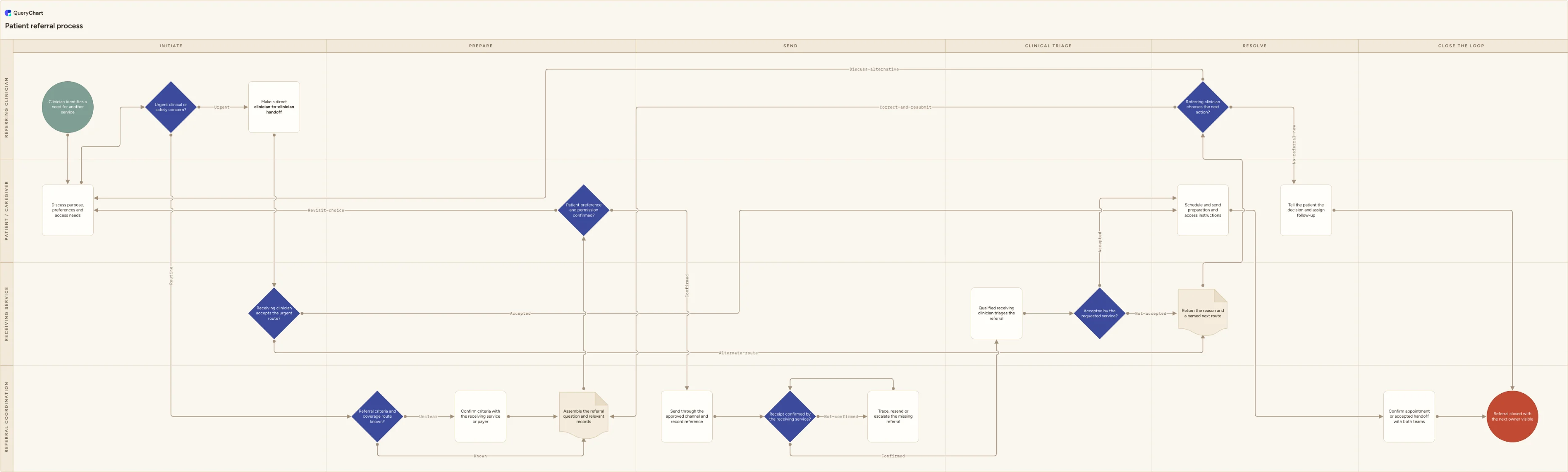
Patient referral process flowchart (send, triage and close the loop)
Patient referral flowchart template for patient choice, complete records, confirmed receipt, qualified clinical triage, rejected-referral recovery, scheduling and closed-loop ownership.
What the patient referral process flowchart (send, triage and close the loop) process is
A closed-loop referral is more than sending a document. The referring clinician discusses purpose and preferences with the patient, separates urgent concerns from the routine queue, and provides a focused question with the relevant records. Referral coordination verifies the destination and records a transmission reference. The receiving service confirms receipt and a qualified clinician performs triage. If the referral is not accepted, the reason and a named next route return to the referring clinician, who decides whether to correct and resubmit, discuss an alternative or retain follow-up. The loop closes only when the appointment or accepted handoff is visible to both sides.
Use the chart as an adaptable operational starting point, not medical advice or a substitute for clinical referral criteria. It does not diagnose a patient, rank urgency, guarantee acceptance or prove HIPAA compliance. Configure it for local clinical protocols, patient choice and permission, network and payer rules, approved exchange channels, language and accessibility support, and the responsibilities that apply while a referral is pending. Urgent clinical decisions and changes of destination belong to qualified clinicians.
What this flowchart covers
In this template
- Four swimlanes for the referring clinician, referral coordination, receiving service and patient or caregiver across initiation, preparation, transmission, triage, resolution and closure
- A direct clinician-to-clinician route for urgent concerns, with the referring clinician retaining ownership until a qualified receiver accepts or directs another safe route
- Focused referral assembly, patient preference and permission, a recorded transmission reference and a receipt-confirmation loop for referrals that go missing
- Accepted, rejected, corrected, alternative and no-referral outcomes that all return a named next owner instead of leaving the patient between services
When to use this template
- Referrals are marked sent but the referring team cannot tell whether the receiving service obtained or accepted them
- Receiving services reject incomplete referrals and the reason does not reach the clinician who can correct the question or records
- Urgent concerns are entering a routine work queue instead of receiving a direct clinician handoff
- Patients receive no update when the requested service declines, redirects or schedules the referral
How it works
Define acceptance and urgency routes
Record each receiving service's current referral criteria and contact route. Separately define how a referring clinician makes and confirms an urgent handoff without depending on the routine referral queue.
Specify the minimum referral packet
List the focused question, relevant history, results, records and communication needs required for each destination. Send what the receiver needs rather than an indiscriminate record dump.
Name every pending owner
Assign responsibility while awaiting receipt, during receiving-service triage, after a rejection and while scheduling. State when an unanswered referral escalates and when responsibility returns to the referring clinician.
Test closure in both directions
Trace one accepted referral, one missing transmission, one rejection and one urgent handoff. Confirm that the patient and both teams can identify the outcome, appointment or follow-up owner in every case.
Frequently asked questions
What are the steps in a patient referral process?
Identify the need, discuss purpose and choice with the patient, route urgent concerns directly between clinicians, confirm routine referral criteria, assemble and send the focused referral, confirm receipt, obtain qualified clinical triage, recover any rejection or missing transmission, schedule accepted care and confirm the next owner with both teams.
What makes a referral closed loop?
A referral is closed loop when the sender knows whether it was received and accepted, the patient knows the outcome, and responsibility for the next action is explicit. A sent fax or portal status alone does not prove that a qualified receiver accepted clinical responsibility.
Who should triage a clinical referral?
An appropriately qualified clinician working under the receiving service's criteria should triage clinical content. Coordinators can verify completeness, coverage routes, receipt and scheduling, but should not diagnose or substitute their judgment for the referring or receiving clinician.
Does this referral template establish HIPAA compliance?
No. The template does not establish HIPAA compliance or permission to disclose information. Your privacy and legal owners must define permitted uses, minimum necessary information where applicable, patient permissions, approved channels, safeguards and recordkeeping for your setting.
Where this process fits
In most operations this process hands off to Patient intake process flowchart (request to clinical handoff).
It is one step in Patient journey.
Step 1: Patient referral process flowchart (send, triage and close the loop) You are here
Patient referral flowchart template for patient choice, complete records, confirmed receipt, qualified clinical triage, rejected-referral recovery, scheduling and closed-loop ownership.
Step 2: Patient intake process flowchart (request to clinical handoff)
Patient intake flowchart template for appointment requests, identity and information checks, accessibility needs, safe clinician escalation, check-in and a named handoff to the receiving care team.
Step 3: Prior authorization process flowchart (request, denial and appeal)
Step 5: Medication reconciliation process flowchart (compare and hand off)
Step 6: Patient discharge planning flowchart (safe transition and follow-up)