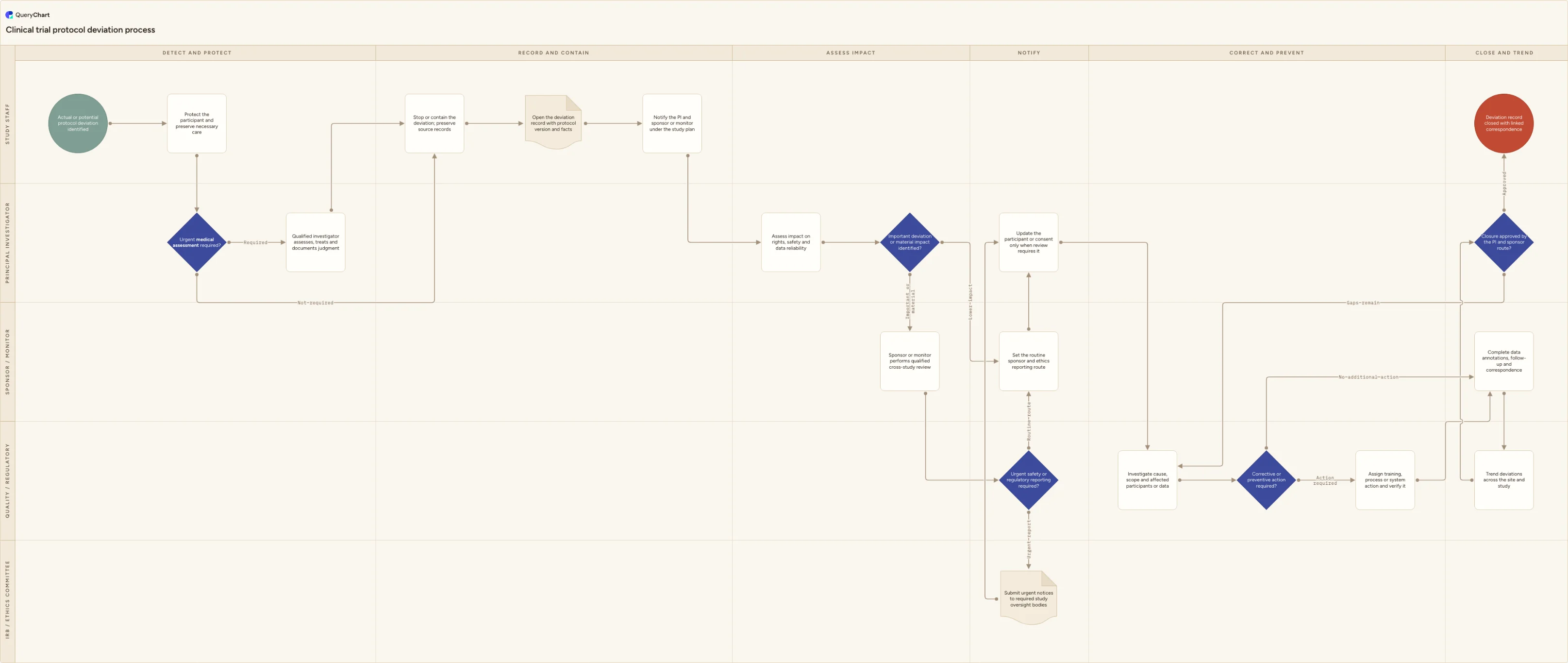
Clinical trial protocol deviation process flowchart
Clinical trial protocol deviation workflow for participant protection, factual documentation, qualified impact review, oversight notices, corrective action and trending.
What the clinical trial protocol deviation process is
A protocol deviation starts with protecting the participant and preserving necessary care, not with choosing a category. Study staff stop or contain an ongoing departure, preserve source records and open a factual record with the protocol version, dates and known scope. The Principal investigator makes any urgent medical judgment and assesses impact on participant rights, safety and data reliability. Important or materially impactful cases receive sponsor or monitor review; Quality or Regulatory applies the controlled reporting matrix, and the site submits urgent or routine notices to the oversight bodies that actually apply to the study.
This workflow handles departures from an approved clinical trial protocol after they are identified. It is not a protocol-authoring process, adverse-event causality assessment, medical-management algorithm, monitoring plan, data-query workflow or universal definition of an important deviation. A missed visit, dosing variance or consent error can have very different significance depending on the protocol and participant. Decisions such as "Urgent medical assessment required?" and "Important deviation or material impact identified?" therefore stay with qualified investigators, sponsor and quality reviewers rather than a software score. This is a customizable operational starting point, not medical or legal advice, and it does not guarantee GCP, regulator, ethics-committee, sponsor or accreditation compliance.
The chart separates event handling from improvement without losing the connection between them. The deviation record retains immediate action and correspondence; the investigation identifies cause, scope and affected participants or data; and any training, process or system action receives an owner and verification. Data annotations and follow-up are completed before cross-site or cross-study trending. Closure loops back when the PI or sponsor route finds gaps, preventing a file from closing merely because the initial notification was sent.
What this flowchart covers
In this template
- Five swimlanes across participant protection, factual intake, qualified impact assessment, oversight notification, corrective action and study-level trending
- The decision "Urgent medical assessment required?" owned by the Principal investigator or appropriately delegated clinician before administrative classification
- A deviation record tied to the correct protocol version, source records, immediate containment, PI awareness and sponsor or monitor notification
- The qualified gate "Important deviation or material impact identified?" followed by cross-study review rather than automatic classification from the event type
- Separate urgent and routine reporting routes for sponsor, IRB or ethics committee and regulators, driven by a controlled study-specific matrix
- Cause and scope review, verified corrective action, data annotations, correspondence, trending and PI or sponsor closure approval
When to use this template
- A research site or sponsor is defining one route for actual and potential departures from an approved clinical trial protocol
- Sites use inconsistent labels or deadlines and need classification and notice decisions visibly owned by qualified reviewers
- Deviation records capture what happened but omit participant follow-up, affected data, sponsor correspondence or corrective-action verification
- Monitors repeatedly reopen closed deviations because source records and committee acknowledgements are not linked to the file
- You are configuring a clinical trial management or quality system and need the site, sponsor, ethics and quality handoffs agreed before automation
How it works
Rename lanes to the study's accountability model
Replace generic study staff, PI, sponsor, monitor, ethics and quality labels with the roles named in the protocol, delegation log and agreements. Show which activities remain with the investigator even when a coordinator or vendor performs the task.
Attach participant-protection and medical routes
Link the first decision to study-specific medical contacts, emergency unblinding where applicable and adverse-event procedures. Keep medical assessment and treatment decisions in qualified clinical hands rather than encoding them in deviation categories.
Define deviation significance with controlled criteria
Use the protocol, sponsor procedure and governing definitions to describe important, major or other locally used categories. Record the rationale and reviewer; avoid a numeric score that automatically decides impact on rights, safety or data reliability.
Build the study reporting matrix
For each country, reviewing ethics body, sponsor and regulator, identify report types, owners, clocks, forms and acknowledgement evidence. Have qualified regulatory and legal owners verify it for the specific study instead of copying a deadline from this generic map.
Specify data and consent follow-up
Define how affected visits, forms, samples and analysis populations are annotated, who decides whether consent or participant communication must change, and how those decisions are linked without overwriting the original source record.
Test recurring and high-impact examples
Run one isolated timing deviation, one consent-related case and one event with possible safety or data impact through the workflow. Confirm qualified review, all required acknowledgements, corrective-action verification and study-level trending before release.
Frequently asked questions
What are the steps in a clinical trial protocol deviation process?
Protect the participant and obtain qualified medical assessment if needed. Stop or contain the departure, preserve source records and open a deviation record tied to the protocol version. Notify the PI and sponsor or monitor, then assess effects on rights, safety and data reliability. Qualified sponsor and quality reviewers classify the case and select urgent or routine oversight notices. Investigate cause and scope, complete any training, process or system action, annotate affected data, retain correspondence, trend the event across the site and study, and close only after the required PI and sponsor review finds no gaps.
What makes a protocol deviation important?
Significance depends on the protocol and the effect on participant rights, safety, well-being and the reliability of trial results. ICH E6(R3) uses risk-proportionate quality management and addresses important protocol deviations, but it does not turn every missed window into the same outcome. The PI, sponsor and qualified quality or regulatory reviewers should apply the current protocol, sponsor definitions and governing requirements to the facts. This chart deliberately does not classify an event automatically.
Must every protocol deviation be reported immediately to an IRB or regulator?
No universal immediate-report rule covers every deviation. US IRBs must have procedures for prompt reporting of unanticipated problems involving risks and serious or continuing noncompliance under 21 CFR 56.108, while protocols, sponsors, institutions, countries and ethics committees may define additional routes and timelines. Routine deviations may be summarized periodically where allowed. Qualified study and regulatory owners must determine the applicable recipient and clock; this template is not legal advice or a reporting determination.
Is a protocol deviation the same as an adverse event?
No. A deviation is a departure from the approved protocol; an adverse event is an unfavorable medical occurrence. One event can be both, such as a dosing departure followed by harm, but each route asks different questions and may have different recipients and timelines. Link the records where both apply, while keeping medical assessment and adverse-event causality in the appropriate qualified process.
Does this template make a trial GCP or regulator compliant?
No. It is a customizable operational flowchart, not medical or legal advice, a protocol, a monitoring plan, an ethics submission or proof of GCP compliance. Requirements differ by study, sponsor, reviewing ethics body and jurisdiction, and accreditation may add separate expectations. The PI, sponsor and qualified quality, regulatory and legal owners should review the adaptation and verify it against real deviation files before use.