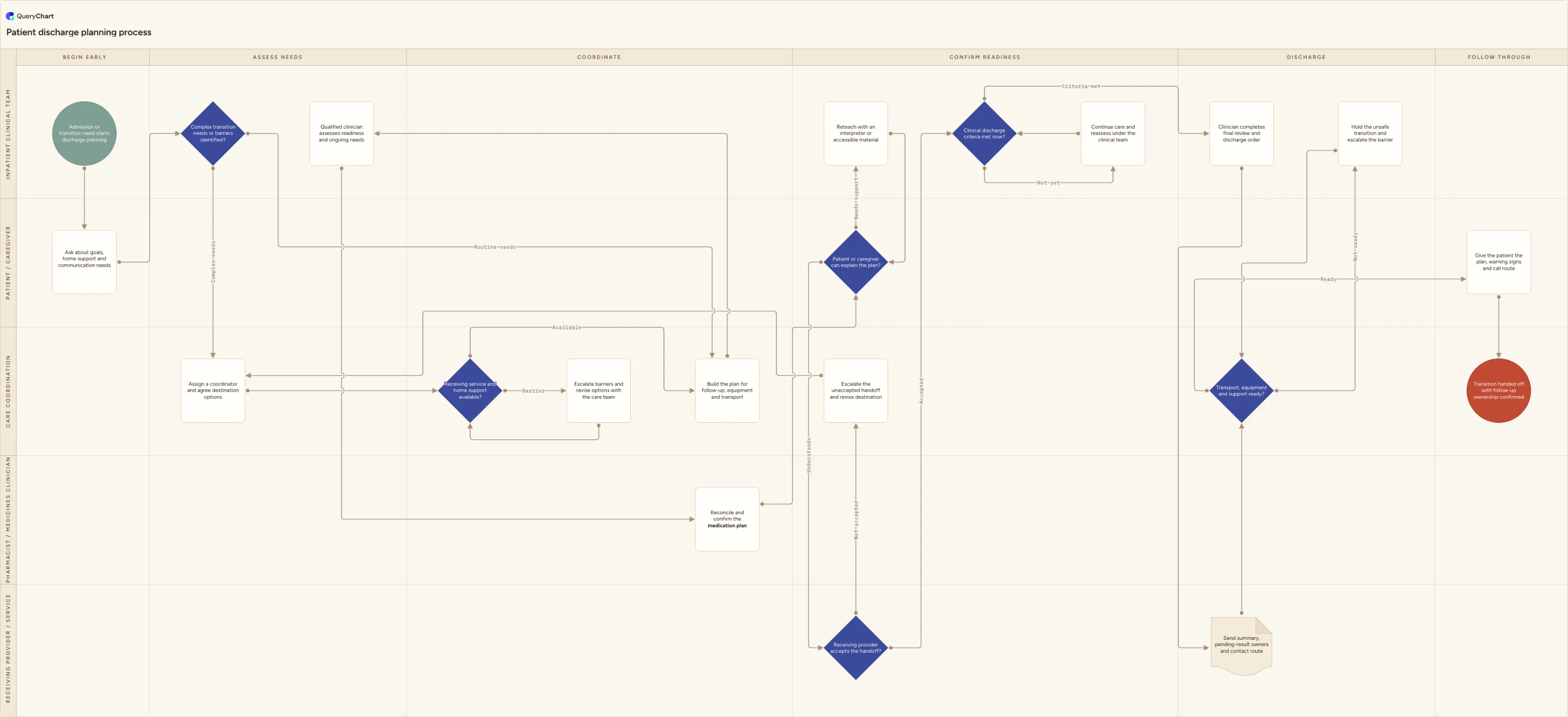
Patient discharge planning flowchart (safe transition and follow-up)
Patient discharge planning flowchart template for early needs assessment, care coordination, medication review, teach-back, accepted handoffs, readiness checks and follow-up ownership.
What the patient discharge planning flowchart (safe transition and follow-up) process is
Discharge planning begins at admission or as soon as a transition need is known. The team asks about the patient's goals, home support and communication needs, identifies barriers, agrees realistic destination options and coordinates follow-up, equipment and transport. Qualified clinicians assess readiness and reconcile the medication plan. The patient or caregiver uses teach-back, and the receiving provider explicitly accepts the handoff. If clinical criteria, transport, equipment, support or receiving ownership are not ready, the transition is held and escalated rather than pushed through to meet a date.
This chart is an adaptable operations template, not a clinical discharge protocol or medical advice. It does not decide when a patient is medically ready, prescribe medicines, guarantee service availability or prove HIPAA compliance. Adapt the steps to the population, setting, legal duties, payer arrangements, local escalation rules and approved information channels. Qualified clinicians must own readiness, warning signs and medication decisions; care coordinators should make barriers and handoff ownership visible.
What this flowchart covers
In this template
- Five swimlanes linking the patient or caregiver, inpatient clinical team, care coordination, receiving provider or service, and pharmacist or medicines clinician
- Early identification of complex needs, destination and home-support barriers, with a loop that escalates unresolved barriers instead of treating the planned date as approval
- Medication reconciliation, accessible teach-back, receiving-provider acceptance and clinical readiness as separate checks with clearly qualified owners
- A final equipment, transport and support gate followed by a patient-facing plan, warning signs, contact route and confirmed follow-up ownership
When to use this template
- Discharge work starts late and equipment, transport, home support or follow-up becomes visible only on the planned day
- Receiving providers get summaries without agreeing who will review pending results or answer post-transition questions
- Patients or caregivers leave with documents but cannot explain the plan, medicine changes or whom to call
- Teams need a common map for routine and complex transitions without turning operational staff into clinical decision-makers
How it works
Set the early planning trigger
Define when screening begins, which needs assign a coordinator and how the expected transition date is updated. Include patient goals, caregiver availability, communication needs, equipment, transport and destination constraints.
Name the qualified decision owners
Assign clinical readiness, medication reconciliation, warning signs and any change in care level to appropriately qualified clinicians. Keep logistical coordination and clinical authorization separate on the map.
Define an accepted handoff
State what the receiving provider must receive, how acceptance is confirmed, who owns pending results and how both teams contact each other. A transmitted summary without named responsibility is not closure.
Rehearse barriers and holds
Run the map with unavailable home support, delayed equipment, a failed teach-back and a receiving service that declines. Confirm who can hold the transition, who escalates and what evidence allows the route to resume.
Frequently asked questions
What are the steps in patient discharge planning?
Start early, ask about goals and support, identify complex needs and barriers, coordinate destination, follow-up, equipment and transport, assess clinical readiness, reconcile medicines, use teach-back, obtain receiving-provider acceptance, issue the discharge order, send the summary and pending-result ownership, confirm logistics and give the patient a clear plan and contact route.
Who decides whether a patient is ready for discharge?
An appropriately qualified clinician decides clinical readiness under the organization's policies and the patient's circumstances. Coordinators, schedulers and utilization staff can surface barriers and arrange services, but a target date or completed checklist should not replace clinical judgment.
What is a safe discharge handoff?
A safe operational handoff identifies the receiving person or service, confirms acceptance, sends the relevant summary and medication plan through an approved channel, assigns pending results and gives the patient accessible instructions, warning signs and a route for questions. The clinical content must come from qualified staff.
Does this discharge planning template prove HIPAA compliance?
No. It is a process-design aid, not proof of HIPAA compliance or clinical quality. Your organization must apply its own privacy, security, consent, documentation, safeguarding and clinical governance requirements and have the adapted process reviewed by the responsible specialists.
Where this process fits
In most operations this process follows Medication reconciliation process flowchart (compare and hand off).
It is one step in Patient journey.
Step 1: Patient referral process flowchart (send, triage and close the loop)
Step 2: Patient intake process flowchart (request to clinical handoff)
Step 3: Prior authorization process flowchart (request, denial and appeal)
Step 5: Medication reconciliation process flowchart (compare and hand off)
Medication reconciliation flowchart template for a best possible medication history, source checks, discrepancy review, qualified clinical decisions, patient teach-back and closed-loop handoff.
Step 6: Patient discharge planning flowchart (safe transition and follow-up) You are here
Patient discharge planning flowchart template for early needs assessment, care coordination, medication review, teach-back, accepted handoffs, readiness checks and follow-up ownership.