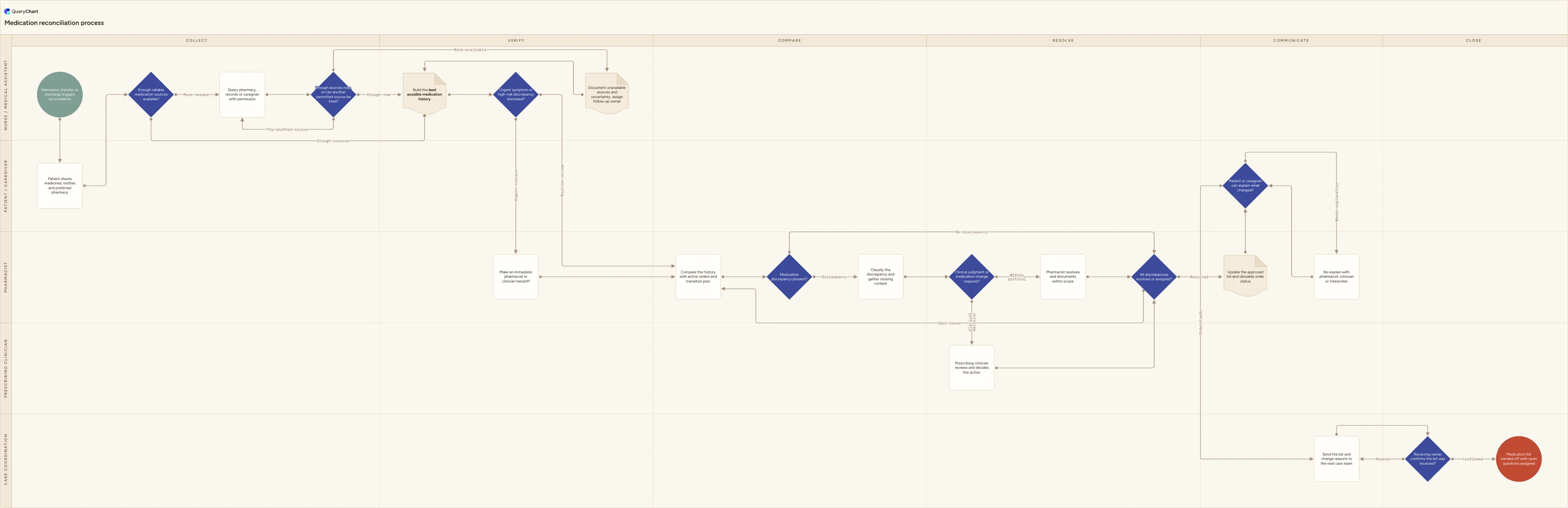
Medication reconciliation process flowchart (compare and hand off)
Medication reconciliation flowchart template for a best possible medication history, source checks, discrepancy review, qualified clinical decisions, patient teach-back and closed-loop handoff.
What the medication reconciliation process flowchart (compare and hand off) process is
Medication reconciliation starts at admission, transfer or discharge by asking how the patient actually uses prescribed, over-the-counter and complementary products. Staff compare multiple permitted sources rather than treating one list as automatically correct. If enough sources are not available, they try another permitted source where possible; when no more can be obtained, they document unavailable sources and uncertainty and assign follow-up before building the best possible medication history. A pharmacist compares that history with active orders and the transition plan. Urgent symptoms or high-risk discrepancies receive an immediate qualified handoff; clinical judgments and treatment changes go to the prescribing clinician, while pharmacists resolve matters within their authorized scope. The approved list is explained with teach-back and sent to the next care owner.
This is an adaptable operational starting point, not medication advice, a prescribing protocol or a substitute for professional judgment. It does not tell anyone to start, stop or change a medicine, guarantee medication safety or prove HIPAA compliance. Adapt it to your setting, professional scopes, formulary, transition points, source access, privacy rules, approved channels and escalation policies. Pharmacists and appropriately qualified prescribing clinicians must own clinical review and medication decisions.
What this flowchart covers
In this template
- Five swimlanes for patient or caregiver, nurse or medical assistant, pharmacist, prescribing clinician and care coordination across collection, verification, comparison, resolution and handoff
- A best possible medication history built from the patient and available permitted sources, with unavailable sources, uncertainty and follow-up ownership documented rather than guessed
- Separate urgent-concern, discrepancy, clinical-judgment and closure decisions that prevent unqualified staff from independently changing treatment
- An approved medication list, patient teach-back and confirmation that the next care owner received both the list and the reasons for changes
When to use this template
- Medication lists disagree across admission records, referral documents, pharmacy histories and what the patient reports taking
- Transitions generate omissions, duplications or unexplained changes whose owner is unclear
- Patients receive a new list but cannot identify what changed, what remains uncertain or whom to contact
- You need to distinguish data collection, pharmacist review, prescribing decisions and care-coordination handoff in one workflow
How it works
Define accepted information sources
List the patient interview, containers, caregiver, pharmacy, prior records and other sources your team may use, including required permission, how conflicting or unavailable information is marked and who follows up.
Set professional decision boundaries
Write which discrepancies a pharmacist may resolve under scope or protocol and which require the prescribing clinician. Collection staff should preserve the patient's words and escalate concerns, not independently change treatment.
Choose transition checkpoints
Apply the workflow at the care transitions relevant to your setting, such as admission, internal transfer and discharge. Define the authoritative list and the completion signal at each point.
Test communication and receipt
Walk through an omission, duplicate, unknown dose, urgent concern and unavailable source. Confirm the patient can explain the approved changes and the receiving owner can see unresolved questions and who will answer them.
Frequently asked questions
What are the steps in medication reconciliation?
Collect how the patient actually takes all medicines, verify the history with additional permitted sources, build the best possible medication history, compare it with active orders and the transition plan, identify discrepancies, route clinical decisions to qualified professionals, update the approved list, use teach-back and confirm receipt by the next care owner.
What is a best possible medication history?
It is the most complete and accurate history reasonably available from a structured patient or caregiver interview and any other appropriate sources that can be obtained. It includes dose, route, frequency, last use and actual use, and documents unavailable sources, unresolved uncertainty and follow-up rather than filling gaps by assumption.
Who should resolve medication discrepancies?
A pharmacist may resolve discrepancies within their professional scope and approved protocols; changes requiring diagnosis, prescribing judgment or alteration of the treatment plan belong to an appropriately qualified prescribing clinician. Other staff collect, compare, document and escalate rather than prescribe.
Does this medication reconciliation template provide medical advice or HIPAA compliance?
No. It provides neither medical advice nor proof of HIPAA compliance. It must be adapted to professional scopes, local clinical policy, patient-specific circumstances, privacy and security requirements, and reviewed by the clinical, pharmacy and privacy leaders responsible for the workflow.
Where this process fits
In most operations this process follows Telehealth visit workflow flowchart and hands off to Patient discharge planning flowchart (safe transition and follow-up).
It is one step in Patient journey.
Step 1: Patient referral process flowchart (send, triage and close the loop)
Step 2: Patient intake process flowchart (request to clinical handoff)
Step 3: Prior authorization process flowchart (request, denial and appeal)
Step 4: Telehealth visit workflow flowchart
Telehealth visit workflow from request and suitability review through secure connection, clinician assessment, in-person handoff, orders and follow-up.
Step 5: Medication reconciliation process flowchart (compare and hand off) You are here
Medication reconciliation flowchart template for a best possible medication history, source checks, discrepancy review, qualified clinical decisions, patient teach-back and closed-loop handoff.
Step 6: Patient discharge planning flowchart (safe transition and follow-up)
Patient discharge planning flowchart template for early needs assessment, care coordination, medication review, teach-back, accepted handoffs, readiness checks and follow-up ownership.