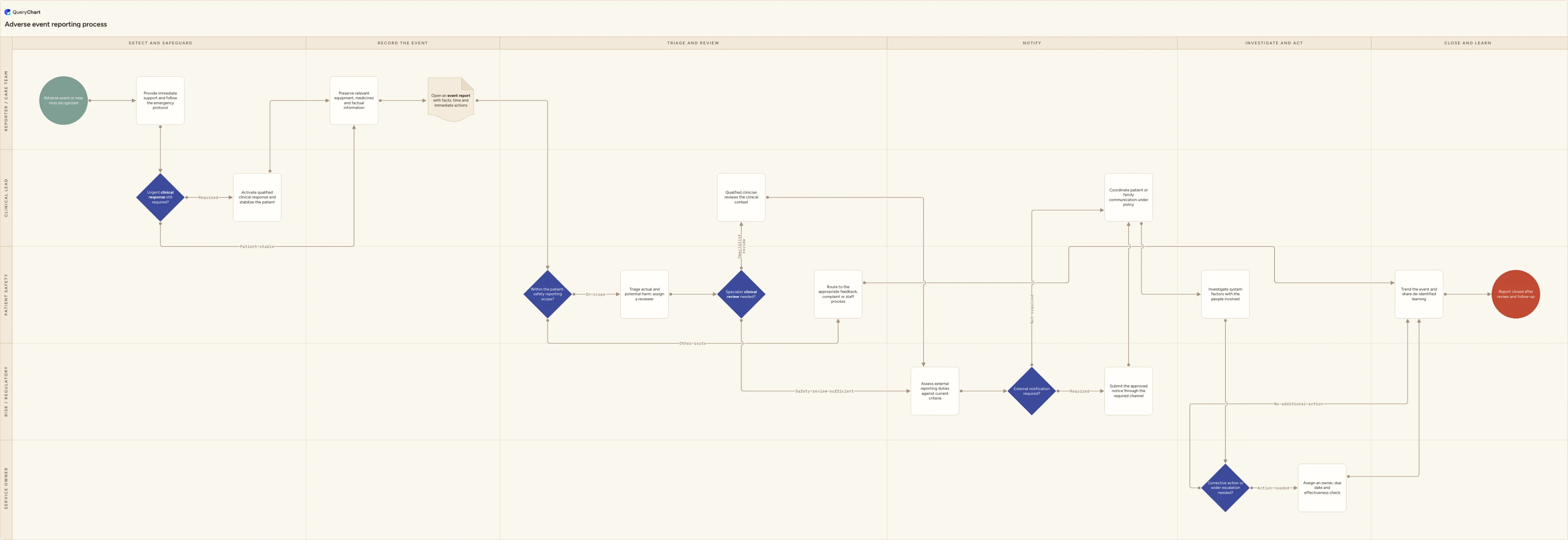
Adverse event reporting process flowchart
Adverse event reporting flowchart for immediate safety, factual intake, qualified clinical review, external-notice assessment, investigation, action and learning.
What the adverse event reporting process is
An adverse event report should begin with the patient, not the form. The care team provides immediate support and follows its emergency protocol before preserving relevant equipment, medicines and factual information. A report is then opened with what was observed, when it happened and what was done, without turning an early account into a conclusion about fault. Patient safety triages actual and potential harm, assigns a reviewer and asks whether specialist clinical review is needed. Risk or regulatory staff assess external duties against current criteria, the clinical lead coordinates appropriate patient or family communication, and a systems investigation decides whether an owned corrective action is needed before the event is trended and closed.
This workflow covers internal patient-safety reporting for an adverse event or near miss in care delivery. It is not a diagnostic or treatment algorithm, a medication causality tool, a product-vigilance procedure, a professional-conduct investigation or a legal disclosure script. Those routes may connect to the same event, but each has different evidence, decision owners and reporting rules. Decisions such as "Urgent clinical response still required?" and "Specialist clinical review needed?" deliberately sit with qualified people; no box infers severity or automates clinical judgment. The template is an operational starting point to customize with local policy and qualified clinical, privacy, risk and legal review. It is not medical or legal advice and does not guarantee compliance with any regulator, reporting law or accreditation standard.
Five swimlanes separate the work that is often blurred in one incident inbox. The Reporter / Care team owns immediate care and factual capture; the Clinical lead owns clinical review and communication appropriate to the patient's circumstances; Patient safety owns scope, triage, investigation and learning; Risk / Regulatory determines whether an outside body must be notified; and the Service owner accepts and verifies improvement work. An out-of-scope report is redirected with a rationale rather than discarded, so complaints, workforce concerns and other feedback still reach the right process.
What this flowchart covers
In this template
- Five swimlanes across six phases, from Detect and safeguard through Close and learn, with immediate patient needs separated from later review and improvement work
- The qualified decision "Urgent clinical response still required?" before documentation, so a reporting form never delays emergency or clinical escalation
- A factual event report, evidence-preservation step and "Within the patient-safety reporting scope?" gate that redirects other concerns instead of silently closing them
- A Patient safety triage followed by "Specialist clinical review needed?", keeping medical interpretation with an appropriate clinician rather than a category or score
- An external-duty assessment and "External notification required?" decision owned by Risk / Regulatory, using current controlled criteria rather than a universal deadline embedded in the chart
- Systems investigation, an owned effectiveness check, de-identified learning and trending before the report is closed
When to use this template
- You are defining a common internal route for patient harm, potential harm and near misses reported from clinical services
- Staff know how to provide care but are unsure when and where to open a safety report or what factual information to preserve
- Clinical review, external reporting and patient communication are happening in parallel without a clear owner or handoff
- Events are closed after investigation findings are written, while corrective actions, effectiveness checks or trend review remain unassigned
- You need to map one facility's process before configuring event categories, notification rules and task states in a reporting system
How it works
Rename lanes to the roles that actually respond
Replace the generic care team, clinical lead, patient safety, risk and service-owner labels with local roles and on-call arrangements. Show who receives an event outside office hours and who may act when the usual reviewer is unavailable.
Attach the emergency and clinical escalation routes
Link the first steps to approved emergency, rapid-response and specialty escalation procedures. Keep symptom thresholds and treatment instructions in those clinically governed documents, not in this reporting workflow.
Define report scope and redirect destinations
List what enters patient-safety reporting and where complaints, privacy events, occupational injuries, product complaints and conduct concerns go instead. Require the receiving owner and rationale to be recorded so out of scope never means lost.
Build the external reporting matrix
Have qualified risk and legal owners identify the authorities, accreditation bodies and internal executives relevant to each service and jurisdiction. Maintain criteria, deadlines and approved channels in a controlled matrix that can change without redrawing the whole workflow.
Set communication ownership
Name who coordinates communication with the patient or family, who verifies facts and who joins difficult conversations. Align the step with disclosure, privacy and interpreter policies while leaving clinical and legal judgments to the responsible professionals.
Test closure against recent events
Walk a near miss, an event requiring specialist review and an externally reportable event through the diagram. Confirm each has a review owner, retained rationale, completed follow-up and visible trend record before calling the workflow ready.
Frequently asked questions
What are the steps in an adverse event reporting process?
Safeguard the patient and activate any required clinical response first. Preserve relevant items and facts, open a factual event report, check that it belongs in the patient-safety route, triage actual and potential harm and obtain specialist clinical review where needed. Risk or regulatory staff then assess outside reporting duties, the clinical lead coordinates appropriate patient or family communication, and patient safety investigates systems factors. The service owner completes any assigned action and effectiveness check. Finally, the event is trended, learning is shared without unnecessary identifiers, and the report is closed after follow-up.
Who decides whether an event is clinically serious?
A qualified clinician or clinical governance route should make clinical judgments using the patient's condition, available evidence and the organization's approved criteria. A reporter can describe observed harm and request urgent help, while a reporting system can flag missing information, but neither a generic category nor this flowchart should diagnose severity, causality or treatment need automatically. The chart therefore routes specialist review before regulatory and improvement decisions that rely on clinical context.
Does every adverse event have to be reported outside the organization?
No universal rule applies to every event, facility or jurisdiction. External duties may arise from national or state law, a professional or product-reporting regime, payer terms, or an accreditation policy, and the definitions and clocks differ. For example, a US FDA product report and a state hospital patient-safety notice are different routes even if they arise from the same event. The Risk / Regulatory lane is responsible for applying current criteria and recording the rationale. This template is not legal advice or a reporting determination.
Is an adverse event report part of the clinical record?
The clinical record should contain the clinically relevant facts, assessment, care and communication needed for continuity of care. A separate safety-reporting system may contain additional analysis about contributing factors and improvement work, subject to local policy and law. Organizations should define what is documented in each system, how corrections are made and who may access it. This chart does not establish privilege, confidentiality or record-retention status in any jurisdiction.
Does this template meet regulator or accreditation requirements?
No. It is a customizable operational map, not medical or legal advice, an incident-classification standard, an accreditation submission or evidence of compliance. Regulators and accreditors use different definitions and may require additional notifications, analyses, governance and records. Have the adapted workflow reviewed against the current requirements that actually apply to the facility, service and location, and verify performance from real cases rather than from the presence of the diagram.