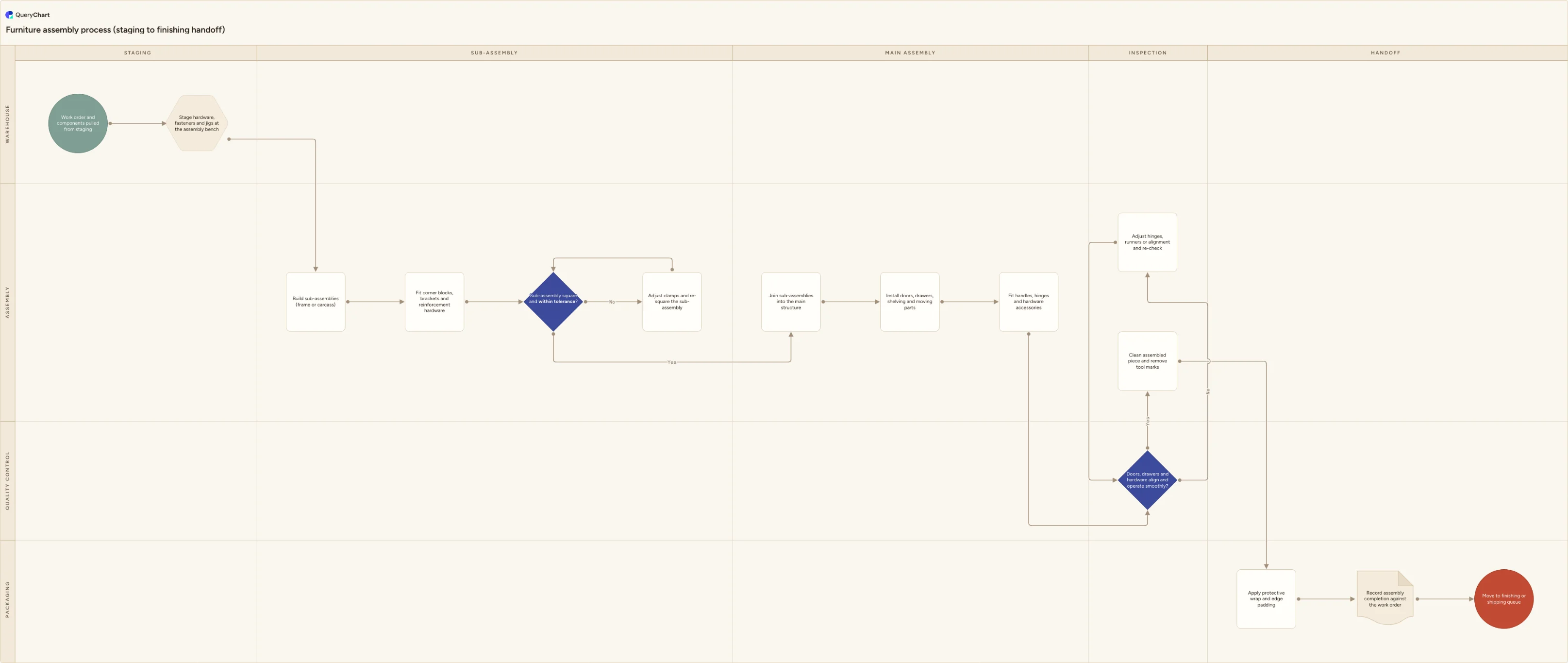
Furniture assembly process flowchart
A furniture assembly process flowchart from staging through sub-assembly, main assembly, hardware fitting, alignment checks and handoff to finishing or shipping.
What the furniture assembly process is
Assembly is where a stack of correctly machined components either becomes a piece of furniture that closes squarely and opens smoothly, or one that never quite does either — and the difference is almost always decided before hardware is ever fitted. A carcass or frame glued out of square cannot be corrected by careful hinge adjustment later; it can only be caught by checking squareness at the sub-assembly stage, while clamps are still on and the joint can still be adjusted.
That is why this template puts a squareness check right after sub-assembly, before the piece moves on to become part of a larger structure, rather than treating the whole assembly as one step that gets inspected only at the end. A second check, after doors, drawers and hardware are fitted, catches the failure mode that only shows up once moving parts exist: a door that doesn't sit flush, a drawer that binds, a hinge that was mounted a few millimeters off.
The process runs across five phases (staging, sub-assembly, main assembly, inspection and handoff) and four lanes (Warehouse, Assembly, Quality control and Packaging). It covers staging hardware and jigs at the bench, building and squaring sub-assemblies, joining them into the main structure and fitting moving parts and hardware, an alignment check before the piece is cleaned and wrapped, and a handoff that logs completion against the work order.
What this flowchart covers
In this template
- Four lanes (Warehouse, Assembly, Quality control and Packaging) across five phases, from staging to handoff.
- A "Sub-assembly square and within tolerance?" check immediately after the frame or carcass is built, before it becomes part of a larger structure that can no longer be re-squared.
- The main assembly sequence: joining sub-assemblies, installing doors, drawers, shelving and moving parts, then fitting handles, hinges and hardware accessories.
- A "Doors, drawers and hardware align and operate smoothly?" check that catches fit and operation faults only visible once moving parts are fitted, with an adjust-and-recheck loop rather than a pass assumed from correct hardware installation.
- The handoff sequence: cleaning tool marks, applying protective wrap and edge padding, and recording assembly completion against the work order before the piece moves to finishing or shipping.
When to use this template
- You are documenting an assembly line's work instruction and the current version has no checkpoint between sub-assembly and finished piece.
- Pieces are reaching final inspection with alignment or squareness faults that would have been cheap to fix at the sub-assembly stage and are expensive to fix now.
- You are training a new assembly operator and need one picture showing where a squareness check and an alignment check sit relative to hardware fitting.
- You want to separate assembly from the broader manufacturing process so a bottleneck on the assembly bench specifically is visible rather than folded into overall production.
How it works
Put the squareness check before the sub-assembly is joined into anything bigger
"Sub-assembly square and within tolerance?" only has value if it happens while the clamps are still on and the joint can still be adjusted. Checking squareness after the frame is already part of the main structure means the fix is a rebuild, not an adjustment.
Check diagonals against each other, not against a fixed number
A square carcass reads the same diagonal measurement twice, whatever the nominal dimension is. State that comparison method on the decision node rather than a single tolerance figure that doesn't account for size variation across products.
Separate hardware fitting from the alignment check that follows it
Fitting handles, hinges and hardware accessories is a distinct step from verifying "Doors, drawers and hardware align and operate smoothly?" — the second only makes sense once the first is complete, and merging them skips the verification most alignment faults need.
Give the adjustment loop a limit
Repeated hinge or runner adjustment on the same piece usually means a deeper fault — a warped panel, a mis-drilled hole — that adjustment cannot fix. Decide in advance how many adjustment attempts are normal before the piece is pulled for a root-cause check instead of a third re-check.
Record completion against the work order, not just the pass
The handoff step should log which work order the assembly closes and note any adjustment made along the way. A completion record that only says 'done' loses information the finishing or shipping team, or a later defect investigation, might need.
Frequently asked questions
Why check squareness at sub-assembly instead of waiting for final inspection?
Because a frame or carcass glued out of square cannot be corrected once it is joined into the main structure — the fix at that point is a rebuild. Checking while the sub-assembly is still isolated and clamps can still be adjusted is the only point in the process where a squareness fault is cheap to fix.
What's the difference between the squareness check and the alignment check later in the process?
The squareness check verifies the structural joint — is the frame or carcass true — before it becomes part of a larger assembly. The alignment check happens after doors, drawers and hardware are fitted, and verifies a different failure mode entirely: whether moving parts sit flush and operate smoothly, which depends on hardware placement, not joint geometry.
What should happen if a door or drawer keeps failing the alignment check after adjustment?
Repeated failure on the same piece after reasonable adjustment usually indicates a deeper cause — a warped panel, a mis-drilled hinge hole, an out-of-square opening — that adjustment alone will not fix. Set a limit on adjustment attempts before the piece is pulled for a root-cause check rather than cycling through the same recheck indefinitely.
Does this process cover upholstered furniture assembly?
It covers the frame, hardware and moving-parts assembly common to case goods and frame-based furniture generally. Upholstered pieces add fabric or foam application steps this template doesn't detail — see the upholstered furniture manufacturing process for that sequence.
Where does this process hand off to next?
To finishing or to shipping, depending on whether the piece still needs a coating or surface treatment applied after assembly. The protective wrap and edge padding step exists either way, since an assembled piece needs surface protection whether its next stop is a finishing booth or a packing station.
Where this process fits
In most operations this process follows Wood sanding process flowchart and hands off to Furniture finishing process flowchart.
It is one step in Woodworking.
Step 4: Wood cutting process flowchart
Step 7: Wood sanding process flowchart
A wood sanding process flowchart covering dust extraction verification, progressive grit sequencing, hand-detail sanding, and a raking-light inspection.
Step 8: Furniture assembly process flowchart You are here
A furniture assembly process flowchart from staging through sub-assembly, main assembly, hardware fitting, alignment checks and handoff to finishing or shipping.
Step 9: Furniture finishing process flowchart
A furniture finishing process flowchart covering surface prep, stain and sealer application, spray-booth topcoat, controlled cure, and finish inspection.