Furniture frame assembly process flowchart (upholstery frames)
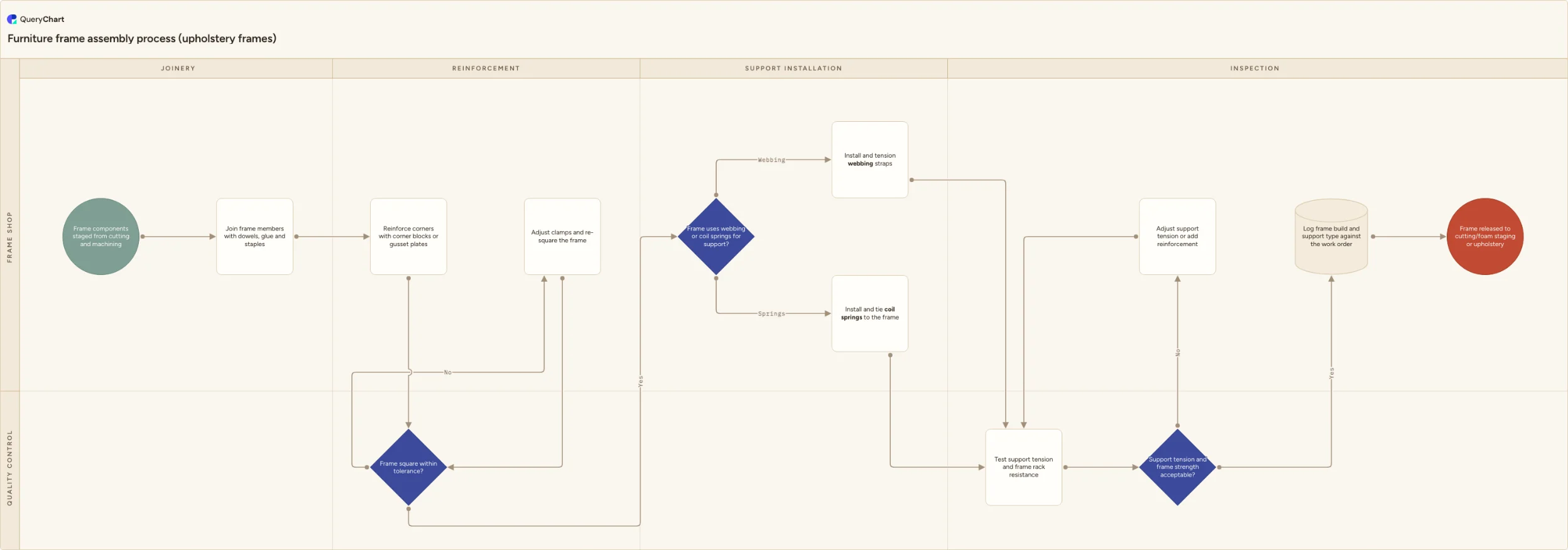
A furniture frame assembly process flowchart for upholstery frames, covering joinery, corner reinforcement, a squareness check, and webbing or spring support installation.
What the furniture frame assembly process flowchart (upholstery frames) process is
An upholstery frame has one property a case-goods frame doesn't need to worry about as much: it has to be square and rack-resistant enough to support seating and standing loads for years, while carrying a support system — webbing or coil springs — that has to be tensioned correctly, all before any of it is hidden under fabric that makes a structural problem invisible from that point forward.
That's why this template checks squareness before support installation, and tests support tension and rack resistance before the frame moves on — both are the last points a structural defect can be caught and corrected without unpicking upholstery.
The process runs across four phases (joinery, reinforcement, support installation and inspection) and two lanes (Frame shop and Quality control), branching between webbing and coil-spring support since the two use different installation methods and different tensioning checks.
What this flowchart covers
In this template
- Frame joinery with dowels, glue and staples, followed by corner reinforcement with blocks or gusset plates.
- A squareness check before support installation, catching a joinery defect while the frame is still bare and correctable.
- A webbing-versus-coil-spring branch, since the two support systems use different installation and tensioning methods.
- A combined tension-and-rack-resistance test after support installation, checking the frame's actual load-bearing behavior rather than just its static dimensions.
- Frame build and support type logged against the work order before release to cutting/foam staging or upholstery.
When to use this template
- You manufacture upholstered furniture and the frame construction process isn't documented separately from general assembly.
- Structural complaints — sagging seats, racking frames — are traced back to support tension or frame squareness that wasn't checked before upholstery covered it.
- You use both webbing and coil-spring support across your product line and need each method's installation and check documented distinctly.
- You need frame build data logged per work order for warranty investigation or supplier component tracing.
How it works
Check squareness before installing support, not after
A frame that's out of square is much easier to correct while it's bare than once webbing or springs are tensioned across it. Check and correct squareness first.
Document webbing and spring installation as genuinely different procedures
"Frame uses webbing or coil springs for support?" leads to different installation steps and different tension checks — treating them as interchangeable variations of one step loses the specifics each actually needs.
Test rack resistance, not just visual squareness
A frame can look square at rest and still rack under a real seating or standing load. Testing actual rack resistance after support installation is what catches a joint that's visually fine but structurally marginal.
Give the frame a real identity before it leaves the frame shop
Logging frame build and support type against the work order is what lets a later structural complaint be traced back to a specific frame's construction, rather than treated as an unexplained one-off.
Frequently asked questions
Why check the frame's squareness before installing webbing or springs?
Because it's the last point the frame is bare and a joinery defect is straightforward to correct — clamping and adjusting an open frame is simple, but doing the same after webbing is tensioned across it or springs are tied in means undoing that support work first. Checking squareness before support installation catches the defect while it's still cheap to fix.
Why does the process branch between webbing and coil springs?
Because they're genuinely different support systems with different installation methods and different ways of verifying correct tension. Webbing is stretched and stapled to a target tension; coil springs are tied in a pattern and their tension is checked differently. Treating them as one generic 'install support' step loses the specific verification each needs.
What does testing rack resistance actually check?
How the frame behaves under a lateral or racking load — the kind of stress a chair or sofa experiences from someone sitting down, standing up, or leaning back repeatedly over years of use. A frame can measure perfectly square at rest and still have a joint that's marginal under that real load, which a static squareness check alone won't reveal.
How does this relate to the general furniture assembly process template?
The general furniture assembly process template covers case-goods assembly — carcasses, doors, drawers, hardware. This template is specific to upholstery frames, which have a different structural profile (they need to support seating loads and carry a webbing or spring system) and different failure modes than case goods do.
Where this process fits
In most operations this process follows Fabric cutting process flowchart and hands off to Upholstery process flowchart (padding to trim).
It is one step in Upholstery.
Step 2: Fabric cutting process flowchart
A fabric cutting process flowchart covering grain and pattern-repeat layout, directional-fabric alignment, marking, cutting, and a piece-count verification.
Step 3: Furniture frame assembly process flowchart (upholstery frames) You are here
A furniture frame assembly process flowchart for upholstery frames, covering joinery, corner reinforcement, a squareness check, and webbing or spring support installation.
Step 4: Upholstery process flowchart (padding to trim)
An upholstery process flowchart covering padding attachment, fabric draping and stitching, optional tufting, and a fabric-tension check with a re-secure loop.