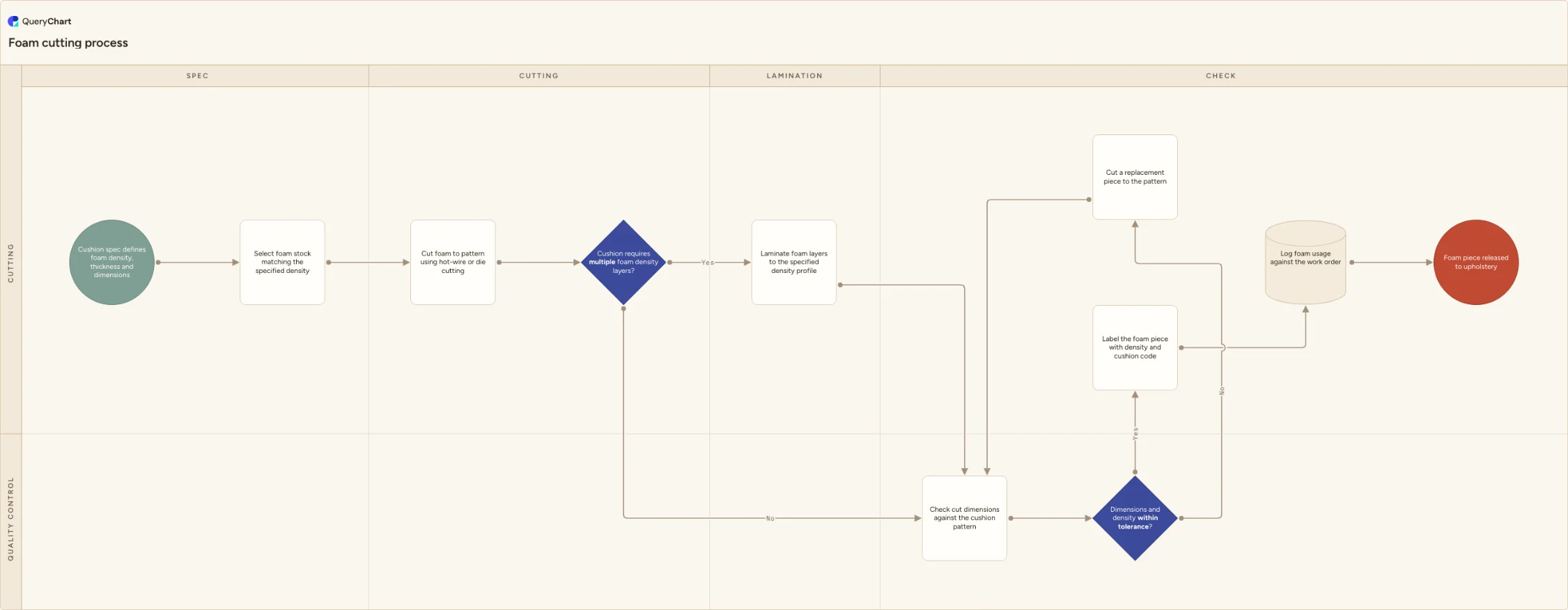
Foam cutting process flowchart
A foam cutting process flowchart covering density selection, hot-wire or die cutting, multi-density lamination, and a dimension-and-density tolerance check.
What the foam cutting process is
Foam cutting looks simple and has one non-obvious failure point: a cushion spec calling for layered densities — a firmer support layer under a softer comfort layer, for instance — needs those layers laminated to the correct profile before the piece reaches upholstery, and getting the layer order or thickness wrong produces a cushion that feels wrong in a way that's very hard to diagnose after the piece is fully upholstered.
That's why this template treats the multi-density decision as an explicit branch rather than an assumption. A single-density cushion skips lamination entirely; a layered one needs the layers built to a stated profile before it's checked against the pattern.
The process runs across four phases (spec, cutting, lamination and check) and two lanes (Cutting and Quality control), verifying both dimensions and density before the piece is labeled with its density and cushion code and released.
What this flowchart covers
In this template
- Foam stock selection matched explicitly to the cushion spec's density, rather than pulled from whatever's closest in the bin.
- Hot-wire or die cutting to pattern as the base cutting step, before any lamination decision.
- A "Cushion requires multiple foam density layers?" branch that laminates to a stated profile only when the cushion spec actually calls for it.
- A combined dimension-and-density tolerance check, since either one being wrong produces a cushion that doesn't match spec even if the other is correct.
- Density and cushion code labeling on every piece, so upholstery can confirm the correct foam reached the correct cushion.
When to use this template
- You produce cushions with layered foam densities and the current cutting process doesn't document lamination as a distinct, checked step.
- Customers or QC have reported cushions that don't match the specified firmness despite correct dimensions.
- You need foam pieces labeled with density and cushion code so upholstery isn't relying on visual judgment to match foam to cushion.
- You want foam usage logged per work order for cost tracking across different density grades.
How it works
Select foam by density, not by what's closest to hand
Foam density directly determines how a finished cushion feels. Matching stock to the spec's density explicitly, rather than substituting a close-enough density, is what keeps the same product feeling consistent across production runs.
Treat multi-density lamination as a stated decision
"Cushion requires multiple foam density layers?" should route to a documented lamination profile — layer order and thickness — not an assumption that whoever's cutting knows the spec from memory.
Check density as well as dimensions
A piece can be cut to the correct dimensions from the wrong density foam, or laminated to the wrong profile, and still pass a dimension-only check. Verify both before release.
Label every piece, not just the ones that might get confused
Density and cushion code labeling on every foam piece — not only when multiple similar-looking densities are in production at once — is what prevents upholstery from having to guess which foam belongs to which cushion.
Frequently asked questions
Why does multi-density foam need its own lamination step?
Because a cushion spec calling for layered densities — a firmer support layer under a softer comfort layer, for example — needs those layers built to a specific order and thickness profile. Getting the layer order or proportions wrong produces a cushion that feels incorrect in a way that's difficult to diagnose once it's fully upholstered and the foam is no longer visible.
Can a foam piece pass a dimension check and still be wrong?
Yes — a piece cut to the exact correct dimensions from the wrong density foam, or laminated with the wrong layer proportions, will still measure correctly. That's why this template checks density and dimensions together rather than treating a correct measurement as sufficient confirmation.
Why label foam pieces with a density and cushion code?
So upholstery can confirm the foam in hand matches the cushion it's meant for without relying on visual judgment — different foam densities can look nearly identical, especially once cut to similar shapes, and a labeling error caught at upholstery is far more expensive to fix than one caught at cutting.
How does this relate to the upholstery process?
Foam cutting produces the labeled, density-verified pieces that the upholstery process then attaches to the frame as padding, alongside the fabric produced by the fabric cutting process. Both cutting processes feed into upholstery as parallel inputs.
Where this process fits
In most operations this process hands off to Upholstery process flowchart (padding to trim).
Comes after
- Upholstery process flowchart (padding to trim) — An upholstery process flowchart covering padding attachment, fabric draping and stitching, optional tufting, and a fabric-tension check with a re-secure loop.