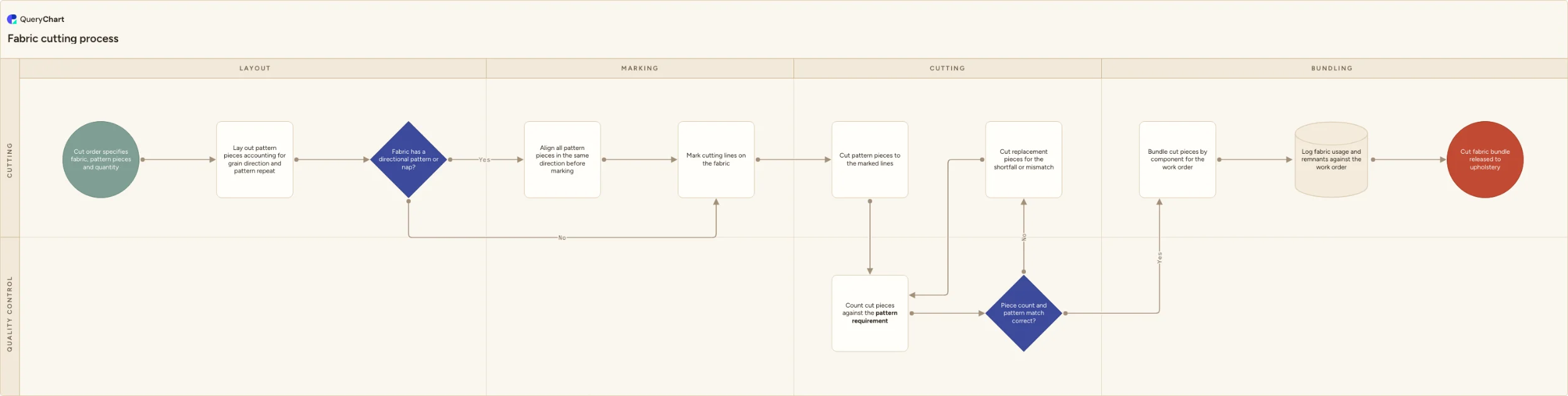
Fabric cutting process flowchart
A fabric cutting process flowchart covering grain and pattern-repeat layout, directional-fabric alignment, marking, cutting, and a piece-count verification.
What the fabric cutting process is
Fabric cutting has a failure mode wood cutting doesn't: a directional pattern or a nap (the raised fibers on velvet and similar fabrics) that reads differently depending on which way a panel is oriented, so a piece cut without checking direction can be structurally fine and visibly wrong once assembled — panels that look shaded differently or a pattern that doesn't align across seams.
That's why this template puts a directional-fabric check before marking, not after cutting. Once fabric is cut, there's no way to reorient a piece that was laid out backward relative to its neighbors; the check only has value before the cutting lines go down.
The process runs across four phases (layout, marking, cutting and bundling) and two lanes (Cutting and Quality control), with a piece-count and pattern-match verification after cutting that catches a shortfall before pieces reach the upholstery bench short a panel.
What this flowchart covers
In this template
- A directional-pattern-or-nap check before marking, aligning all pieces consistently rather than assuming grain direction doesn't matter.
- Pattern-repeat layout that accounts for matching a repeating pattern across seams, not just fitting pieces onto the available fabric.
- Marking and cutting as distinct steps, so a marking error is caught before the fabric is committed to a cut.
- A piece-count and pattern-match verification against the pattern requirement, with a replacement-cutting loop for a shortfall or mismatch.
- Bundling by component with fabric usage and remnants logged against the work order.
When to use this template
- You work with directional or napped fabrics (velvet, some patterned weaves) and the current cutting process doesn't document a direction check.
- Finished pieces have shown pattern mismatch across seams or visibly different shading between panels of the same fabric.
- You need a piece-count verification before bundling, so a shortfall is caught before it reaches the upholstery bench.
- You want fabric usage and remnant data logged per work order for cost tracking or nesting efficiency analysis.
How it works
Check for directional fabric before marking, not after
"Fabric has a directional pattern or nap?" only has value checked before cutting lines are marked. Once panels are cut, a piece laid out in the wrong direction relative to its neighbors can't be corrected without cutting a replacement.
Plan pattern-repeat matching at layout, not at assembly
If seams need to align across a repeating pattern, that has to be planned into the layout before cutting — matching a misaligned pattern after pieces are cut isn't possible without waste.
Verify piece count before bundling, not at the upholstery bench
"Piece count and pattern match correct?" catches a shortfall or mismatch while it's still a cutting-table correction. Discovering a missing piece at the upholstery bench stalls that work entirely.
Log usage and remnants against the work order
Recording fabric usage and leftover remnants per job is what lets you evaluate nesting efficiency and account for fabric cost accurately, rather than treating fabric consumption as a rough estimate.
Frequently asked questions
Why does directional fabric need its own check before cutting?
Because fabric with a nap (raised fibers, like velvet) or a directional pattern can look different depending on which way it's oriented — light reflects off nap differently by direction, and a directional print reads wrong upside down. A panel cut in the wrong orientation relative to its neighbors is often only discovered once the piece is assembled, when it's too late to simply flip it.
What happens when a piece count comes up short after cutting?
The chart routes it to cutting a replacement piece for the shortfall or mismatch, checked again before bundling — rather than sending an incomplete bundle to the upholstery bench and discovering the gap when someone there needs a panel that isn't in the bundle.
How is pattern-repeat matching planned into the layout?
By accounting for where the pattern needs to align across seams during layout, before any cutting lines are marked — this typically means cutting related pieces from the same section of fabric rather than optimizing purely for material yield, since yield-optimized nesting can misalign a repeating pattern across a seam.
How does this relate to fabric receiving and inspection?
Fabric receiving and inspection confirms dye lot, quality and width before fabric enters stock. This process is what happens once fabric is pulled from that stock for a specific cutting job — layout, directional alignment, marking, cutting and verification against the pattern requirement.
Where this process fits
In most operations this process follows Fabric receiving and inspection process flowchart and hands off to Furniture frame assembly process flowchart (upholstery frames).
It is one step in Upholstery.
Step 1: Fabric receiving and inspection process flowchart
A fabric receiving and inspection process flowchart covering dye lot verification, weaving-flaw and shade-variation inspection, width checks, and disposition.
Step 2: Fabric cutting process flowchart You are here
A fabric cutting process flowchart covering grain and pattern-repeat layout, directional-fabric alignment, marking, cutting, and a piece-count verification.
Step 3: Furniture frame assembly process flowchart (upholstery frames)
A furniture frame assembly process flowchart for upholstery frames, covering joinery, corner reinforcement, a squareness check, and webbing or spring support installation.