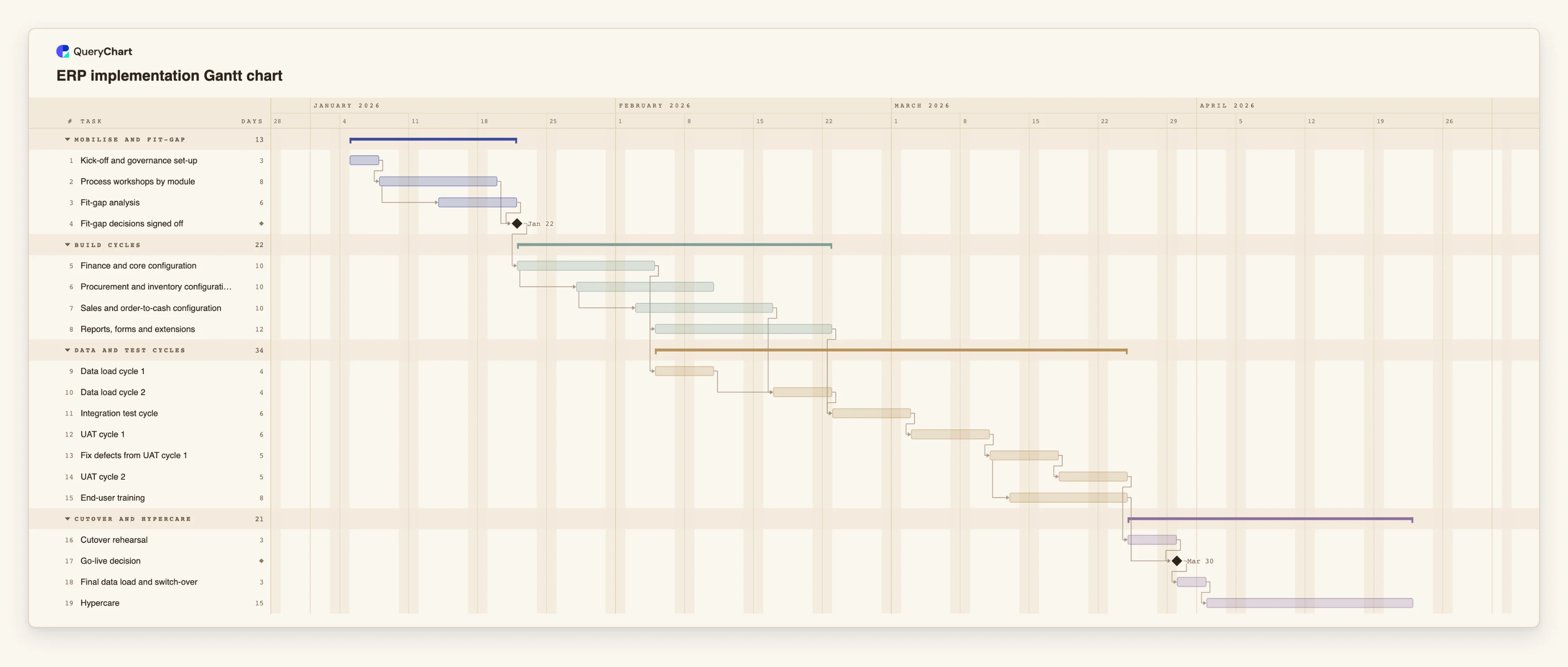
ERP implementation Gantt chart template with build and test cycles
An editable ERP implementation Gantt chart: fit-gap, module-by-module build, two data load cycles, integration and two UAT cycles, cutover rehearsal, go-live decision and hypercare, with dependencies.
What the ERP implementation gantt chart template with build and test cycles process is
An ERP programme is rarely one build followed by one test. Finance is configured first, because other modules post to it. Procurement, inventory and sales follow, partly in parallel. The data is loaded more than once, because the first load always shows what was wrong with the source data. Users test, find defects, and test again. A plan with one box for 'configuration' and one for 'testing' hides all of this, and it is where these plans most often go wrong: the second load, the second test cycle and the rehearsal were never in the schedule.
This template has four phases: Mobilise and fit-gap, Build cycles, Data and test cycles, and Cutover and hypercare. "Kick-off and governance set-up" is the only starting task. "Process workshops by module" takes 8 working days and "Fit-gap analysis" starts four working days after the workshops start, so the analysis is not waiting for the last workshop. The "Fit-gap decisions signed off" milestone waits for both. Everything after it depends on those decisions, which is deliberate: a build that starts before the gaps are decided is rework waiting to happen.
The build is three overlapping configuration tasks of 10 working days each. "Procurement and inventory configuration" starts four working days after "Finance and core configuration" starts, and "Sales and order-to-cash configuration" starts four working days after that. "Reports, forms and extensions" (12 days) follows finance. "Data load cycle 1" follows finance and "Data load cycle 2" waits for both the first load and the sales configuration. "Integration test cycle" waits for the second load and for the reports and extensions.
Testing is two UAT cycles with a repair task between them. "UAT cycle 1" is 6 days, "Fix defects from UAT cycle 1" is 5, and "UAT cycle 2" is 5. "End-user training" starts two working days after the fixes start. "Cutover rehearsal" follows the second cycle, and the "Go-live decision" milestone waits for the rehearsal and the training. "Final data load and switch-over" and 15 days of "Hypercare" follow. All durations are illustrative. Set them from your module list, data volumes and test scope, and treat the cycle counts as a starting assumption, not a rule. Names of ERP or CRM products are not needed: the same shape fits any packaged business system.
This is a planning chart for a business system project. It does not configure anything, and finishing every task on time does not mean the system is ready for the business. For the process view, including the decision points, see the enterprise software implementation process at /templates/enterprise-software-implementation-process, the data migration process at /templates/data-migration-process and the user acceptance testing process at /templates/user-acceptance-testing-process. For a shorter, single-system plan see /templates/implementation-plan-gantt-chart.
What this flowchart covers
In this template
- Four phases with 19 tasks and two milestones, "Fit-gap decisions signed off" and "Go-live decision".
- Overlapping module builds: "Procurement and inventory configuration" and "Sales and order-to-cash configuration" each start four working days after the module before them starts.
- Repeated cycles that are often forgotten: "Data load cycle 1" and "Data load cycle 2", then "UAT cycle 1", "Fix defects from UAT cycle 1" and "UAT cycle 2".
- A fit-gap analysis that overlaps the workshops with a start-to-start link, signed off by one milestone.
- A gated cutover: "Cutover rehearsal" and "End-user training" must both be finished before the "Go-live decision", followed by "Final data load and switch-over" and "Hypercare".
When to use this template
- You are planning an ERP, finance or supply chain system rollout and need to show the build, load and test cycles on one timeline.
- A steering group asks why go-live is later than the build finish and you need to show the data loads, the test cycles and the rehearsal.
- You are comparing a phased module rollout with a single go-live by changing the dependencies and reading the finish date.
- You want a sensible starting structure for a CRM or other packaged-system implementation without starting from an empty sheet.
The plan, task by task
Every task in the chart with its length in working days and what it waits for. A dependency is a step number; SS is start-to-start, FF is finish-to-finish, and +n is a lag in working days.
| # | Task | Group | Working days | Depends on |
|---|---|---|---|---|
| 1 | Kick-off and governance set-up | Mobilise and fit-gap | 3 | |
| 2 | Process workshops by module | Mobilise and fit-gap | 8 | 1 |
| 3 | Fit-gap analysis | Mobilise and fit-gap | 6 | 2SS+4 |
| 4 | Fit-gap decisions signed off | Mobilise and fit-gap | Milestone | 2, 3 |
| 5 | Finance and core configuration | Build cycles | 10 | 4 |
| 6 | Procurement and inventory configuration | Build cycles | 10 | 5SS+4 |
| 7 | Sales and order-to-cash configuration | Build cycles | 10 | 6SS+4 |
| 8 | Reports, forms and extensions | Build cycles | 12 | 5 |
| 9 | Data load cycle 1 | Data and test cycles | 4 | 5 |
| 10 | Data load cycle 2 | Data and test cycles | 4 | 7, 9 |
| 11 | Integration test cycle | Data and test cycles | 6 | 8, 10 |
| 12 | UAT cycle 1 | Data and test cycles | 6 | 11 |
| 13 | Fix defects from UAT cycle 1 | Data and test cycles | 5 | 12 |
| 14 | UAT cycle 2 | Data and test cycles | 5 | 13 |
| 15 | End-user training | Data and test cycles | 8 | 13SS+2 |
| 16 | Cutover rehearsal | Cutover and hypercare | 3 | 14 |
| 17 | Go-live decision | Cutover and hypercare | Milestone | 15, 16 |
| 18 | Final data load and switch-over | Cutover and hypercare | 3 | 17 |
| 19 | Hypercare | Cutover and hypercare | 15 | 18 |
How it works
List your modules and replace the three build tasks
Keep finance or the core ledger first. Add one configuration task per module and link each to the one before with a start-to-start overlap such as 6SS+4 if it can begin early.
Set the fit-gap decision as a gate
Make every build task depend on "Fit-gap decisions signed off". If decisions come in per module, split the milestone into one per module.
Add every load and test cycle you expect
Keep one task per data load and per test cycle, with a repair task between test cycles. Adding a third UAT cycle is a visible change to the finish date, which is the point.
Plan training and the rehearsal as predecessors of go-live
Link "End-user training" and "Cutover rehearsal" to the go-live decision so a late rehearsal moves the decision, not the other way round.
Add owners, group and read the critical path
Put the module owner in People and switch on the critical path in the View menu to see which chain sets the finish date.
Share, record progress and export
Share the chart with the steering group, record progress as cycles complete and export a PDF for the programme file.
Frequently asked questions
Is this plan for a specific ERP product?
No. It is a general shape for a packaged business system rollout. The task names are generic, so you can rename them for your own system and modules.
How many data load cycles should I plan?
It depends on the quality of your source data and the number of systems you migrate from. The template has two and the durations are illustrative. Add a cycle if your first load is expected to need a lot of cleansing.
Can I plan a phased rollout by country or business unit?
Yes. Copy the build and test tasks for each wave, group them by wave and link the second wave to the first go-live. Keep the waves in one chart so the dependencies between them stay visible.
How is this different from the implementation plan template?
The shorter implementation plan at /templates/implementation-plan-gantt-chart covers one system in a single pass. This one breaks out module builds, repeated data loads and test cycles, and a rehearsal before go-live.