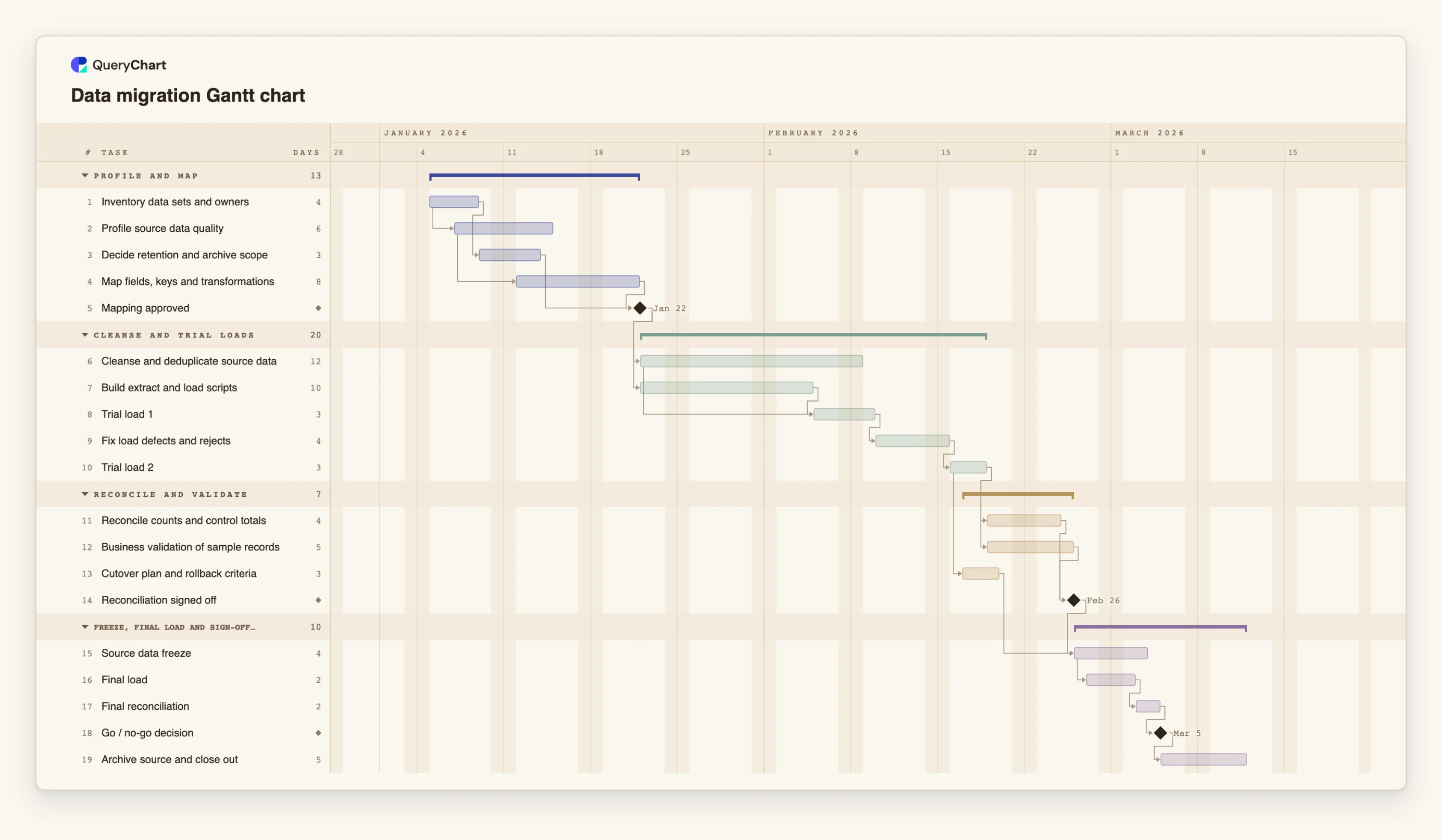
Data migration Gantt chart template from profiling to sign-off
An editable data migration Gantt chart: profiling, mapping, cleansing, trial loads, reconciliation, a source freeze, the final load and sign-off, with dependencies, overlaps and milestones.
What the data migration gantt chart template from profiling to sign-off process is
Data migration plans go wrong in the middle and at the end. The middle is the trial loads: the first one almost always shows rejects, mappings that were not quite right and data that was cleaner in the profile than in the extract, and each fix needs another load. The end is the freeze: the source cannot change while the final load runs, so the window is short and its length decides when the business is affected. A plan with one "load data" task hides both.
This template has four phases: Profile and map, Cleanse and trial loads, Reconcile and validate, and Freeze, final load and sign-off. "Inventory data sets and owners" is the only starting task. "Profile source data quality" starts two working days after it starts, and "Decide retention and archive scope" follows the inventory. "Map fields, keys and transformations" starts three working days after profiling starts. "Mapping approved" is a milestone that waits for both the mapping and the retention decision, so nothing is built on a mapping that still includes data you are not going to move.
After approval, "Cleanse and deduplicate source data" (12 working days) and "Build extract and load scripts" (10) run side by side. "Trial load 1" waits for the scripts and starts five working days after cleansing starts, so it runs on partly cleansed data, which is realistic and is the reason for the next task. "Fix load defects and rejects" is followed by "Trial load 2". Then "Reconcile counts and control totals" and "Business validation of sample records" run in parallel, and "Cutover plan and rollback criteria" starts one working day after the second trial load starts. "Reconciliation signed off" waits for the first two.
"Source data freeze" waits for the sign-off and the cutover plan. "Final load" starts one working day after the freeze starts, so the freeze is in place before it, and "Final reconciliation" and the "Go / no-go decision" follow. "Archive source and close out" comes last. All durations are illustrative: they depend on volumes, the quality of the source and how many trial loads you need. A timeline schedules the work. It does not make the data correct and it does not replace the reconciliation evidence. For the process logic, see the data migration flowchart at /templates/data-migration-process, and for rules about keeping and disposing of records, /templates/data-lifecycle-management-process.
What this flowchart covers
In this template
- Four phases, Profile and map, Cleanse and trial loads, Reconcile and validate and Freeze, final load and sign-off, with 19 tasks and three milestones: "Mapping approved", "Reconciliation signed off" and "Go / no-go decision".
- Overlapping early work: "Profile source data quality" starts two working days after "Inventory data sets and owners" starts, and "Map fields, keys and transformations" starts three working days after profiling starts.
- Cleansing and scripts in parallel: "Cleanse and deduplicate source data" (12 working days) and "Build extract and load scripts" (10) both follow "Mapping approved", and "Trial load 1" starts five working days into cleansing.
- Two trial loads with a fix between them, then "Reconcile counts and control totals" beside "Business validation of sample records", both gating "Reconciliation signed off".
- A freeze that precedes the final load: "Source data freeze" is 4 working days and the final load starts one working day after it begins, then come "Final reconciliation" and "Go / no-go decision".
When to use this template
- You are moving data between systems and need to show when mapping, cleansing, trial loads and the final load fall.
- You need to agree the length of the source freeze with the business and want to see what it depends on.
- You want to show a steering group why a second trial load, and the time to fix rejects, belongs in the plan.
- You are asked when reconciliation has to be signed off for the cutover date to hold.
The plan, task by task
Every task in the chart with its length in working days and what it waits for. A dependency is a step number; SS is start-to-start, FF is finish-to-finish, and +n is a lag in working days.
| # | Task | Group | Working days | Depends on |
|---|---|---|---|---|
| 1 | Inventory data sets and owners | Profile and map | 4 | |
| 2 | Profile source data quality | Profile and map | 6 | 1SS+2 |
| 3 | Decide retention and archive scope | Profile and map | 3 | 1 |
| 4 | Map fields, keys and transformations | Profile and map | 8 | 2SS+3 |
| 5 | Mapping approved | Profile and map | Milestone | 3, 4 |
| 6 | Cleanse and deduplicate source data | Cleanse and trial loads | 12 | 5 |
| 7 | Build extract and load scripts | Cleanse and trial loads | 10 | 5 |
| 8 | Trial load 1 | Cleanse and trial loads | 3 | 6SS+5, 7 |
| 9 | Fix load defects and rejects | Cleanse and trial loads | 4 | 8 |
| 10 | Trial load 2 | Cleanse and trial loads | 3 | 9 |
| 11 | Reconcile counts and control totals | Reconcile and validate | 4 | 10 |
| 12 | Business validation of sample records | Reconcile and validate | 5 | 10 |
| 13 | Cutover plan and rollback criteria | Reconcile and validate | 3 | 10SS+1 |
| 14 | Reconciliation signed off | Reconcile and validate | Milestone | 11, 12 |
| 15 | Source data freeze | Freeze, final load and sign-off | 4 | 13, 14 |
| 16 | Final load | Freeze, final load and sign-off | 2 | 15SS+1 |
| 17 | Final reconciliation | Freeze, final load and sign-off | 2 | 16 |
| 18 | Go / no-go decision | Freeze, final load and sign-off | Milestone | 17 |
| 19 | Archive source and close out | Freeze, final load and sign-off | 5 | 18 |
How it works
Start from the inventory
Replace the lengths of "Inventory data sets and owners" and "Profile source data quality" with your own. Keep the overlap if profiling can begin on the first data sets while the inventory finishes.
Gate building on the approved mapping
"Cleanse and deduplicate source data" and "Build extract and load scripts" both wait for "Mapping approved". Add a task if a separate sign-off from the data owners takes time.
Decide how many trial loads you need
Duplicate "Trial load 2" and its fix task if you expect more than two cycles. Each pair adds its own length to the plan.
Make reconciliation a gate
Keep "Reconciliation signed off" as a milestone that waits for the counts and the business validation. Write the acceptance criteria in the task notes.
Size the freeze and the final load
Set the length of "Source data freeze" from what the business can accept. The final load starts after it begins, so lengthen the load and see how the freeze must grow.
Add owners, share and export
Put the data owner or engineer in People, share the chart with the business owners, and export a PDF for the cutover record.
Frequently asked questions
How many trial loads should I plan?
It depends on volumes, the quality of the source and how much the mapping changes. The template has two with a fix task between them as an illustration. Add more pairs if your first load is likely to show many rejects.
Does the chart check that the migrated data is correct?
No. It schedules the reconciliation and validation tasks. Whether the counts, totals and samples match is shown by your own evidence, which belongs in your project record, not in a timeline.
How long should the source freeze be?
Long enough for the final load and final reconciliation, and short enough for the business to accept. Compare the finish date with the date you need, and change the load or reconciliation length to see the effect.
Can I paste my own task list?
Yes. Copy rows from Excel, Sheets or a CSV and paste them into the sheet. If the first line names columns such as Task, Duration and Depends on, each column is matched by name. There is no file upload for Gantt charts yet.
Where is the flowchart for this work?
The data migration process at /templates/data-migration-process draws the decisions, including rollback. For the cloud side of a move, see /templates/cloud-migration-gantt.