Equipment decommissioning process flowchart (asset retirement)
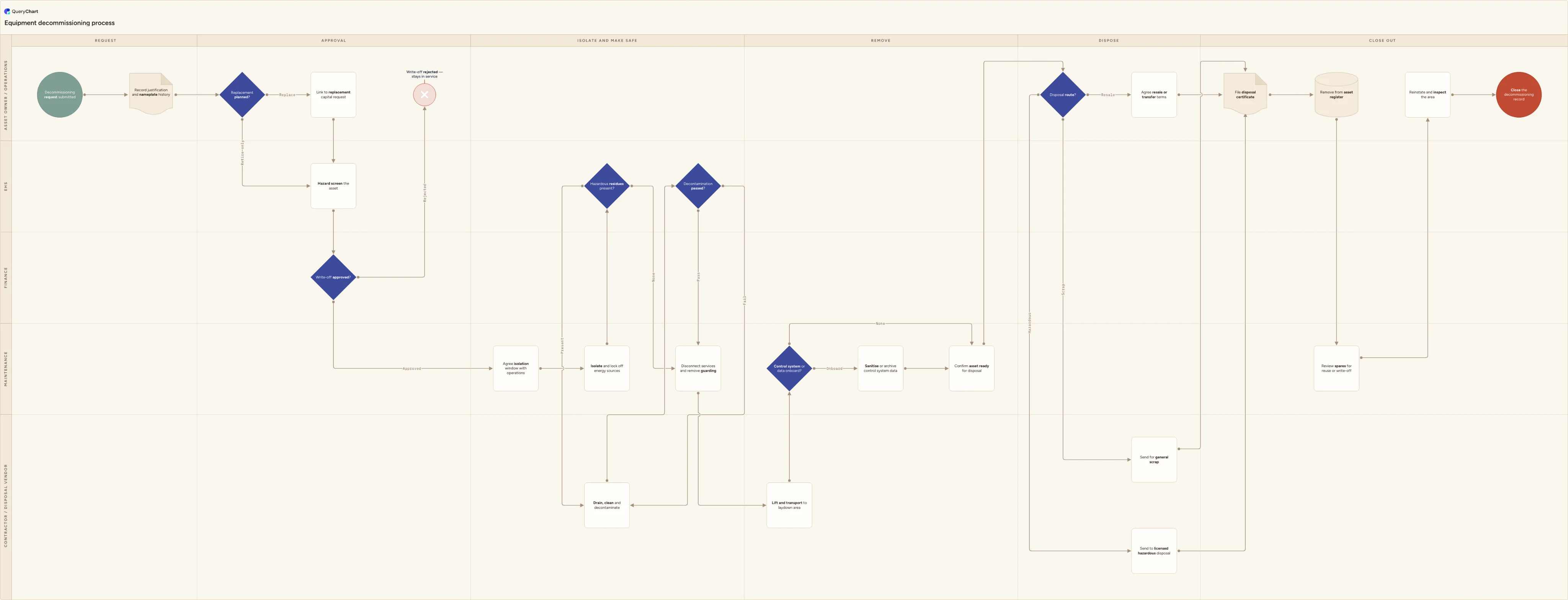
Equipment decommissioning process flowchart template: write-off approval, hazard screening, energy isolation, decontamination, disposal route decision and asset register removal.
What the equipment decommissioning process flowchart (asset retirement) process is
Equipment decommissioning is the process that permanently retires an asset rather than repairing or reassigning it. The trigger is a decommissioning request — an asset that has failed beyond economic repair, become obsolete, or is being replaced by a new machine — and the chart below follows that request end to end: the write-off approval that has to satisfy finance, EHS and operations together, the isolation and de-energising of the asset, a decontamination step where residues warrant it, physical removal from its location, the decision on where the asset goes next, and the records, asset-register and spares clean-up that close the file.
This chart does not cover equipment commissioning — bringing a new or replacement asset into service — or asset handover, where a working asset moves from one owner, area or site to another without leaving service; each of those is its own process with its own approval chain the moment this one ends. It also stops short of a full statutory permit-to-work or hazardous-waste procedure: energy isolation, decontamination and disposal are drawn here as gates, not as the detailed method statements a competent person still has to write. Treat this as a starting point to adapt to your own EHS procedures, your site permits and your jurisdiction's hazardous-waste rules, not as a substitute for them.
Four decisions carry the process. 'Write-off approved?' sits with finance because it is the step that makes retirement irreversible, and its 'Rejected' branch sends the asset straight back into service rather than treating the approval as a formality. 'Hazardous residues present?' and 'Decontamination passed?' both sit with EHS, not maintenance, because confirming an asset is safe to move should not be signed off by the person who has been working on it. 'Disposal route?' decides whether the asset is resold, scrapped or sent for licensed hazardous disposal, and keeping those three routes visibly distinct is what stops a hazardous item quietly leaving with general scrap.
What this flowchart covers
In this template
- Five swimlanes (Asset owner / operations, Maintenance, EHS, Finance and Contractor / disposal vendor) across six phases: request, approval, isolate and make safe, remove, dispose and close out
- A 'Replacement planned?' decision at the top of the approval phase, so the same chart covers a straight retirement and a replace-and-retire case, linking the old asset's write-off to the new asset's capital request when one exists
- A 'Write-off approved?' decision owned by finance, fed by a 'Hazard screen the asset' step from EHS, with a 'Write-off rejected — stays in service' terminal that returns the asset to service rather than treating approval as a formality
- An isolation step that locks off energy sources before a 'Hazardous residues present?' decision routes the asset to decontamination, with a 'Decontamination passed?' check and a fail branch that loops back for another pass rather than letting a contaminated asset move
- A 'Control system or data onboard?' decision that sends PLCs, HMIs and drives through a data-sanitisation step ahead of a three-way 'Disposal route?' decision — resale, scrap or licensed hazardous disposal — each with its own paperwork
- Closure on evidence: a filed disposal certificate, removal from the asset register, a 'Review spares for reuse or write-off' step that keeps obsolete parts off the shelf, and the area reinstated and inspected before the record closes
When to use this template
- You are writing or updating a decommissioning procedure and need one picture of the handoffs between operations, maintenance, EHS, finance and the disposal vendor.
- A machine is being scrapped, sold or transferred and you need the write-off, isolation and disposal-route decisions to happen in the right order and by the right person.
- You are configuring your CMMS or ERP asset register and want the retirement workflow agreed before the write-off, disposal and register-removal steps are built.
- Finance or maintenance keeps finding decommissioned assets that were never removed from the register, still holding spares or PM schedules against them.
- An auditor, insurer or regulator has asked how you retire equipment safely and account for where each asset went, including hazardous items.
How it works
Rename the lanes to your roles
Replace Asset owner / operations, Maintenance, EHS, Finance and Contractor / disposal vendor with the roles and functions that actually sign off decommissioning on your site. On a small site the EHS review might be one person wearing two hats: merge lanes rather than drawing a handoff that never happens.
Define what triggers a decommissioning request
State who can raise a request and on what grounds — failed beyond economic repair, obsolete, superseded by a replacement, or genuinely no longer required. Wire the 'Replacement planned?' decision into your capital-approval process wherever a new asset is going in at the same time.
Set your write-off approval chain
Name who has to sign off the write-off besides finance — EHS, operations, and asset or engineering management are typical — and what evidence they need: depreciated value, condition, and the hazard screen. Decide what a rejection actually does, since 'stays in service' only works if someone owns getting the asset back into the PM schedule.
Write your isolation and decontamination rules
Record what isolation the asset needs, who applies and removes it, and whether a permit to work is required. State which residues trigger the decontamination branch — oils, refrigerants, process chemicals, insulation — and who is qualified to sign off that decontamination has passed.
Decide the disposal routes you actually use
List the real options: internal transfer, resale, general scrap, and licensed hazardous disposal. For each, state what paperwork the chart's 'File disposal certificate' step has to produce, and who is authorised to choose a route above a given value.
Set the data and spares rules
State which asset classes carry onboard data — PLCs, drives, HMIs, building controls — and your data-sanitisation standard for wiping or archiving it before the asset leaves site. Decide who reviews spares for reissue rather than letting them sit against a retired asset's stock code.
Walk it against a completed decommissioning
Take a recently retired asset, one that went smoothly and one that stalled, and trace both through the chart. A step people describe that is not drawn, or is drawn but gets skipped under pressure to clear floor space, is the finding worth fixing before you publish it.
Frequently asked questions
What are the steps in equipment decommissioning?
The process starts with a decommissioning request and a record of the reason and the asset's nameplate history. A 'Replacement planned?' decision links a retire-and-replace case to the new asset's capital request, then EHS runs a hazard screen and finance decides whether the write-off is approved — a rejection sends the asset straight back into service. Once approved, maintenance agrees an isolation window and locks off the asset, and EHS decides whether hazardous residues need decontaminating, with a fail branch that loops back for another pass. The asset is disconnected, lifted to a laydown area, checked for onboard control-system data, and sanitised if it has any. A 'Disposal route?' decision sends it for resale, scrap or hazardous disposal, then the certificate is filed, the asset comes off the register, spares are reviewed, the area is reinstated, and the record closes.
What is the difference between decommissioning, handover and commissioning?
Commissioning brings a new or repaired asset into service for the first time, with its own testing and acceptance steps. Handover moves a working asset from one owner, area or site to another without taking it out of service — the receiving party still needs to operate and maintain it. Decommissioning is effectively the opposite of commissioning: it permanently retires an asset, whether that means selling it, scrapping it or sending it for hazardous disposal, and it is the only one of the three that ends with the asset off the register rather than on it. A replacement project typically runs a commissioning process for the new asset and a decommissioning process for the old one side by side, which is why this chart links out to a capital request rather than trying to cover both in one diagram.
Who has to approve a decommissioning write-off?
It varies by organisation, but the pattern on this chart is deliberately more than one signature: finance owns the write-off decision because it removes a depreciated asset from the books, EHS has to confirm the hazard screen before that approval is given, and operations or the asset owner has to agree the asset is genuinely no longer needed. Above a certain value, or for safety-critical or regulated assets, many organisations add an engineering or site-management sign-off as well. Whatever your chain is, name it on the chart rather than leaving 'approved' to mean whichever manager happened to be free — that is the detail an auditor asks for first.
What records does a decommissioned asset need?
At minimum: the reason for retirement and the asset's nameplate and maintenance history, the write-off approval, evidence of isolation and any decontamination, the disposal certificate or consignment note for wherever it went, and the date it was removed from the asset register. If the asset carried a control system, its data-sanitisation or archive record belongs in the same file. Keeping these together is what lets you answer, months later, exactly what happened to a specific serial number — which is the question that actually gets asked, whether by an auditor, an insurer or a regulator, and statutory retention periods for some of these records vary by jurisdiction.
What is the biggest failure mode in equipment decommissioning?
An asset that is physically gone but administratively still there: removed from the floor, but left on the asset register, still generating PM work orders, still holding spares against its stock code, and still counted as a live asset for insurance or depreciation. It happens because the physical removal is visible and gets prioritised, while the register clean-up is paperwork nobody chases once the floor space is needed. Closing the loop — register, spares, insurance and the area itself reinstated and inspected — is what separates a scrapped machine from a properly decommissioned one, and it is exactly the back half of this chart.
Where this process fits
In most operations this process follows Equipment maintenance process flowchart.
It is one step in Asset lifecycle.
Step 1: Equipment commissioning process flowchart (installation to handover)
Step 2: Equipment maintenance process flowchart
Five-lane equipment maintenance process flowchart: work request, planned or breakdown triage, job planning, spares check, permit to work and costed close-out.
Step 3: Equipment decommissioning process flowchart (asset retirement) You are here
Equipment decommissioning process flowchart template: write-off approval, hazard screening, energy isolation, decontamination, disposal route decision and asset register removal.