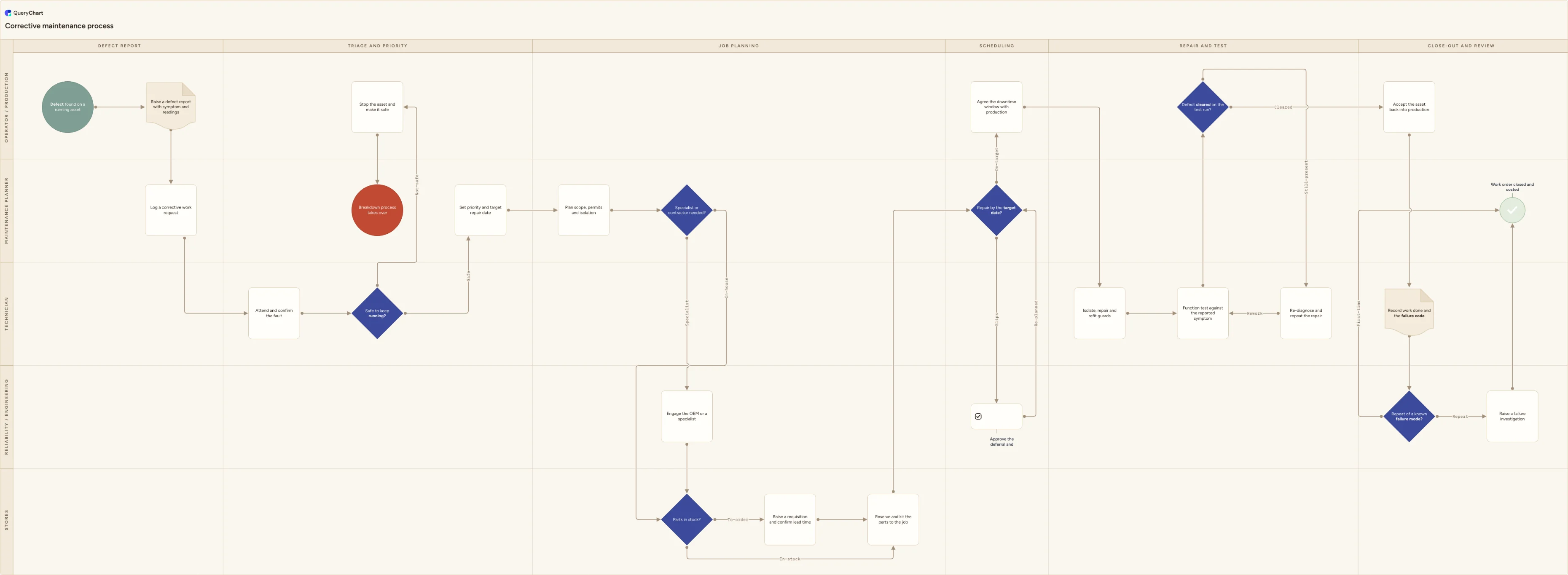
Corrective maintenance process flowchart (planned repair of a known defect)
Corrective maintenance process flowchart template: defect report, triage and priority, safe-to-run decision, job planning, parts and lead time, deferral approval, scheduled repair, test and failure code close-out.
What the corrective maintenance process flowchart (planned repair of a known defect) process is
Corrective maintenance is the repair of a defect that is already known about. The trigger is a defect report rather than a schedule or a stoppage: an operator hears a bearing, an inspector marks a leak, or a technician finds something outside the scope of the preventive maintenance task they were sent to do. The asset is still running, and that is exactly what makes the work plannable. The chart below follows one corrective job end to end: the defect report raised against a running asset, a technician's confirmation on site, a priority and a target repair date, job planning with permits and isolation, parts and lead time, an agreed downtime window, the repair itself, a functional test the original reporter signs off, and a closed work order carrying a failure code the reliability team can count.
This is planned repair, not breakdown response. If the asset has already stopped, or the technician's first look says it cannot safely be left running, the job leaves this chart at the safe-to-run decision and becomes a breakdown: a different clock, a different priority and a different set of people. It is not preventive maintenance either. Nothing here is triggered by a calendar interval or a meter reading; scheduled servicing is its own process, and this chart is where the defects that servicing finds go next. It is also narrower than a general equipment maintenance flow, which has to triage every kind of need at the top; here the need is already settled before the first box. Root cause analysis, capital replacement decisions and stock reordering sit outside the boundary, named on the chart only where the job is handed off to them. Isolation, permits and the decision to keep running with a known defect are safety-critical on most sites, so treat this as a starting point to adapt under your own procedures, the regulations that apply to you, and competent-person review.
Four decisions carry the process. The safe-to-run call is the immediate-versus-deferred split, and it sits in the Technician lane because it is a judgement made at the machine rather than a scheduling preference made at a desk. The parts decision and the target-date decision are the two that actually determine when the job happens, which is why a deferral approval hangs off the second one: choosing to run another month with a known defect is something somebody should own in writing. The test decision sits in the Operator / production lane rather than the technician's, because the person who reported the symptom is the person who can say it has gone. The chart closes on a repeat-failure question, which is what turns a pile of individual repairs into something a reliability engineer can act on.
What this flowchart covers
In this template
- Five swimlanes (Operator / production, Maintenance planner, Technician, Stores and Reliability / engineering) across six phases: defect report, triage and priority, job planning, scheduling, repair and test, and close-out and review.
- A defect-report entry rather than a stoppage: the chart opens on a running asset, the operator raises the report with the symptom and readings, and the planner has to "Log a corrective work request" before anyone is dispatched to it.
- A "Safe to keep running?" decision in the Technician lane whose no branch runs "Stop the asset and make it safe" and ends at "Breakdown process takes over", so the line between planned and unplanned repair is drawn rather than assumed.
- Planning before scheduling: "Set priority and target repair date" against asset criticality, "Plan scope, permits and isolation", and a "Specialist or contractor needed?" branch that engages the OEM in the engineering lane before parts are touched.
- A "Parts in stock?" decision in the Stores lane whose to-order branch runs "Raise a requisition and confirm lead time" and rejoins the kitting step, then a "Repair by the target date?" gate with a deferral engineering approves and the planner re-plans.
- Verification and close-out: "Function test against the reported symptom", a "Defect cleared on the test run?" decision owned by production with a rework loop, the failure code record, and a "Repeat of a known failure mode?" referral to investigation.
When to use this template
- You are separating planned repair from breakdown response and need one picture of where the boundary sits and who is allowed to move it
- Defects get reported and then disappear: nothing is prioritised, nothing is planned, and the same fault returns weeks later as an unplanned stoppage
- You are configuring corrective work order types, priorities, target dates and failure codes in a CMMS and want the process agreed before the fields are built
- Production and maintenance argue about downtime for known defects, so the target date, the deferral approval and the agreed window need to be explicit and owned
- An auditor, insurer or customer has asked how you decide to keep running with a known defect, and what record shows the repair was tested and closed
How it works
Rename the lanes to your roles
Replace Operator / production, Maintenance planner, Technician, Stores and Reliability / engineering with the roles your site actually has. On a small plant the planner, the storeman and the reliability engineer are often one supervisor: merge those lanes rather than drawing three handoffs that never happen.
Write your safe-to-run rule onto the first decision
State who is allowed to answer the safe-to-run question, on what evidence, and what happens to the answer. Most sites need a short list of conditions that always stop the asset — defeated guarding, leaks of hazardous media, disabled protective devices, structural damage — so the call does not rest on how busy the line happens to be that morning.
Set your priority bands and target repair dates
The priority and target date on the chart are placeholders. Replace them with your own bands and the target response and completion time each one carries, tie the band to asset criticality and the consequence of waiting, and say who may change a priority once it has been set and on what grounds.
Decide what needs a specialist and what does not
Adapt the specialist branch to the work you genuinely cannot do in-house: statutory examinations, warranty-bound repairs, calibration, high-voltage or pressure-system work, and anything the manufacturer insists on. Name who holds the contract and how long engagement takes, because that is the number that moves the target date.
Fix the parts and lead-time rule
Say what counts as in stock, whether a critical spare may be taken from another job, and who confirms the lead time on a requisition rather than quoting the last known figure. Add your own rule for obsolete parts: on an ageing asset that branch, not the repair itself, is where corrective jobs stall for months.
Define the deferral approval and the close-out record
Decide who may approve running on with a known defect, for how long, and what interim controls go with the approval. Then define the record: which failure code list is used, whether the cause is coded as well as the mode, and what count of repeats triggers a failure investigation instead of another repair.
Walk it against two real corrective jobs
Take one job that went to plan and one that was deferred twice, and trace both through the chart. Any step people describe that is not drawn, any box that is drawn but skipped in practice, and any defect that closed without a failure code is a finding worth acting on before you publish it.
Frequently asked questions
What are the steps in a corrective maintenance process?
An operator or inspector finds a defect on an asset that is still running, raises a defect report, and the planner logs a corrective work request. A technician attends, confirms the fault and decides whether the asset is safe to keep running; if it is not, it stops and the job leaves as a breakdown. If it is, the planner sets a priority and target repair date, plans scope, permits and isolation, and books a specialist if needed. Stores answer whether the parts are in stock, raise a requisition and confirm the lead time if not, then kit them to the job. If the repair will miss its target date, engineering approves a deferral with interim controls. A downtime window is agreed with production, the technician isolates, repairs, refits guards and function tests against the reported symptom. Production confirm the defect has cleared, the failure code is recorded, a repeat goes to investigation, and the work order is closed.
What is the difference between corrective, preventive and breakdown maintenance?
Preventive maintenance is triggered by a schedule — a calendar interval or a meter reading — and is carried out whether or not anything appears to be wrong. Corrective maintenance is triggered by a known defect and is carried out to restore the item to a state in which it can perform its required function. EN 13306, the European maintenance terminology standard, splits it further: immediate corrective maintenance is done without delay to avoid unacceptable consequences, while deferred corrective maintenance is held back in accordance with given rules. This chart is the deferred case, which is the one worth drawing, because it is the case with planning, priorities, parts and a target date in it. Breakdown or reactive maintenance is what happens once the asset has already failed and stopped, and it is what this chart hands off to at the safe-to-run decision.
Who decides whether a machine can keep running with a known defect?
On this chart the technician makes the technical call after attending the asset, and engineering approves any decision to defer the repair past its target date. In practice the split matters more than the job titles: one person judges the condition, and a different, more senior person owns the risk of carrying it. Write down the conditions that always stop an asset regardless of who is asking — defeated guarding or protective devices, leaks of hazardous media, damage to structure or lifting equipment, anything a statutory examination has flagged — so the judgement only covers what is genuinely a judgement. Where the equipment is covered by a statutory examination regime or a safety case, the rules on continued operation are set outside your maintenance procedure and are not the planner's to trade away. Every deferral should carry an owner, a review date and the interim controls it depends on.
What is a failure code and why does the close-out record need one?
A failure code turns one repair into a data point. It names what failed and how — the failure mode, and ideally the cause — from a fixed list rather than free text, so that a year of work orders can be counted rather than read. Free text cannot be counted: 'seal gone', 'leaking seal' and 'replaced seal' are three records of the same failure mode that no report will ever group together. ISO 14224, the standard for collecting and exchanging reliability and maintenance data for equipment in the petroleum, petrochemical and natural gas industries, is the usual reference for a coding taxonomy, and many CMMS failure hierarchies are built to align with it; other sectors keep their own equivalent lists. Whichever you use, the code has to be picked at close-out by the person who did the work, because nobody can reconstruct it later from the parts issued.
Why do corrective jobs stall in the maintenance backlog?
Usually at one of the three places this chart makes visible. The first is triage: a defect report with no priority and no target date has nothing to sort it by, so it drops below whatever is loudest that week. The second is parts, and specifically obsolete or long-lead spares on ageing assets, which is why the lead time is confirmed on the chart rather than assumed. The third is the downtime window: a job that is planned and kitted but never gets a slot from production will sit indefinitely, and the deferral it is really taking is nobody's decision because nobody was asked to approve it. Measuring the backlog in weeks of crew capacity rather than in number of work orders makes its size comparable week to week. Set your own target for it, because a healthy figure depends on your crew, your assets and how much emergent work you carry.
Where this process fits
In most operations this process follows Predictive maintenance process flowchart (condition-based) and hands off to Equipment breakdown process flowchart (unplanned failure).
It is one step in Maintenance.
Step 1: Maintenance work order process flowchart (request to close-out)
Step 2: Preventive maintenance process flowchart (scheduled PM)
Preventive maintenance process flowchart template: interval or meter trigger, planned work order, parts kit, isolation, PM task list, test and handback.
Step 3: Corrective maintenance process flowchart (planned repair of a known defect) You are here
Corrective maintenance process flowchart template: defect report, triage and priority, safe-to-run decision, job planning, parts and lead time, deferral approval, scheduled repair, test and failure code close-out.
Step 4: Equipment maintenance process flowchart
Five-lane equipment maintenance process flowchart: work request, planned or breakdown triage, job planning, spares check, permit to work and costed close-out.
Step 5: Equipment failure investigation process flowchart (RCFA)