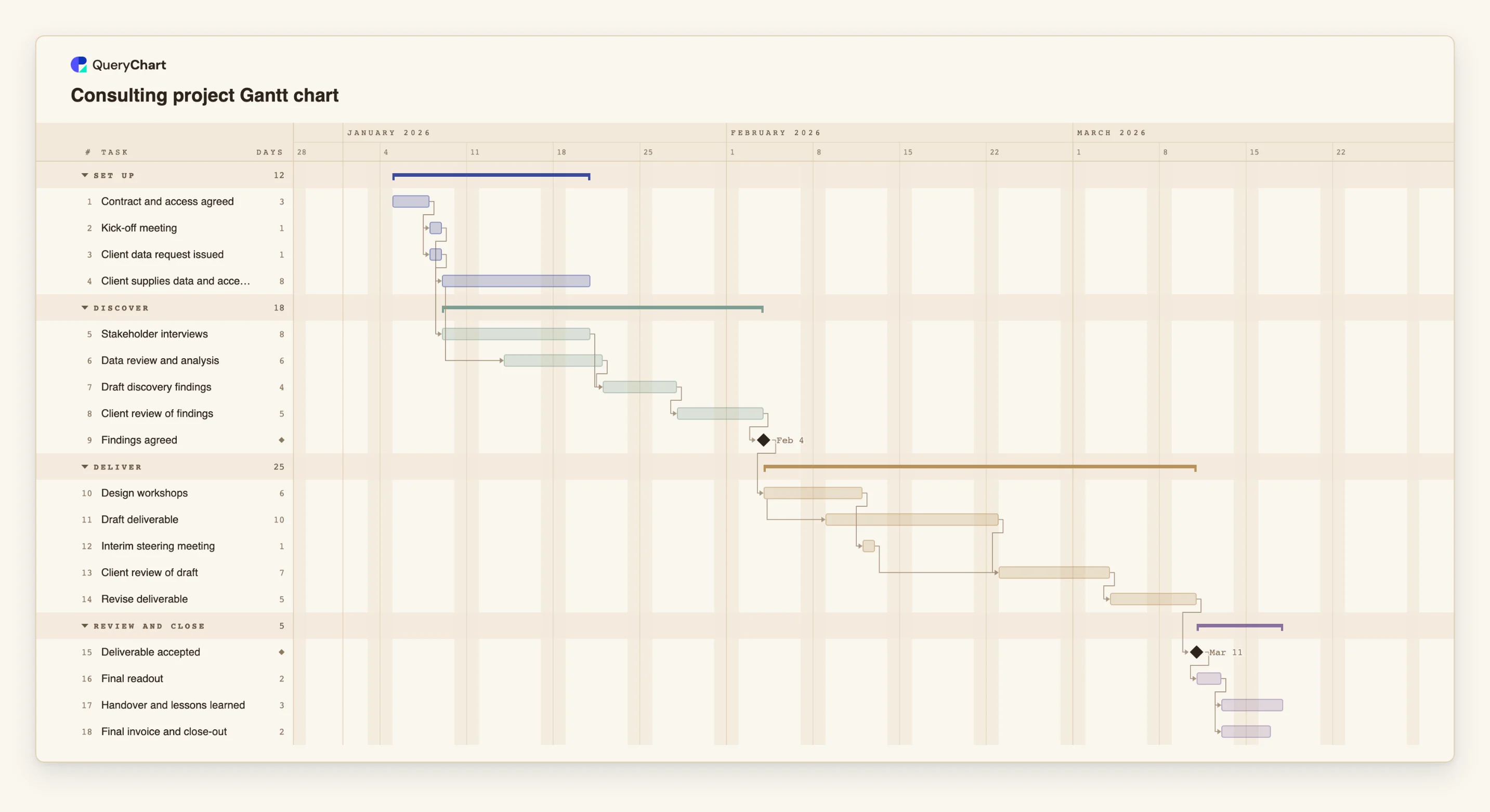
Consulting project Gantt chart template with client review waits
An editable consulting project Gantt chart: contract and access, kick-off, discovery, client review waits, design workshops, steering meeting, deliverable acceptance, final readout and handover, with dependencies.
What the consulting project gantt chart template with client review waits process is
A consulting engagement is scheduled by two parties. The consultants control the analysis, the workshops and the writing. The client controls the data, the access, the review and the acceptance. Plans go wrong in the second set: the data arrives a week later than requested, the review takes ten days instead of five, and the readout date was already in the client's diary. A plan that shows only the consultants' tasks makes the delivery date look like their promise when part of it is waiting time owned by someone else.
This template has four phases: Set up, Discover, Deliver, and Review and close. "Contract and access agreed" is the only starting task. "Kick-off meeting" and "Client data request issued" both follow it, and "Client supplies data and access" (8 working days) is a task of its own so the wait is visible. "Stakeholder interviews" follow the kick-off and take 8 days. "Data review and analysis" starts three working days after both the data supply and the interviews start, so analysis begins on the first material, and "Draft discovery findings" waits for the interviews and the analysis to finish.
"Client review of findings" is 5 working days of waiting and "Findings agreed" is a milestone after it. Nothing in delivery starts before it. "Design workshops" (6 days) are followed by "Interim steering meeting", while "Draft deliverable" starts three working days into the workshops and runs for 10. "Client review of draft" waits for both the draft and the steering meeting. "Revise deliverable" follows, then "Deliverable accepted" and "Final readout". "Handover and lessons learned" and "Final invoice and close-out" both follow the readout and end the plan.
All durations are illustrative. Use the lengths in your statement of work, and set the review waits to what the client has agreed to, not to what you would like. If a client date is fixed, such as the readout or a steering group, pin that task's Start and the chart will flag it when the earlier work cannot meet it. This plan covers one engagement. For the process behind it, see the IT consulting project lifecycle at /templates/it-consulting-project-lifecycle and the business process discovery template at /templates/business-process-discovery.
A Gantt chart does not replace the scope, the contract or the project governance. It shows when things are expected to happen if the dependencies hold. Client onboarding, which some firms treat as a separate process, is folded into the first phase here as access, data and kick-off. For a similar structure in a software context, see /templates/project-gantt-chart.
What this flowchart covers
In this template
- Four phases with 18 tasks and two milestones, "Findings agreed" and "Deliverable accepted".
- Client-owned waits as tasks: "Client supplies data and access", "Client review of findings" and "Client review of draft".
- An overlap in discovery: "Data review and analysis" starts three working days after "Client supplies data and access" and "Stakeholder interviews" start.
- Drafting that starts before the workshops finish: "Draft deliverable" starts three working days after "Design workshops" start, and "Client review of draft" waits for it and for "Interim steering meeting".
- Two ends after "Final readout": "Handover and lessons learned" and "Final invoice and close-out".
When to use this template
- You are scoping a client engagement and want a timeline for the proposal or the kick-off that shows what the client has to provide and when.
- A client is late on data or review and you need to show what moves as a result.
- You deliver several similar engagements and want one starting structure you can copy and adjust.
- You want to compare a short and a long client review wait and see the effect on the readout date.
The plan, task by task
Every task in the chart with its length in working days and what it waits for. A dependency is a step number; SS is start-to-start, FF is finish-to-finish, and +n is a lag in working days.
| # | Task | Group | Working days | Depends on |
|---|---|---|---|---|
| 1 | Contract and access agreed | Set up | 3 | |
| 2 | Kick-off meeting | Set up | 1 | 1 |
| 3 | Client data request issued | Set up | 1 | 1 |
| 4 | Client supplies data and access | Set up | 8 | 3 |
| 5 | Stakeholder interviews | Discover | 8 | 2 |
| 6 | Data review and analysis | Discover | 6 | 4SS+3, 5SS+3 |
| 7 | Draft discovery findings | Discover | 4 | 5, 6 |
| 8 | Client review of findings | Discover | 5 | 7 |
| 9 | Findings agreed | Discover | Milestone | 8 |
| 10 | Design workshops | Deliver | 6 | 9 |
| 11 | Draft deliverable | Deliver | 10 | 10SS+3 |
| 12 | Interim steering meeting | Deliver | 1 | 10 |
| 13 | Client review of draft | Deliver | 7 | 11, 12 |
| 14 | Revise deliverable | Deliver | 5 | 13 |
| 15 | Deliverable accepted | Review and close | Milestone | 14 |
| 16 | Final readout | Review and close | 2 | 15 |
| 17 | Handover and lessons learned | Review and close | 3 | 16 |
| 18 | Final invoice and close-out | Review and close | 2 | 16 |
How it works
Name the client-owned tasks
Keep the data supply and each review as tasks with a duration. Agree those durations with the client at kick-off and put the client contact in People.
Start analysis on first material
Use a start-to-start link such as 6SS+3 so analysis can begin before all data and interviews are finished, and keep the findings task dependent on both finishing.
Gate delivery on agreed findings
Link design workshops to the "Findings agreed" milestone so unresolved findings show up as a delay, not as rework.
Pin the dates the client controls
Give the readout or steering meeting a fixed Start only if the date is already booked. The chart flags a fixed start that the earlier work cannot meet.
Group by phase and add owners
Put the consultant or client owner of each task in People. Read the critical path from the View menu to see which wait sets the readout date.
Share with the client and export
Share the chart so the client can see their own tasks, and export a PDF for the proposal or the steering pack.
Frequently asked questions
Should client tasks be in the same chart as ours?
Yes, if the delivery date depends on them. Showing them as tasks with a duration and a name makes the dependency visible to both sides. Use the People field to say who owns each.
How long should a client review be?
Use what the client has agreed in the contract or at kick-off. The 5 and 7 working days here are illustrations. A review that has no agreed length is the most common cause of a late engagement.
Does this cover client onboarding?
The first phase covers the contract, access, the data request and the kick-off. For the process side of onboarding a client, see /templates/customer-onboarding-process.
Can I track billing in the chart?
Not as amounts. QueryChart does not track cost or budget, so the chart only has "Final invoice and close-out" as a task. Add milestones for your invoice points if you want them visible.