Stripe Organizational Structure & Org Chart
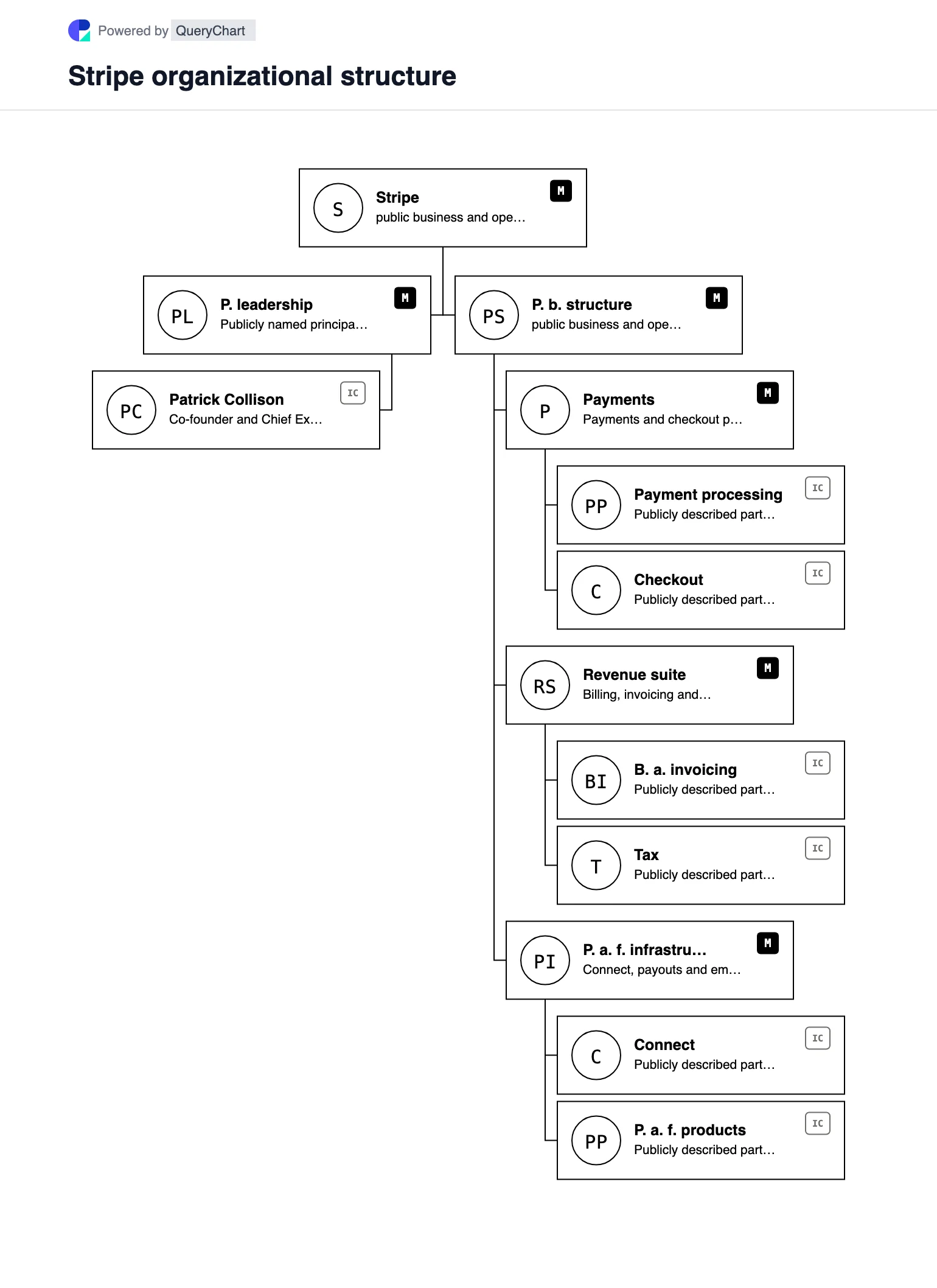
Stripe's public structure is best understood through Payments, Revenue suite, Platform and financial infrastructure. The interactive chart is a researched, editable map of those published areas.
Stripe organizational chart
Edit this organizational chart
Stripe's reporting structure as of 2026-09. Drag to pan, scroll to zoom — or open it in QueryChart and edit it as your own.
- Industry
- Financial infrastructure software
- Headquarters
- South San Francisco, California and Dublin, Ireland
- Founded
- 2010
- CEO
- Patrick Collison
- Ownership
- Private
- Structure as of
- 2026-09
- Structure last reviewed
- 2026-09-29
About the company
Stripe is a financial infrastructure software organization. Its current public materials identify Payments, Revenue suite, Platform and financial infrastructure as useful ways to understand its activities. Stripe is private and does not publish reportable financial segments. Its public product portfolio provides a safer map: payments, revenue and financial or platform infrastructure; these are product families, not disclosed internal departments.
This QueryChart tree puts those disclosed areas next to a single, separately marked leadership branch for Patrick Collison. The business branches describe a public portfolio, not a confidential employee hierarchy. A line between a category and an offering means the offering belongs in that published category; it does not say that a particular executive personally manages every team shown.
Published businesses and operating areas
Payments is one of the visible areas in Stripe's published structure. Payments and checkout products help businesses accept and optimize transactions. The editable chart places Payment processing and Checkout beneath this branch so a reader can find concrete activities instead of a generic departmental box. This is a simplified grouping of disclosed work, and the sources below should be used for the exact legal entities, segment definitions and current management roles.
Revenue suite is one of the visible areas in Stripe's published structure. Billing, invoicing and tax tools help businesses price, collect and report revenue. The editable chart places Billing and invoicing and Tax beneath this branch so a reader can find concrete activities instead of a generic departmental box. This is a simplified grouping of disclosed work, and the sources below should be used for the exact legal entities, segment definitions and current management roles.
Platform and financial infrastructure is one of the visible areas in Stripe's published structure. Connect, payouts and embedded financial products serve platforms and marketplaces. The editable chart places Connect and Payouts and financial products beneath this branch so a reader can find concrete activities instead of a generic departmental box. This is a simplified grouping of disclosed work, and the sources below should be used for the exact legal entities, segment definitions and current management roles.
Key leadership roles
Patrick Collison
Co-founder and Chief Executive Officer
How this structure supports the business
The Payments and Revenue suite branches answer different questions about Stripe. Payments and checkout products help businesses accept and optimize transactions. Billing, invoicing and tax tools help businesses price, collect and report revenue. Showing them side by side is more informative than drawing an unsupported chain of managers, particularly when the public materials report a portfolio or service line rather than a complete internal org chart.
Stripe is private and does not publish reportable financial segments. Its public product portfolio provides a safer map: payments, revenue and financial or platform infrastructure; these are product families, not disclosed internal departments. Connect, payouts and embedded financial products serve platforms and marketplaces. The diagram makes that distinguishing feature visible while keeping the named leadership layer separate. It is useful as a starting point for an editable company chart; users can replace the public groupings with their own teams, roles and verified reporting relationships.
Advantages and disadvantages
- The Payments branch uses a publicly described company-specific grouping.
- A portfolio branch does not prove an individual reporting line.
- The chart distinguishes Revenue suite from Platform and financial infrastructure.
- A single-parent tree cannot show every cross-business collaboration or legal-entity link.
Interesting facts
- Stripe's public materials identify Payments as a major area.
- Revenue suite includes Billing and invoicing and Tax in this educational map.
- Platform and financial infrastructure is shown separately because connect, payouts and embedded financial products serve platforms and marketplaces.
- The principal leadership role is identified as Patrick Collison (Co-founder and Chief Executive Officer).
Related process templates
Related organization charts
- PayPal Organizational Structure & Org Chart
- Visa Organizational Structure & Org Chart
- Mastercard Organizational Structure & Org Chart
- JPMorgan Chase Organizational Structure & Org Chart
- Bank of America Organizational Structure & Org Chart
- HSBC Organizational Structure & Org Chart
- Goldman Sachs Organizational Structure & Org Chart
Frequently asked questions
How is Stripe organized?
This educational chart maps Payments, Revenue suite, Platform and financial infrastructure, using the company's public materials. It does not attempt to reproduce a full internal employee hierarchy.
Who leads Stripe?
Patrick Collison is the publicly identified Co-founder and Chief Executive Officer in the sources reviewed on 29 September 2026.
Is this an official Stripe org chart?
No. It is an independent reconstruction of public business categories and leadership information, with simplified connections for exploration and editing.
Use this org chart template
Open this Stripe structure in QueryChart and rename roles, add departments, remove areas or change connections for your own organization.