Visa Organizational Structure & Org Chart
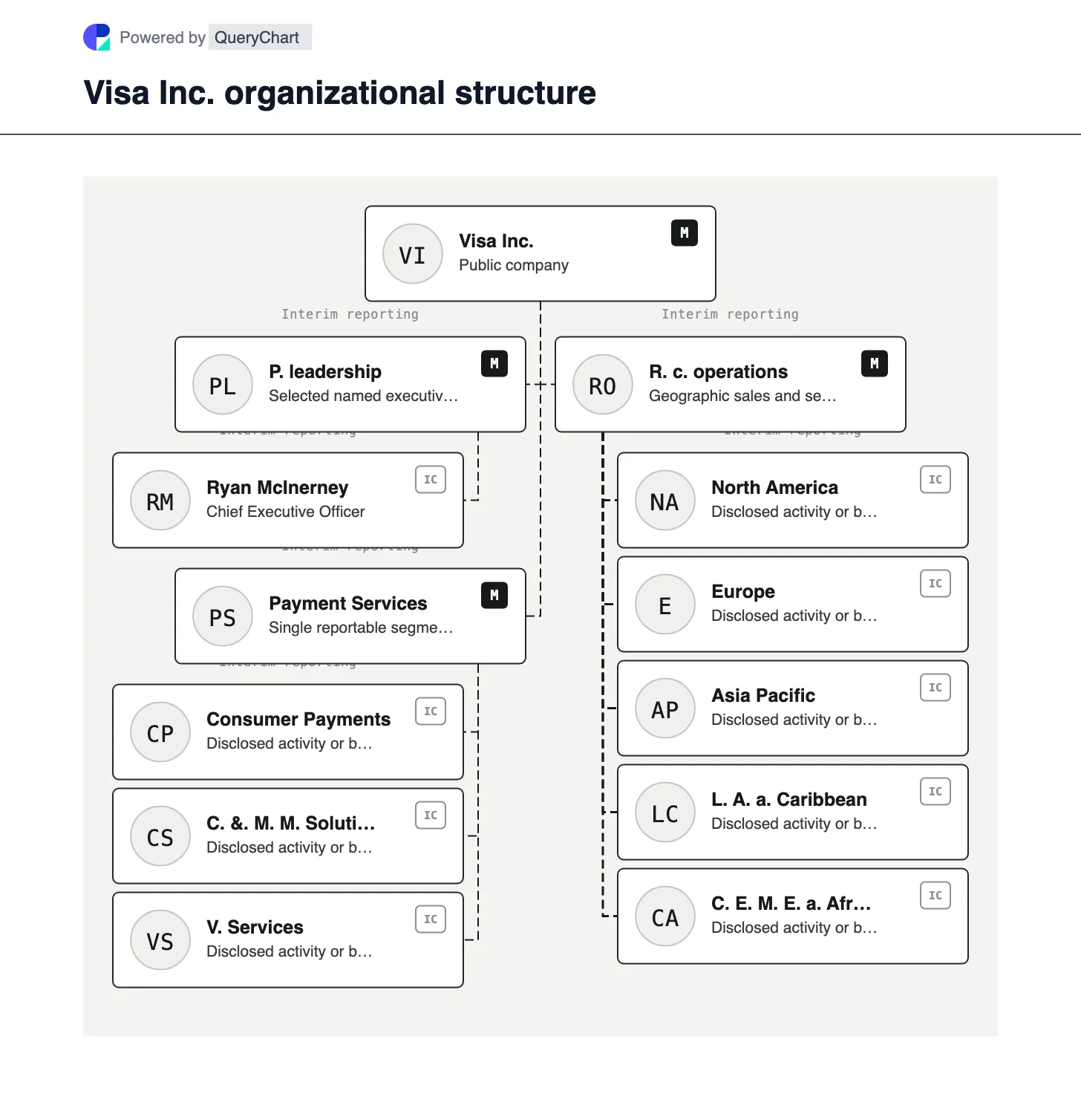
Visa reports one global Payment Services segment. Consumer payments, commercial money movement and value-added services are useful strategic views within that business, not three separate SEC reportable segments.
Visa Inc. organizational chart
Visa Inc.'s reporting structure as of 2026-09. Drag to pan, scroll to zoom — or open it in QueryChart and edit it as your own.
- Industry
- Payments technology
- Headquarters
- San Francisco, California, United States
- Founded
- 1958 (BankAmericard predecessor)
- Employees
- Approximately 34,100 (FY2025)
- CEO
- Ryan McInerney
- Revenue
- $40.0B net revenue (FY2025)
- Ownership
- Public
- Structure as of
- 2026-09
- Structure last reviewed
- 2026-09-24
About the company
Visa operates a global digital payments network that connects financial institutions, merchants, consumers and other participants. The company does not issue most Visa-branded cards or extend the related cardholder credit itself. Its 2025 Form 10-K says significant operating decisions are based on Visa as a single global business.
A chart that breaks Visa into imagined bank divisions would misstate its role. This diagram starts with the one reportable Payment Services segment and then groups the activities Visa uses in its investor materials: consumer payments, commercial and money movement solutions, and value-added services. Those groupings explain what the network enables without claiming three independently reported segments.
One reported segment with three strategic activity groups
The Payment Services segment contains the global network and the products and services built around it. Consumer Payments covers the familiar cards and digital credentials used through issuing and accepting partners. Issuing banks and merchants participate in the network; they are not Visa subsidiaries just because their customers use Visa.
Commercial & Money Movement Solutions covers business payments and movement of funds beyond a conventional consumer card purchase. Visa Direct is a product family within this area; it is neither a separate corporate parent nor a bank.
Value-Added Services includes risk and security, acceptance, issuing, advisory and other capabilities. Its services can work with Visa payments and, in some cases, beyond Visa's own network. The dotted diagram branches are a strategic map within one accounting segment, while the separate CEO node records the published leadership role.
Key leadership roles
Ryan McInerney
Chief Executive Officer
How this structure supports the business
A single global segment reflects the network economics and the way products reinforce one another. It also avoids suggesting that issuers, acquirers and merchants belong to Visa's corporate hierarchy.
The three strategic groups make the breadth of products visible for a reader who knows Visa only from cards, while the chart caption preserves the one-segment accounting fact.
Advantages and disadvantages
- A global platform can reuse network, security and data capabilities across products.
- A single reported segment gives less financial detail for each strategic product group.
- The activity map shows uses beyond consumer cards.
- Its branches are explanatory groupings, not a published internal manager chart.
Interesting facts
- Visa's FY2025 Form 10-K identifies one reportable segment, Payment Services.
- The company reported $40.0 billion in FY2025 net revenue.
- Visa's investor materials distinguish Consumer Payments, Commercial & Money Movement Solutions, and Value-Added Services as strategic areas.
- Visa is a network provider; issuing financial institutions handle cardholder credit relationships.
Related process templates
Related organization charts
Frequently asked questions
How many reportable segments does Visa have?
One: Payment Services, according to its FY2025 Form 10-K.
Is Visa a consumer bank?
No. Visa provides payment network and related services; financial institutions generally issue the cards and manage cardholder accounts.
Are Visa Direct and value-added services separate legal subsidiaries?
Their placement in this chart denotes product and strategic activity groups, not a legal entity chain.
Use this org chart template
Open the dated Visa business map in QueryChart and adapt the editable groups to your own organization.