Coca-Cola Organizational Structure & Org Chart
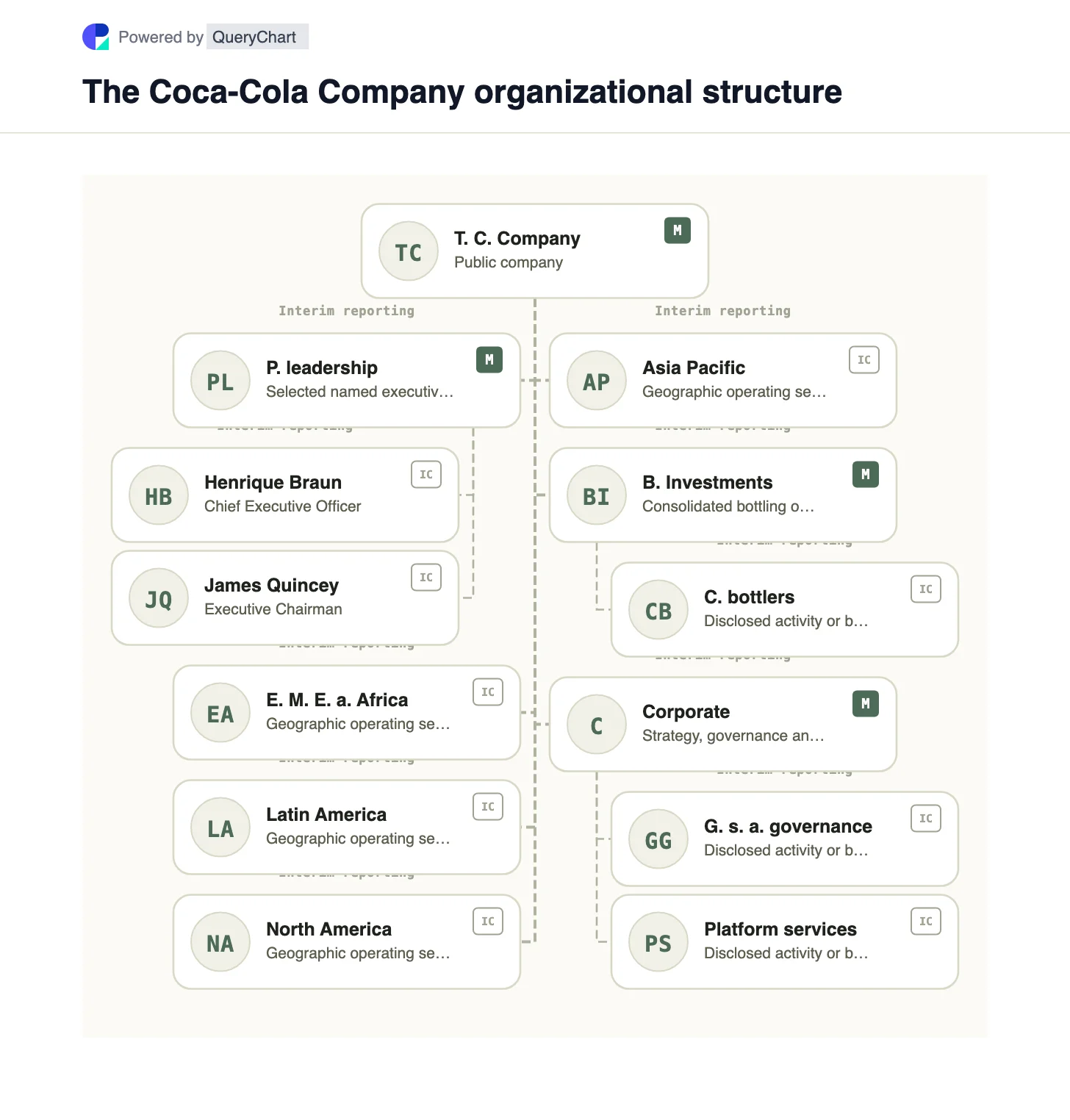
Coca-Cola's 2025 filing reports four geographic operating segments plus Bottling Investments. Henrique Braun became CEO in March 2026, while James Quincey moved to executive chair.
The Coca-Cola Company organizational chart
The Coca-Cola Company's reporting structure as of 2026-09. Drag to pan, scroll to zoom — or open it in QueryChart and edit it as your own.
- Industry
- Nonalcoholic beverages
- Headquarters
- Atlanta, Georgia, United States
- Founded
- 1892
- Employees
- Approximately 65,900 (year-end 2025)
- CEO
- Henrique Braun
- Revenue
- $47.9B net operating revenues (2025)
- Ownership
- Public
- Structure as of
- 2026-09
- Structure last reviewed
- 2026-09-24
About the company
The Coca-Cola Company develops and markets beverage brands through a global system of company operations and independent bottling partners. The useful corporate chart is a map of the five operating segments disclosed in its 2025 Form 10-K; a list of soft drink brands would answer a different question.
The company sold or refranchised many bottling businesses over time. Its Bottling Investments segment contains consolidated bottlers, while independent partners are part of the wider Coca-Cola system without becoming subsidiaries simply because they make and distribute company beverages. This distinction is central to the diagram.
Four geographic segments and Bottling Investments
Europe, Middle East and Africa, Latin America, North America, and Asia Pacific organize the geographic beverage business. Those segments derive much of their revenue from concentrates and syrups, with some finished-product activity.
Bottling Investments groups consolidated bottling operations regardless of where the bottler is located. Its location-neutral reporting means it should not be drawn beneath one geographic segment. Independent bottling partners remain outside this consolidated branch.
Corporate contains the center for strategy and governance and platform services that support operating units and global capabilities. The 2025 filing describes five operating segments after the prior Global Ventures presentation was changed. The chart uses that newer structure, with a separate CEO node for the March 2026 transition.
Key leadership roles
Henrique Braun
Chief Executive Officer — Succeeded James Quincey on March 31, 2026.
James Quincey
Executive Chairman — Moved from the CEO role in March 2026.
How this structure supports the business
Geographic accountability helps Coca-Cola tailor beverages and route-to-market activity to local demand while retaining shared global brands and capabilities.
The distinct bottling branch clarifies which bottlers are consolidated. A brand map or a geographic map alone would obscure the ownership and reporting difference.
Advantages and disadvantages
- Geographic segments mirror disclosed results and local markets.
- Global brands cut across those regional boundaries.
- Separating bottling investments makes control more visible.
- The full Coca-Cola system includes independent partners that are outside this corporate tree.
Interesting facts
- The 2025 Form 10-K names five operating segments.
- Bottling Investments covers consolidated bottling operations regardless of location.
- Coca-Cola also works with independent bottling partners.
- Henrique Braun became CEO on March 31, 2026.
- James Quincey transitioned to executive chairman.
Related organization charts
Frequently asked questions
What are Coca-Cola's operating segments?
EMEA, Latin America, North America, Asia Pacific and Bottling Investments.
Does Coca-Cola own every bottler in its system?
No. The system also includes independent bottling partners; the chart's bottling branch represents consolidated operations.
Who is Coca-Cola's CEO in 2026?
Henrique Braun became CEO on March 31, 2026.
Use this org chart template
Open the dated Coca-Cola business map in QueryChart and adapt the editable groups to your own organization.