How to create a purchase order process
How to design a purchase order process: separate requisition from order, put the budget check before the commitment, set thresholds from your delegation of authority, and define match tolerances.
A purchase order process turns an approved internal request into an external commitment, then matches what was ordered, what arrived and what was invoiced before anything is paid.
The short version
- Requisition is internal and commits nobody; the PO is the commitment.
- Budget check before the PO, not after: it is the last cheap moment to decline.
- Thresholds come from the delegation of authority and belong on the decision.
- No goods receipt means no three-way match, which means an exception queue.
- State the match tolerance, or every rounding difference becomes an exception.
The requisition is not the order
The distinction that makes a purchase order process work is also the one most often collapsed: a requisition is an internal request that commits nobody, and a purchase order is an external commitment that does. Once they are the same document, the budget check happens after the supplier has been told to proceed, and the control has become a formality performed on a decision already taken.
Everything else follows from getting that boundary right. The budget check belongs between the two, because it is the last cheap moment to say no. Approval thresholds route by value and come from the delegation of authority rather than from the process designer. And the three-way match at the end (order, receipt, invoice) only works if someone actually records the receipt, which is the step most often skipped and the reason most invoice exception queues exist.
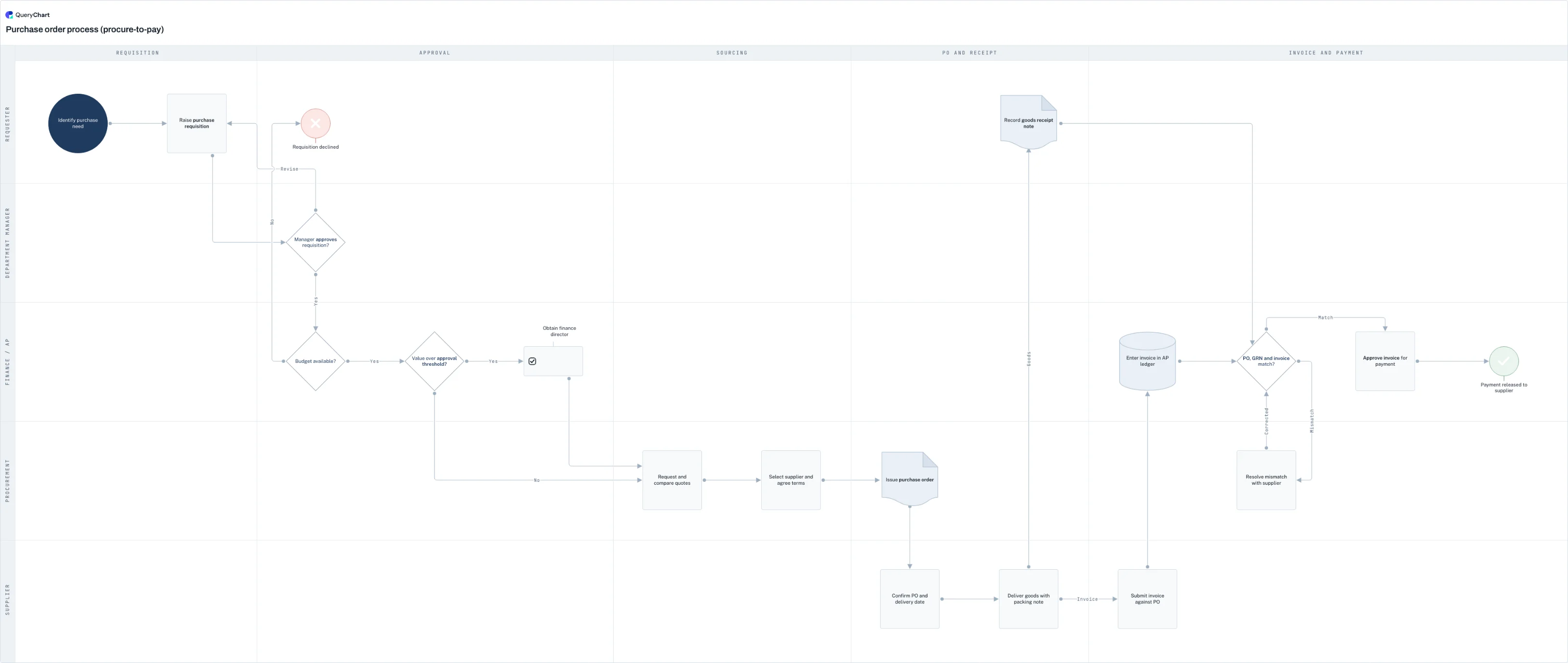
The example below is a procure-to-pay flow across five lanes including the supplier. Watch the two branch points teams argue about: the value threshold routing to a second approver, and the match exception that goes back to procurement and re-enters the match.
Requisition to payment
A procure-to-pay flow across five lanes. Watch the two gates before commitment and the match exception after delivery.
Internal request first
A need identified and a requisition raised carrying cost centre, coding, quantity and need-by date. Everything that follows depends on this data being complete, which is why coding belongs on the requisition rather than being added by finance later.
Two gates before any commitment
Manager approval with a revise route, then a budget check that can decline outright, then a value threshold routing to finance director approval. Three decisions and no supplier has been contacted yet: that is the point.
Commitment, and the supplier's own lane
Quotes compared, supplier selected, purchase order issued, and the supplier confirms and delivers. Giving the supplier a lane makes visible how much of the elapsed time belongs to someone you cannot manage.
The match, and its exception
Goods receipt and invoice arrive on independent arms, then a three-way match with a mismatch route back to procurement that re-enters the match once corrected. Without the receipt step the match cannot happen at all.
Approve and pay
Invoice approved and payment released. A process that stops at the match leaves the last handoff (AP to payment run) undefined, which is where suppliers experience the delay.
How it works
Separate the requisition from the order
Make them distinct steps with distinct approvals even if your system uses one form. The requisition is the internal decision; the PO is the external commitment. Collapsing them means the budget check happens after the supplier has been told to proceed.
Put the budget check where it can still say no
Before the PO is issued. Decide too whether it tests committed spend (open requisitions and open orders) or only posted actuals, and write that on the step. Checking actuals alone means the budget looks available right up until every open order lands.
Set thresholds from the delegation of authority
Take the figures from the authority schedule, state the currency, and set them high enough that the second approver triggers rarely. Low thresholds produce order splitting, which is precisely the behaviour the threshold exists to prevent.
Make the goods receipt someone's job
Name who records receipt and by when. This is the step organisations skip because it feels like admin, and its absence is the direct cause of most invoice exception queues: with no receipt, the match cannot run and every invoice needs manual chasing.
Write the match tolerance and name the exception owner
Put your price and quantity tolerance on the three-way match decision and name who owns the mismatch queue. Without a stated tolerance every rounding difference becomes an exception, and the exception queue quietly becomes the real process.
Draw the routes that bypass the PO
Purchasing cards, framework call-offs and emergency purchases exist. Draw them with their own controls rather than pretending they do not happen: an undrawn bypass has no controls at all, and it is where unrecorded commitment accumulates.
Mistakes to avoid
PO raised after the invoice
A retrospective purchase order is a receipt for a decision already made. Frequent occurrences are a sign the process is too slow, not that people are careless.
Budget checked against actuals only
Ignoring committed spend makes funds look available until every open order lands at once.
No stated tolerance
Every penny of difference becomes an exception, the queue grows, and people start approving exceptions in bulk.
Three approval levels
Each one adds cycle time and dilutes attention. Two (budget holder plus a threshold approver) covers the overwhelming majority of spend.
Create your own purchase order process
Open the procure-to-pay example as your own chart and set your thresholds, tolerances and lane owners.
Related guides
Frequently asked questions
What is the difference between a purchase requisition and a purchase order?
A requisition is an internal request to buy: it carries the cost centre and coding, is routed for budget and management approval, and creates no obligation to any supplier. A purchase order is the external commitment issued once the requisition is approved, fixing item, quantity, price and delivery terms. Keeping them separate is what allows the budget check to happen while declining is still free.
What is a three-way match?
A comparison of the purchase order (what you agreed to buy), the goods receipt note (what actually arrived) and the supplier invoice (what you are being asked to pay). If all three agree within tolerance the invoice can be approved without further review. It is the main control against paying for goods never received or at a price never agreed, and it depends entirely on someone recording the receipt, which is why that step deserves a named owner.
How many approval levels should a purchase order process have?
Two covers most spend: the budget holder for everything, plus a second approver above a threshold taken from your delegation of authority. Each extra level adds queue time and encourages splitting orders to stay under a limit: the exact behaviour the threshold is meant to prevent. If a level has never rejected anything, it is a notification and should be drawn as one.
What should happen when an invoice does not match?
It goes to a named owner rather than sitting in the AP queue. The usual causes are a price change the supplier applied without amending the PO, a short or partial delivery, or a goods receipt nobody recorded. Route the mismatch back to procurement to resolve with the supplier, then re-enter the match once the PO, receipt or invoice has been corrected, so nothing is paid on the strength of an email.