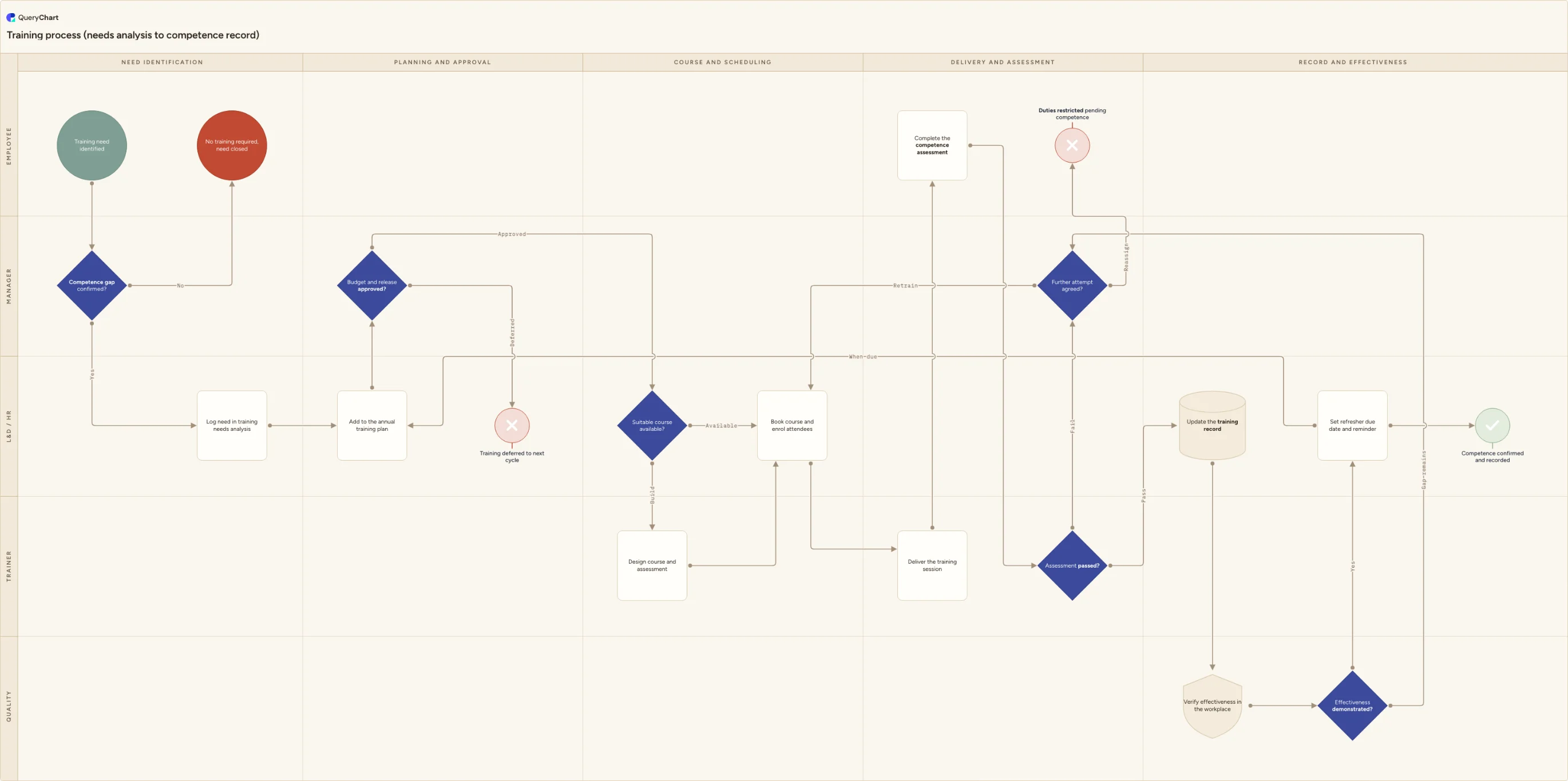
Training process flowchart
A training process flowchart: need identification, plan and budget approval, course selection, delivery, competence assessment, records and refresher dates.
What the training process is
A training process turns a competence gap into evidence that the gap has closed. It starts when someone notices a need, which in practice comes from one of four places: a new or changed role, the appraisal cycle, an audit or inspection finding, or a change in regulation or standard. It ends with two artefacts, a training record showing what was delivered and how competence was judged, and a verification that the person can now do the task in the workplace.
The gap between those two artefacts is where most training processes fail. Attendance is easy to record, so the training record quietly becomes a sign-in sheet. Nobody writes down the pass criterion before the course runs, so the assessment afterwards is a judgement call. Effectiveness evaluation gets skipped entirely because it happens weeks later and has no owner. Each of those is a documentation problem rather than a training problem, and each is fixed by giving the step a lane and a named role rather than leaving it as an implied follow-up.
This template runs across five lanes, Employee, Manager, L&D / HR, Trainer and Quality, and five phases from need identification to record and effectiveness. It keeps the awkward routes visible rather than assuming a happy path: a confirmed need with no budget ends explicitly as deferred, a failed assessment goes to a manager decision about a further attempt before anyone is reassigned, and a refresher due date feeds back into the annual plan so recurring training re-enters the process instead of relying on someone's memory.
What this flowchart covers
In this template
- Five swimlanes (Employee, Manager, L&D / HR, Trainer, Quality) across five phases: Need identification, Planning and approval, Course and scheduling, Delivery and assessment, and Record and effectiveness.
- Need identification: the trigger is logged with its source (role change, appraisal, audit finding or regulatory change), then a manager "Competence gap confirmed?" decision either closes the request with no training or passes it to L&D to log in the training needs analysis.
- Planning and approval: the need is added to the annual training plan and goes to a "Budget and release approved?" decision, whose deferred branch terminates explicitly as "Training deferred to next cycle" rather than disappearing.
- A "Suitable course available?" decision that either books an existing course or hands the Trainer lane a design step covering course content and assessment, with both branches rejoining at "Book course and enrol attendees".
- The pass or fail branch: the trainer delivers the session, the employee completes the competence assessment, and "Assessment passed?" routes a failure to a manager "Further attempt agreed?" decision that either sends the person back to enrolment for retraining or restricts duties pending competence.
- Record and effectiveness: L&D updates the training record, Quality verifies effectiveness in the workplace, and "Effectiveness demonstrated?" sends a remaining gap back to the retraining decision. A refresher due date and reminder are set, feeding back into the annual training plan when due.
When to use this template
- Writing or rewriting the training and competence procedure in a quality manual, where you need one diagram showing how competence is determined, delivered and evidenced.
- Training happens reliably but nobody can show it worked, and the effectiveness check needs a named owner and a fixed place in the flow rather than being an optional follow-up.
- Several functions are involved and it is unclear who approves the budget and the release of time, who assesses competence, and who signs the record.
- Configuring an LMS or an HR system workflow, where the process should be agreed before anyone builds approval rules and reminders into a tool.
- Roles carry mandatory refresher cycles and you need a documented route back into the annual plan when a qualification falls due.
How it works
Rename the lanes to your real roles
Replace Employee, Manager, L&D / HR, Trainer and Quality with the functions that genuinely do this work. In smaller organisations L&D sits inside HR and the manager is also the assessor; merge those lanes rather than pretending they are separate people. If an external provider delivers the training, keep the Trainer lane and label it as the provider.
Write down where needs come from and who confirms them
The start node lists four sources: role change, appraisal, audit finding and regulatory change. Cut the ones that do not apply and add any that do, then name who confirms the gap at the "Competence gap confirmed?" decision. Where the need comes from usually sets the deadline, so record the source on the request.
Set the pass criterion before the course exists
Decide, for each type of training, what passing means: a test score, an observed task signed off by a named assessor, or a supervised period. Write it into the design step and the "Assessment passed?" decision. Without a stated criterion the record evidences attendance rather than competence.
Define what the training record must contain
Specify the fields at the record step: who was trained, on what content and which version of it, when, by whom, how competence was judged and the result. Decide where it lives and who can change it, and keep earlier versions so you can show what the record said at any past date.
Give effectiveness verification a method and a time lag
Choose how Quality verifies effectiveness (workplace observation, supervisor confirmation, error or defect rates, the next internal audit) and how long after delivery it happens. Thirty to ninety days is common. An immediate check tells you the person passed a test, not that behaviour changed.
Set refresher intervals and who owns the reminder
Record the interval per training type, whether it is fixed by regulation or by internal policy, and who is notified when the date approaches. The refresher branch in this chart re-enters the annual training plan, so the recurring cycle stays inside the same process rather than living in a spreadsheet.
Frequently asked questions
What are the stages of a training process?
Most training processes have six: identify the need and confirm the competence gap, plan and approve the training including budget and release of time, select or design the course, schedule and enrol, deliver and assess, then record the outcome and verify that it worked. The chart above adds a seventh element that is often left out, the refresher due date, because recurring qualifications need a documented route back into the annual plan rather than a reminder in someone's calendar.
How does this relate to ISO 9001 clause 7.2?
Clause 7.2 (Competence) asks an organisation to determine the competence needed for work affecting quality performance, ensure people are competent on the basis of education, training or experience, take action where there is a gap and evaluate the effectiveness of that action, and retain documented information as evidence of competence. This template is shaped around those four requirements, which is why it has an explicit effectiveness verification step and a record step rather than ending at delivery. Drawing the process does not satisfy the clause on its own; the retained records and the evaluation results are the evidence.
How do you evaluate training effectiveness?
Pick a method proportionate to the risk and apply it after enough time has passed for behaviour to show. Workplace observation against the task, supervisor confirmation, a review of error or rework rates, or the next internal audit all work. The Kirkpatrick model is a common frame for this, distinguishing reaction, learning, behaviour and results, but no standard requires it. What matters is that the method is stated in advance, has an owner, and that a negative result routes somewhere, in this chart back to the decision about a further attempt.
What should happen when someone fails the assessment?
Give the failure an explicit route rather than repeating the course by default. In this template a failed assessment goes to a manager decision, "Further attempt agreed?", which either sends the person back to enrolment for retraining or restricts the duties concerned until competence is demonstrated. Recording that decision matters as much as the result, because restricting a task is a business decision with a cost, and in regulated or safety-related work the record of who authorised continued performance is the point of the process.